Pricing intelligence converts live market and competitor pricing data into repeatable, measurable revenue decisions. For business leaders, that single capability separates brands that react to market shifts from those that anticipate and shape them.
The capability runs in three layers: a data foundation that collects and cleans pricing signals from every relevant source, an intelligence layer that models elasticity, detects competitive patterns, and generates recommendations, and an action layer that executes or guides price changes across channels. Get all three working together and you get three outcomes that matter at the executive level:
Key Takeaways
Pricing intelligence is a capability stack (data foundation, intelligence modeling, and action layer) that converts market signals into measurable revenue decisions, and programs that build the matching layer first consistently outperform those that lead with AI.
What does pricing intelligence actually mean?
Pricing intelligence is not the same as price monitoring. Monitoring tells you what a competitor charged yesterday. Intelligence tells you what you should charge tomorrow and why. The distinction matters when you are evaluating vendors, because most tools lead with monitoring and bury the intelligence layer in the fine print.
Forage, and that model is the clearest mental map available for decision-makers:
Extraction
Web scrapers, marketplace APIs, and data feeds pull raw pricing signals from competitor sites, Amazon, Walmart, Google Shopping, and other channels. Coverage breadth and crawl frequency determine how much of the market you can actually see.
Matching
Raw data is useless without product matching. This layer links a competitor’s SKU to your own SKU so you are comparing the same item, not just similar-sounding ones. Matching confidence is the single most underrated variable in any pricing program.
Monitoring
Once products are matched, the system tracks price changes, promotional events, stock availability, and effective price (which includes shipping, bundles, and delivery speed, not just list price). Modern pricing intelligence accounts for the total offer a customer experiences, not the raw sticker price.
Intelligence
This is where the value compounds. The intelligence layer applies elasticity models, identifies key value items (KVIs), detects competitor promotion patterns, and generates positioning signals. Without a reliable data foundation and accurate matching underneath it, this layer produces noise, not insight.
Action
Recommendations become price changes. Some platforms automate execution within guardrails; others surface recommendations for human review. Either way, the action layer closes the loop between data and revenue.
Glossary of terms you will see in vendor materials:
Why pricing intelligence matters for your margins and growth
The business case for pricing intelligence is straightforward once you map it to metrics your finance team already tracks.
when making a purchase decision, which means a competitor’s price move on a high-visibility item can shift share faster than any advertising campaign.
How pricing intelligence works: data, matching, and models
The operational flow starts with data ingestion. A mature pricing intelligence system pulls from multiple source types simultaneously:
Product matching sits between data ingestion and analysis, and it is where most programs quietly fail. The practical gap in many pricing programs is matching confidence: once matching is reliable, elasticity and positioning signals start producing decisions that pricing teams actually trust. A matching failure looks like this in practice: your system flags a competitor’s 12-pack as a price threat to your 8-pack.
Intelligence outputs from a well-built system include:
TGNDATA describes modern pricing intelligence as a continuous, AI-enabled decision layer that connects pricing engines, ERPs, and marketplaces rather than sitting as a standalone dashboard.
Pro Tip: Data freshness cadence materially changes outcomes. A system that refreshes competitor prices every 24 hours is adequate for weekly category reviews. For Amazon or Walmart, where prices can change multiple times per day, you need sub-hourly refresh rates on your top-200 SKUs at minimum. Ask every vendor for their actual crawl frequency by tier, not their headline number.
What capabilities should you expect from pricing intelligence tools?
Not every feature a vendor demos is worth paying for. Some are table stakes; others are genuine differentiators that separate a system you will trust from one you will abandon after six months.
Table-stakes features (every vendor should have these)
Strategic differentiators (insist on these before signing)
Matching confidence scoring. The system should tell you, per match, how confident it is that two SKUs are equivalent. A binary matched/unmatched flag is not enough. You need a confidence score so your team can set thresholds and route low-confidence matches for human review.
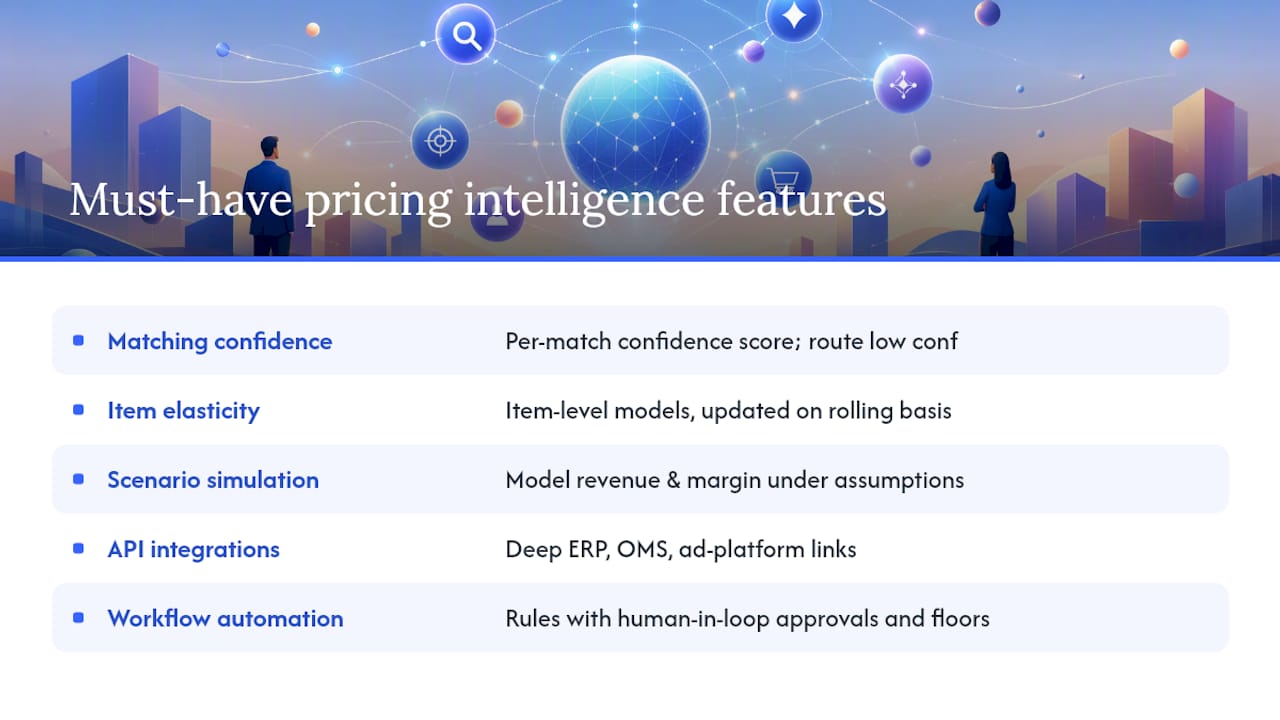
Elasticity modeling at the item level. Category-level elasticity is nearly useless for operational decisions. Demand for a premium coffee brand responds differently than demand for a private-label equivalent in the same category. Item-level models, updated on a rolling basis, are what make recommendations trustworthy.
Black-box outputs create compliance risk and erode team trust fast.
Scenario simulation. Before executing a price change, you should be able to model the revenue and margin impact under different assumptions. This is especially valuable for promotional planning and new product launches.
API-first architecture and integrations. Pricing intelligence only creates value when it connects to your execution systems. Evaluate the depth of integrations with your ERP, OMS, and advertising platforms, not just the number of logos on the vendor’s integration page.
Workflow automation with human-in-the-loop controls. Full automation without guardrails is a liability. The best systems let you define rules (floor prices, maximum change thresholds, category-level approval requirements) so automation operates within boundaries your team sets.
Pro Tip: During vendor demos, ask to see the audit log for a past price change. A system with genuine explainability will show you the data inputs, the model output, the recommendation, and who approved or overrode it. If the vendor cannot show you that trail, the system is not production-ready for an enterprise environment.
What does research say about AI-driven pricing?
The shift from rules-based repricing to AI-powered pricing intelligence is not incremental. BCG’s analysis of AI-powered pricing shows that retailers achieve better margins and customer value perception when they use AI that considers three pricing dimensions simultaneously:
Strategic pricing
Long-term positioning decisions: category roles, brand price architecture, and competitive tier placement. These change quarterly or seasonally and require scenario modeling rather than real-time automation.
Hygienic pricing
Operational accuracy: ensuring prices are consistent across channels, promotions are applied correctly, and no SKU is accidentally priced below cost or above MAP. AI catches hygiene errors at scale that manual audits miss.
Dynamic pricing
Real-time or near-real-time adjustments based on demand signals, inventory levels, and competitor moves. This is where dynamic pricing strategies for e-commerce brands deliver the most visible revenue impact, particularly during peak events like Prime Day or Black Friday.
That is the core logic of de-averaging: instead of cutting prices broadly, you invest precisely where shoppers notice and hold firm everywhere else.
is less a question of whether to adopt and more a question of how fast you can build the data foundation to support it.
Research-backed implications for teams evaluating adoption:
How to implement pricing intelligence effectively
Implementation is a change management project as much as a technology project. Teams that treat it purely as a data integration underestimate the governance and process work by a factor of two.
Phase 1: Data foundation and quick wins (months 1–3)
Phase 2: Intelligence modeling and process integration (months 4–6)
Phase 3: Scale and automation (months 7–12)
Roles and governance:
KPIs to track from day one: price index vs. key competitors by category, margin per SKU on repriced items, response time to competitor price changes, and matching accuracy rate. After six months, add elasticity model accuracy (predicted vs. actual volume response) and promotional cannibalization rate.
How should you evaluate pricing intelligence vendors?
The vendor landscape includes point solutions focused on monitoring, full-stack platforms with AI modeling, and embedded capabilities within larger commerce suites. Three platforms that appear consistently in enterprise evaluations are Wiser, DealHub, and Impact Analytics, each with a distinct profile.
Wiser focuses on retail price intelligence and shelf analytics, with strong coverage across U.S. brick-and-mortar and e-commerce channels. It suits brands and retailers that need competitive price tracking alongside in-store execution data.
DealHub is primarily a CPQ and revenue platform, with pricing intelligence embedded in a broader configure-price-quote workflow. It fits B2B organizations where pricing intelligence needs to connect directly to sales quoting and contract management.
Impact Analytics offers AI-driven forecasting and pricing optimization with deep integration into retail planning systems. It targets enterprise retailers and brands that need pricing intelligence connected to demand planning and inventory optimization.
Evaluation checklist
Red flags to walk away from
What are the real limitations of pricing intelligence?
Pricing intelligence is not a margin guarantee. Every program has failure modes, and the teams that succeed are the ones that plan for them before launch.
Data accuracy and matching errors remain the most common source of bad decisions.
Price wars and margin erosion happen when automation responds to a competitor’s move without context. A competitor clearing discontinued inventory is not a signal to match their price. Without human review of significant moves, automated systems can trigger a race to the bottom in hours.
Elasticity overfitting occurs when models are trained on historical data that includes anomalous periods (a pandemic, a supply chain disruption, a viral product moment). The model learns patterns that do not generalize, and recommendations become unreliable.
Operational complexity and change management are underestimated in nearly every enterprise rollout. Pricing touches category management, finance, marketing, and legal. Without a clear governance structure, recommendations stall in approval queues and the program loses momentum.
Frequent operational surprises teams report after launch:
The mitigation is straightforward: start with a conservative scope, keep humans in the loop for the first six months, run A/B tests on every significant pricing move, and build a cross-functional governance meeting into the weekly calendar from day one.
Who actually benefits from pricing intelligence?
Pricing intelligence is not a universal tool. Its value scales with catalog size, competitive intensity, and the speed at which your market moves.

Retailers with large assortments (thousands of SKUs across multiple categories) get the most immediate lift. The sheer volume of pricing decisions makes manual management impossible, and even small per-SKU margin improvements compound across the catalog.
Brands selling on Amazon and Walmart face a specific challenge: third-party sellers and unauthorized resellers can undercut MAP pricing in real time. Pricing intelligence gives brand managers visibility into the full seller ecosystem and the ability to enforce pricing policies before violations erode brand equity.
Marketplaces and aggregators use pricing intelligence to set platform-level pricing rules, optimize buy-box positioning, and manage the tension between seller competitiveness and platform margin.
Mid-market brands often find the most accessible entry point through a managed service or agency partner that brings the data infrastructure and modeling capability without requiring a full in-house data science team.
How do you measure the ROI of a pricing intelligence investment?
ROI measurement starts before you sign a contract. Without a baseline, you cannot prove impact.
Pre-launch baseline metrics to capture:
Post-launch impact metrics:
Profit margin optimization requires connecting pricing decisions to full-funnel data: conversion rate, average order value, and repeat purchase rate all move when prices change, and isolating the pricing effect requires controlled testing rather than before-and-after comparisons.
Programs that hit the high end typically share three characteristics: a reliable data foundation built before modeling begins, a dedicated pricing COE with executive sponsorship, and a disciplined A/B testing cadence that validates every significant pricing move before full rollout.
The case for a managed approach to pricing intelligence
Most enterprise brands underestimate how much of the implementation work sits outside the vendor’s scope. The vendor delivers the platform. Your team still needs to own data integration, matching validation, model governance, and the change management work of getting category managers to trust and act on recommendations.
The brands that move fastest are typically those that bring in a managed partner for the first 12–18 months. An agency with pricing and marketplace expertise can compress the data foundation phase from six months to six weeks, because they have already built the integrations and validation workflows for similar clients. They can also run the governance process, own the weekly recommendation review, and hand off a functioning program once the internal team is ready.
Two scenarios where managed services consistently outperform in-house builds:
Scenario one: margin recovery during a promotional period. A brand heading into Q4 with inconsistent pricing across Amazon, Walmart, and their own DTC site needs rapid competitive intelligence and repricing guardrails before peak traffic arrives. An agency with existing integrations can stand up monitoring and basic automation in weeks, not quarters.
Scenario two: new marketplace expansion. A brand entering Walmart Marketplace for the first time has no historical pricing data for that channel. A managed partner brings competitive benchmarks, category-level elasticity priors, and the operational playbook to set initial prices correctly rather than learning through margin erosion.
The build-versus-buy decision ultimately comes down to three variables: how fast you need to move, how much engineering capacity you have available, and how much institutional pricing knowledge your team already holds. When all three are constrained, managed services are not a compromise. They are the faster path to a working program.
Nectar brings pricing intelligence to your marketplace operations
Brands that want pricing intelligence operationalized across Amazon, Walmart, and Shopify without building an internal data science team have a direct path through Nectar’s managed marketplace services. Nectar’s proprietary iDerive analytics platform unifies competitive pricing signals, marketplace performance data, and advertising outcomes into a single decision layer, so pricing moves are informed by the full commercial picture, not just a competitor feed.

Nectar’s Cue AI workflows connect intelligence outputs to execution across channels, with human-in-the-loop controls that keep your team in charge of every significant price decision. The managed model means Nectar handles data integration, matching validation, and recommendation governance while your team focuses on strategy.
Services that map directly to the capabilities covered in this article include competitive price monitoring and matching, elasticity-informed repricing recommendations, promotional pricing analysis, and full-funnel creative and listing optimization to protect conversion when prices change. To see how Nectar’s analytics and managed operations work together for your catalog, explore Nectar’s iDerive platform.
Why the conventional wisdom on pricing intelligence gets it backwards
Most of the conversation around pricing intelligence focuses on the technology: which platform has the best AI, the most data sources, the fastest refresh rate. That framing misses the actual constraint in almost every enterprise rollout.
The constraint is not the model. It is the matching layer underneath it.
Every elasticity estimate built on bad matches is wrong. Every recommendation downstream is wrong. The AI is doing exactly what it was designed to do; it is just working with garbage inputs.
The practical implication is counterintuitive: the best investment a pricing team can make before selecting a vendor is a matching audit of their own catalog. Map your top 500 SKUs to their closest competitor equivalents manually. Understand where ambiguity lives (size variants, bundle configurations, private label equivalents). Then use that audit as the benchmark when you evaluate vendor matching accuracy. Any vendor that cannot match your known-hard cases accurately is not ready for your catalog, regardless of how impressive their demo looks on clean data.
The second thing most teams get wrong is treating pricing intelligence as a cost-reduction project. The real value is on the revenue side: finding the SKUs where you are underpriced relative to what the market will bear, and capturing that margin without losing volume. That requires elasticity modeling, not just monitoring. And it requires the organizational courage to raise prices on products where the data says you can, which is a harder sell internally than cutting prices ever is.
Sources
Recommended

































































.webp)