Your listing is probably costing you sales right now — and the leaks sit in six predictable places. Here's the Amazon creative audit framework Nectar runs across 200+ brand partners: four rhythms, five triggers, and seven quarterly checkpoints.
Key Takeaways
- Creative is a system, not a project. One-and-done creative decays; the brands that win audit on a defined cadence with a named owner for each rhythm.
- Six mistakes account for most lost sales: generic targeting, missing differentiators, unanswered AI shopping questions, unmerchandised Brand Stores, weak Brand Story content, and inconsistent branding.
- Run four audit rhythms: a pre-launch error check, a monthly pulse check, a quarterly deep dive on the top sellers driving 80% of sales, and a yearly full-brand review.
- Five triggers override the calendar: conversion drops, competitor changes, Amazon policy updates, and shifts in your own priorities all warrant an immediate audit.
- Optimize for Alexa for Shopping now. In 2025, more than 300 million customers used Amazon's AI shopping assistant, and AI-assisted sessions converted at 3.5× the rate of standard sessions.
- Start with a group of products, not the whole catalog. Audit the ASINs tied to your biggest KPI first, then work outward.
🎥 Watch the Full Session: Want to see the complete breakdown? You can check out the full recording for our webinar session here: Your Listing Is Costing You Sales: A Creative Audit Framework.
Why Creative Is a System, Not a Project
Amazon's AI shopping layer made static creative expensive. In 2025, more than 300 million customers used Amazon's AI shopping assistant — relaunched in May 2026 as Alexa for Shopping (formerly Rufus) — which drove nearly $12 billion in incremental annualized sales, according to Amazon's Q4 2025 results. But here's the catch: the same copy that reads as a generic feature list to a shopper reads as a generic feature list to Alexa for Shopping — and neither one recommends it.
At Nectar, we've managed creative across $3B+ in annual marketplace sales, $250M+ in ad spend, and 200+ brand partners, and the fundamental flaw we see is consistent: brands treat creative as a project — one and done. The larger your catalog, the more nuanced your approach has to be. Great creative is not a project. It's a system with a cadence. An Amazon creative audit is how you keep that system honest, and this guide covers the exact framework we use: the six mistakes we find in most audits, the four rhythms we run them on, and the seven checkpoints inside every quarterly deep dive.
Key 2025–2026 AI Shopping Stats:
- 300M+: customers used Amazon's AI shopping assistant in 2025, driving ~$12B in incremental annualized sales — Amazon Q4 2025 results
- 3.5×: the conversion rate of AI-assisted sessions vs. standard sessions during the 2025 holiday season — Sensor Tower via The Drum
- 60%: how much more likely AI-assistant users are to complete a purchase — Amazon Q3 2025 earnings
The Nectar Creative Audit Framework is a recurring diagnostic system for Amazon listings built on four scheduled audit rhythms, five calendar-overriding triggers, and seven quarterly deep-dive checkpoints covering the full listing, main image, carousel, reviews, title, A+ Content, and backend keywords.
The Six Mistakes We Find in Most Amazon Creative Audits
Across the hundreds of brands we audit, the same patterns surface. Fix these six before anything else.
Mistake 1: Your Listing Speaks to Everyone, So It Converts No One
Relatable creative converts; generic creative doesn't. Amazon gives you demographic data on who actually purchases your product — and it's often different from your off-Amazon retail customer. Pull that data, pick a direction, and reflect the real buyer in your lifestyle imagery, graphics, and copy.
Case in point: Welch's Fruit Snacks had recognizable, colorful creative — but it lacked resonance with the families actually buying. Rebuilding the stack around lifestyle imagery and playful, buyer-specific language made the listing convert the right people instead of speaking to everyone.
Pro Tip: Write a description of your exact buyer based on actual Amazon demographic data, then grade every piece of creative against it.
Mistake 2: Most Listings Never State the Differentiators
Features and benefits aren't differentiation. In a saturated category, shoppers already know what your product type does — a magnesium buyer knows magnesium supports sleep and bone density. What they don't know is why yours. Your first two or three images have to answer that, not restate the category.
Case in point: Doctor's Best sells magnesium in one of the most saturated supplement categories on Amazon. The fix wasn't better-looking creative — it was leading the image stack with "6× Faster Absorption" and "Why Lysinate Glycinate?" so the differentiator hit first.
As Jason Landro put it during the session, shopping is still heavily dominated by search: shoppers put in a keyword and get a page of similar products. If they land on your page and see generic benefits, nothing separates you from the grid. AI can scale production for lower-tier products — and our AI Creative at Scale practice is built on exactly that — but your top sellers need to cut through the gray noise of generated sameness.
"A mistake you don't want to make is to be too generalized — you'll never stand out on your top sellers." — Kathleen Shiban, Director of Creative Strategy at Nectar
Mistake 3: Shoppers Ask AI Questions Your Content Never Answers
Alexa for Shopping surfaces the products whose content directly answers shopper questions. If your listing doesn't answer the top queries in your category, the AI systems suggest your competitors instead. The language that wins is specific, natural, and problem-solving — use cases, times of day, events — not general benefit claims.
Case in point: For Lasko fan units, one theme appeared at least 15 times across top Alexa for Shopping queries and recent reviews: how quiet is this unit? A single bullet rewrite — leading with the quiet-performance technology and the home-office use case — put the answer where AI shopping systems look for it.
Shoppers may skim your bullets, but AI reads them closely. That's why bullet copy matters more in 2026, not less. For a deeper look at this shift, see our guide on why voice and AI search optimization now decides marketplace visibility.
Pro Tip: Pull your top category- and product-level AI shopping questions and map your copy to answer them directly.
Mistake 4: Brand Stores Aren't Merchandised, So Customers Bounce
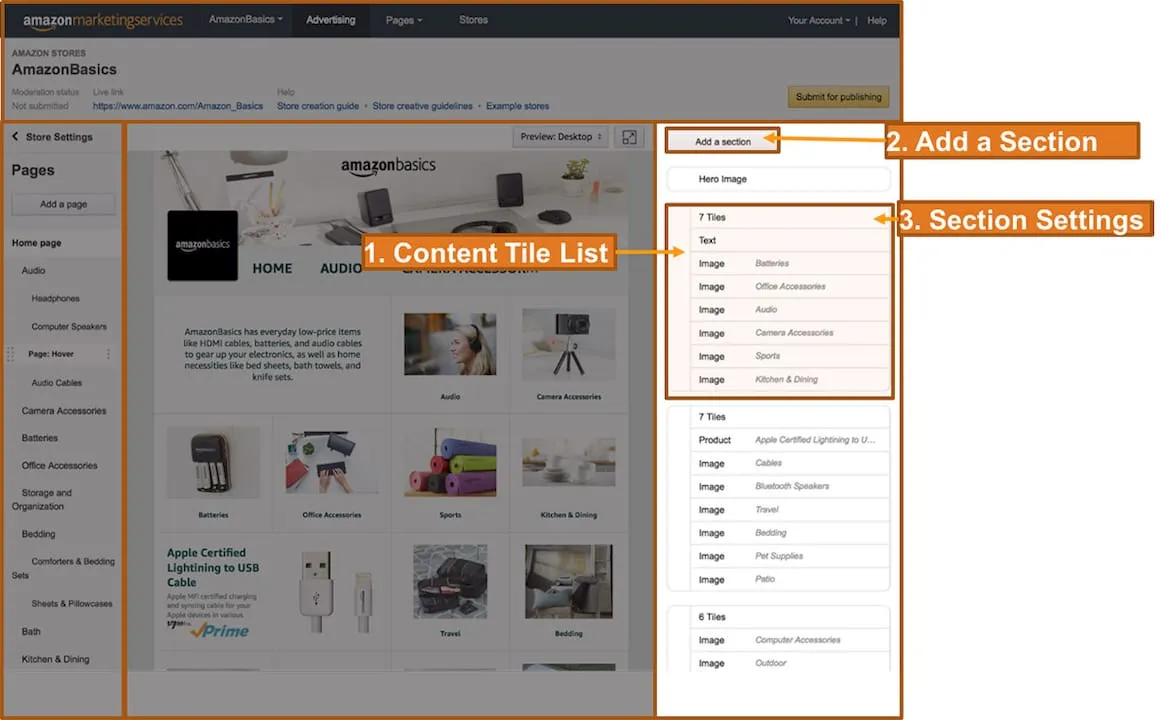
Your Brand Store is your biggest cross-sell surface, and most brands treat it as a set-and-forget catalog dump. Out-of-stock SKUs, inactive listings, and hard-to-find subcategories all push shoppers away. Intentional merchandising means the homepage is maximized for your priority SKUs, navigation matches shopping intent, and seasonal tiles rotate with the calendar. Our Brand Store design team audits this quarterly for exactly that reason.
Pro Tip: Audit your store every quarter for out-of-stock or inactive SKUs and confirm every priority category has easy navigation.
Mistake 5: Weak Brand Story Content Leaves Sales on the Table
The Brand Story is the lowest-hanging fruit in most audits. It appears on every single ASIN you sell — including the C-level products you never have time to optimize — which makes it your cheapest brand-trust and cross-sell placement. Kathleen has seen brands with no Brand Story add one and see branded traffic increase from the recognition alone.
Pro Tip: Audit your Brand Story quarterly: does it cross-sell your range, teach what your brand solves, and stay live on every ASIN?
Jason's framing here matters: the Brand Story prompts shoppers to the Brand Store, the Store maximizes conversion and basket size, and most of that traffic lands back on the PDP (Product Detail Page). "It is all an interconnected system" — auditing one surface in isolation misses how they compound.
Mistake 6: Weak Branding Representation Leaves Shoppers Guessing
Your Amazon presence should feel like your brand, not a generic product grid. If a shopper recognizes Suave on the shelf at the store, the Amazon experience should deliver the same recognition — full selection, clear differentiators, one smooth shopping path. When branding is inconsistent, shoppers are left guessing who you are and what you offer, and guessing shoppers don't convert.
Want the six mistakes scored against your own listings? Talk to our creative team.
The Four Audit Rhythms, Each With a Different Job
How often should you audit Amazon listings? Four rhythms, each with a distinct scope:
- Error check (pre-launch): catch silent failures before traffic arrives — every field live, accurate, and rendering on mobile and desktop.
- Pulse check (monthly): catch breakage and drift — a fast scan of top listings for missing infographics, fallen-off Brand Story, new reviews, and data anomalies.
- Deep dive (quarterly): the full framework on the top sellers driving 80% of sales, aligned to seasonality.
- Full brand (yearly): every listing, end to end, against current strategy.
Pro Tip: Put all four rhythms on your team calendar this week, with an owner named for each.
The Fifth Rhythm: Audits That Don't Wait for the Calendar
Some audits fire off triggers, not schedules. When any of these hits, don't wait for the quarterly review:
- Conversion rate drops. Shows in Business Reports as beyond-weekly variance on tier one. Scope: a full deep dive on the ASIN.
- A competitor changes. Shows in the search grid — pricing, claims, titles, main image. Scope: your main image, title, and carousel versus the grid.
- Amazon changes policy. Shows in Seller & Vendor Central announcements. Scope: a compliance pass on every live asset.
- Your priorities change. New positioning, hero SKU, ad strategy, or audience. Scope: align with new KPIs across all creative touchpoints.
Conversion rate is often the first tell that a new competitor — or a cheaper third-party offer — has entered your grid and is taking share creative could defend.
The Quarterly Deep Dive: Seven Checkpoints
This is the core of the Amazon creative audit — the framework we run each quarter on the products driving the majority of a partner's sales.
Checkpoint 1: Full Listing View — One Unified Story, Every Field Alive
Start with the whole picture, not one field. Does everything sync — main image, title, carousel, A+, Brand Story, Store? Are third-party seller images sneaking into your gallery? Is a discontinued product still sitting in your comparison chart? Contradictions between an updated A+ and stale infographics set wrong expectations, and wrong expectations show up in reviews and returns. On top sellers, update strategically and measure the elements together; Amazon's split-testing tools remain suspect, though its newer Brand Store measurement tools are a step in the right direction.
Checkpoint 2: Main Image — The Highest-Leverage Pixel on Amazon
Click-through rate is the scoreboard; track it, don't guess it. Your main image competes inside a search grid, not in isolation — so screenshot your search results and rank your image against the eight around it, on mobile, across sponsored and organic placements. Push the boundaries as far as you can without suppression, and confirm quality and mobile rendering, because most traffic judges you on a phone.
Checkpoint 3: Carousel — Answer the Questions Shoppers Actually Ask
The carousel is your most essential conversion surface. Grade every stack on five criteria:
- Right demographic — lifestyle imagery, context, and copy match the real buyer
- AI answered — top shopping questions answered proactively
- Legible — readable on every device, phone first
- Differentiated — distinct from the competitor grid, with the differentiator in the first two to three slots, never buried at image six or seven
- Compliant — aligned with the newest Amazon policies
Checkpoint 4: Reviews — Your Cheat Sheet for Content Direction
Read the latest quarter of reviews, not the all-time average. Recent feedback surfaces three things: new use cases you can promote in infographics and A+, shopper language that expresses your value better than you ever could, and quality misunderstandings.
"Misunderstanding is a content bug you can fix." — Kathleen Shiban, Director of Creative Strategy at Nectar
If reviewers keep missing a differentiator, it's not in your content the way it should be — and fixing that converts new customers.
Checkpoint 5: Title — 80 Characters Doing the Work of a Sales Page
Only the first 50–80 characters survive mobile search truncation, so key terms go up front. Confirm the title renders live as intended — suppressed edits fail silently — and that it's aligned with current ad targeting, not last quarter's. And check the basics: it's remarkable how often a title never states what the product actually is. Deep familiarity with your own catalog is exactly how "drill" quietly becomes indistinguishable from "drill bit."
Pro Tip: Search your own hero keyword on a phone and read exactly what survives truncation.
Checkpoint 6: A+ Content — Where Returns Are Prevented
A+ Content sets accurate expectations, and accurate expectations prevent returns. Verify it renders correctly on mobile module by module, the comparison chart reflects current sales priorities and links to in-stock listings, and the content directly addresses the number one reason shoppers return the product. Our A+ Content & Brand Story team treats Voice of the Customer return reasons as a standing input to every A+ refresh.
Pro Tip: Find your top return reason in Voice of the Customer and point to the A+ module that answers it. If no module does, that's your next build.
Checkpoint 7: Backend Keywords — Free Indexing Most Brands Waste
The typical backend keyword field repeats the bullets, sits half-filled, and never gets revisited as search language shifts. The audit standard: every term unique with zero frontend duplication, every indexed character used from current search data, and every term still relevant — irrelevant stuffing can get you penalized by Amazon's AI shopping algorithms. Backend fields are also an underused home for Spanish keywords in the US or French keywords in Canada.
Pro Tip: Export backend keywords for tier one and delete every term already in the frontend.
Five Questions to Take to Your Team
Send these to your creative team, your ad team, or your agency — and ask for numbers, not reassurance:
- What are the conversion rate trends on our top five ASINs, and has anything changed over the past 90 days?
- When was our last full listing audit, and what triggered it?
- Which top AI shopping questions does our carousel answer, and which does it miss?
- What's the number one reason shoppers return our product, and where does our A+ address it?
- What share of our backend keywords duplicate the frontend?
In our work with brands from mid-market to enterprise, one or two of these questions almost always surfaces an easy win within the first audit cycle.
"Brands get caught up in 'we have to redo everything' — and that's just not feasible. We're proponents of chunking it and working out from there." — Jason Landro, Co-Founder & Co-CEO of Nectar
Glossary
- A+ Content: Enhanced product-page modules below the fold that expand on features, comparisons, and brand story to lift conversion and prevent returns.
- Alexa for Shopping: Amazon's AI shopping assistant (formerly Rufus), which answers shopper questions by reading listing copy, images, and backend fields.
- ASIN (Amazon Standard Identification Number): The unique identifier for every product listed on Amazon.
- Brand Store: A brand's multi-page storefront on Amazon, reachable from ads, the Brand Story, and organic search.
- Brand Story: A scrollable brand module that appears on every ASIN a brand sells, typically above or below the A+ Content.
- CTR (Click-Through Rate): The share of shoppers who click your listing after seeing it in search — the scoreboard for your main image.
- CVR (Conversion Rate): The share of page visitors who purchase — the scoreboard for your carousel, copy, and A+.
- KPI (Key Performance Indicator): The metric a team commits to moving, which should direct where an audit starts.
- PDP (Product Detail Page): The main product listing page where shoppers convert.
- SKU (Stock Keeping Unit): A seller's internal identifier for a specific product or variation.
- Voice of the Customer: Amazon's Seller Central report aggregating return reasons and post-purchase feedback by ASIN.
Frequently Asked Questions
What Is an Amazon Creative Audit?
An Amazon creative audit is a structured review of every creative surface on a listing — main image, title, carousel, A+ Content, Brand Story, Brand Store, and backend keywords — scored against conversion data, competitor context, and AI shopping readiness. It runs on a defined cadence (pre-launch, monthly, quarterly, yearly) rather than as a one-time project.
How Often Should You Audit Your Amazon Listings?
Four rhythms: an error check pre-launch, a monthly pulse check for breakage and drift, a quarterly deep dive on the top sellers driving 80% of sales, and a yearly end-to-end review of every listing against current strategy. Five triggers — conversion drops, competitor changes, policy updates, and priority shifts — override the calendar. See the four audit rhythms above.
Where Should You Start If Your Catalog Is Too Big to Audit at Once?
Start with your priorities, not your whole catalog. Pick a group of products tied to your biggest KPI — a growth opportunity you're funding, or top sellers whose conversion rate is trending down — and run the seven checkpoints there first. Even the biggest companies in the world don't audit everything at once; chunk it and work outward.
Should You Fill Out Alt Text on A+ Content?
Yes — but as the last layer, not the first. Alt text matters for accessibility, feeds Amazon's AI shopping systems, and is crawlable by Google, which indexes Amazon pages. Don't hide your most important keyword there, and don't prioritize it over an empty backend keyword field. Fill it as the final step of every creative update.
What Triggers an Immediate Listing Audit?
Four triggers override the audit calendar: a beyond-weekly conversion rate drop on a tier-one ASIN, a competitor changing pricing, claims, titles, or main images in your search grid, an Amazon policy change requiring a compliance pass, and a shift in your own positioning, hero SKU, ad strategy, or target audience.
How Do You Optimize Amazon Listings for Alexa for Shopping?
Pull the top shopping questions for your category and product, then answer them directly in bullet copy using specific, natural, problem-solving language — use cases, times of day, events. In 2025, AI-assisted sessions converted at 3.5× the rate of standard sessions, according to Sensor Tower research, so unanswered questions send that conversion to competitors.
What's the Difference Between a Brand Store & a Brand Story?
The Brand Store is your multi-page storefront on Amazon — your cross-sell and merchandising hub. The Brand Story is a module that appears on every ASIN you sell, building recognition and driving traffic to the Store. They work as one system: the Story prompts the visit, the Store converts it.
Do Backend Keywords Still Matter in 2026?
Yes — they're free indexing most brands waste. Every term should be unique (zero frontend duplication), current, and relevant, because Amazon's AI shopping systems scan backend fields and can penalize irrelevant stuffing. They're also a smart home for Spanish or French keywords in the US and Canada.
Run This Framework on Your Listings
The brands that win on Amazon don't have better one-time creative — they have a system with a cadence, and they catch the leaks before the leaks catch their conversion rate. We'll audit your top sellers against every checkpoint in this framework and hand you the prioritized fix list.
Related Reading
- How to Fix Amazon Creative Mistakes in 2026 — The 4-layer audit we use when search visibility, main image CTR, or PDP conversion breaks.
- How to Audit Product Listings for Amazon and Walmart — The cross-marketplace checklist companion to this framework.
- Optimize for Voice Search: Win on Amazon and Walmart — Why AI and voice search now decide who gets discovered.
- The Role of Creative Assets in Conversion: 2026 Guide — How to maximize ad performance through creative quality.































































.webp)