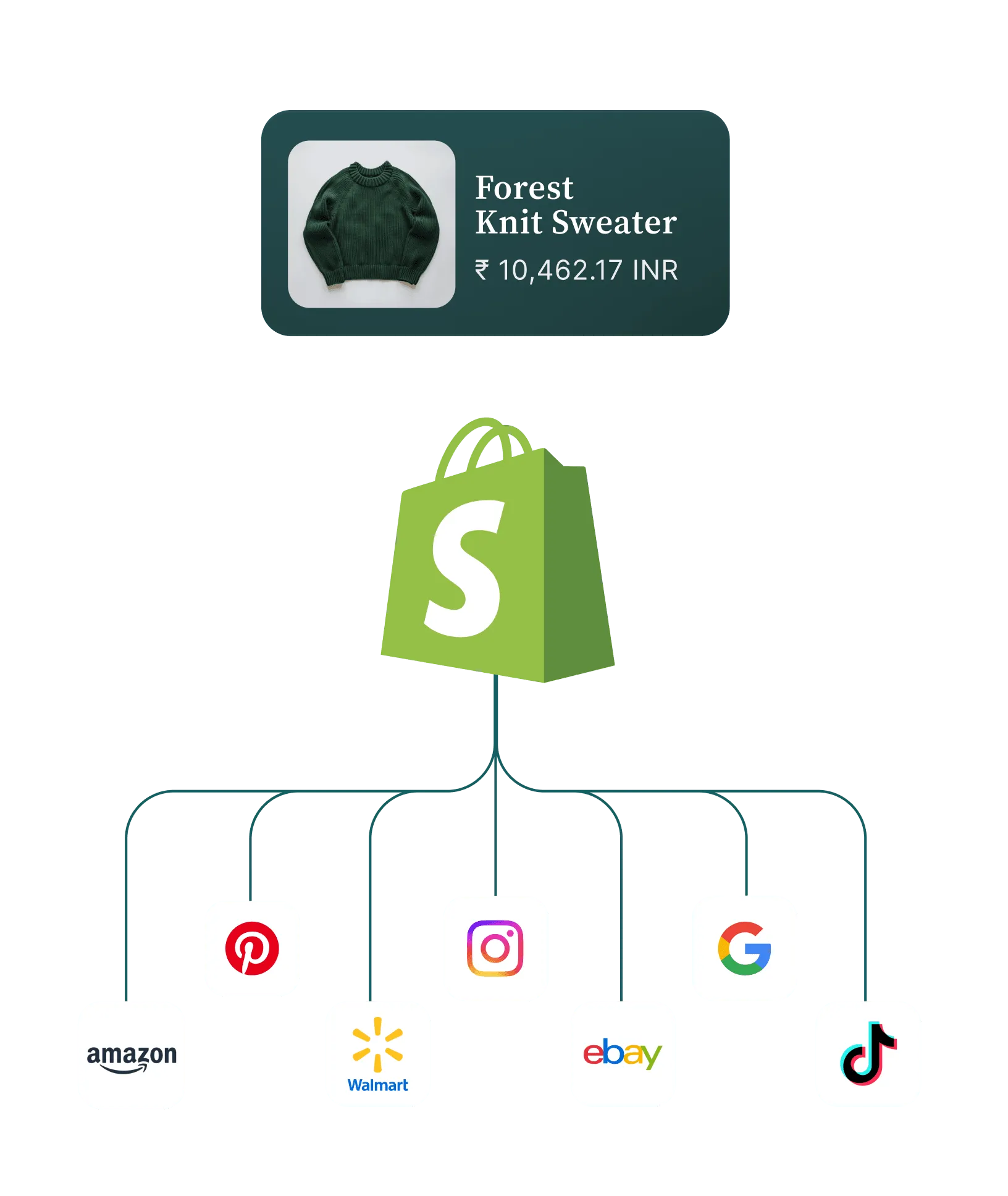
A strong Walmart DSP strategy starts with Walmart’s shopper data, not with channels. Define the shopper you want to reach (lapsed buyers, category buyers who skip your brand, in-market shoppers), match each group to a funnel stage and a format, and judge the results on incremental sales, not only last-click credit. This guide walks through that approach for brands that sell through Walmart and want to extend their reach beyond Walmart.com.
TL;DR
- Walmart DSP lets you buy offsite media (display, video, CTV, audio and more) using audiences built from Walmart purchase data, online and in stores.
- Structure campaigns by funnel stage: awareness on CTV and audio, consideration on video and display, conversion on display and mobile.
- Use more than one channel per audience. Walmart Connect reports that multi-channel campaigns convert better than single-channel ones.
- Measure incrementality, new-to-brand share and in-store sales, not just attributed ROAS.
- Coordinate Walmart DSP with Amazon and D2C media through one set of audience definitions and one measurement view.
What Walmart DSP is and how it differs from Sponsored Ads
Walmart DSP is a demand-side platform that Walmart Connect launched in August 2021, built with The Trade Desk. It lets advertisers buy display, streaming video, mobile, audio and connected TV inventory across multiple channels, using Walmart’s first-party shopper data.
The simplest way to separate it from Walmart Sponsored Ads is by where the shopper is:
- Sponsored Ads reach people already searching or browsing on Walmart’s own site and app. They capture existing intent.
- Walmart DSP reaches people elsewhere on the open web, in streaming video, on audio and on other surfaces. It creates and shapes demand before the shopper ever types a search.
Most brands that grow profitably on Walmart run both. Sponsored Ads harvest demand. DSP builds the pool of shoppers who will later search for you. If you only run search-style ads, you are competing for the same finite set of shoppers as everyone else in your category.
The landscape is also shifting. Walmart Connect’s exclusivity with The Trade Desk has ended, and it has expanded offsite partnerships with Yahoo DSP and Magnite to activate customer data outside the Walmart DSP. The practical takeaway: Walmart audiences are becoming available in more places, so your strategy should be built around the audiences rather than around a single buying tool.
Why the data is the strategy
Walmart’s advantage is purchase data from stores as well as online. The Trade Desk notes that 89% of consumer packaged goods purchases still happen in stores, a sale most online ad platforms never see. For a brand selling physical products, that matters: your audiences reflect what people actually bought, not just what they clicked.
According to the same resource, the first-party data is mapped to the SKU level and turned into thousands of prebuilt audience segments. In practice, you can think of three families:
- Past-purchase audiences: shoppers who bought in a category, or bought specific brands.
- Predictive audiences: shoppers modeled from shopping behavior as likely to buy next.
- Your own audiences: you can upload first-party data and have Walmart Connect match those shoppers to its audiences.
The scale is large. Walmart serves roughly 150 million customers a week in the United States, so even narrow segments can carry meaningful reach.
Build the plan around funnel stages
The most common mistake we see in DSP planning is one campaign, one audience and one goal. Walmart’s own framework is full-funnel: according to The Trade Desk’s Walmart DSP page, awareness reaches in-market audiences on CTV, display and audio, consideration retargets engaged viewers with deeper video or audio storytelling, and intent drives action with lower-funnel display or mobile placements.

Here is how we translate that into a working structure.
Awareness: reach category buyers who do not buy you yet
- Audience: buyers in your category who have not purchased your brand, and predictive segments modeled on your best customers.
- Formats: CTV and audio.
- Judge on: reach, frequency and new-to-brand buyers. Do not judge on direct sales in this tier. It will look expensive if you do.
Consideration: win in-market shoppers
- Audience: shoppers actively buying in your category, and buyers of adjacent or competing products.
- Formats: online video and display, with creative that explains why your product is different.
- Judge on: product page views, add-to-carts, sales lift and the share of new buyers.
Conversion: close the loop
- Audience: lapsed buyers, recent product viewers and people who engaged with your upper-funnel ads.
- Formats: display and mobile.
- Judge on: attributed sales and, where possible, incremental sales.
Each tier needs its own budget line and its own success metric. When a single blended ROAS number governs everything, the conversion tier always looks best, and teams starve awareness until the audience pool dries up.
Use multiple channels per audience
The Trade Desk reports that campaigns that activated audiences across multiple media channels saw an average 49% higher conversion rate than those using a single channel. That is a platform-reported average, so treat it as direction rather than a promise, but it supports a clear planning rule: take the same audience and reach it on at least two surfaces, such as CTV for storytelling and display for the follow-up.
A simple sequence:
- Reach a category-buyer audience with a CTV spot.
- Retarget people who engaged with a shorter video or audio message.
- Follow with a display ad that features a specific product and offer.
- Move people who viewed the product but did not buy into a lapsed or viewer audience for the conversion tier.
This is the handoff problem our team writes about in our Walmart DSP targeting setup guide: audiences rarely fail because a segment is wrong. They fail because the stages do not pass shoppers to one another.
Pick formats and inventory by job
Walmart DSP offsite media spans the open web, social, CTV, audio, gaming and more. The inventory is also widening. Walmart Connect’s October 2026 update describes a proof of concept with Yahoo DSP, powered by Magnite, bringing Walmart audiences and closed-loop measurement into a platform advertisers already use, including VIZIO CTV inventory. It also describes addressable targeting with Walmart audiences across live linear television through private marketplace deals in Walmart DSP.
Walmart’s 2024 purchase of VIZIO for $2.3 billion is the backdrop. As Marketing Dive reports, it was meant to help advertisers reach audiences across CTV and streaming.
A practical way to choose:
- CTV: best for launches, new product lines and category-entry campaigns where you need attention and a story. It pairs with Walmart audiences to limit waste.
- Online video: best for explaining a benefit, demonstrating a product or reinforcing a message with people who already saw your CTV.
- Audio: an efficient reach and frequency layer, especially to support CTV.
- Display: the workhorse for retargeting, product-level promotion and conversion.
- Mobile: useful for lower-funnel prompts close to the purchase moment.
Creative is the part of DSP that gets underfunded. A video and display set that is built for each funnel stage will beat one generic asset repurposed across everything. Our creative and content production team builds photography, video and display assets under the same roof as media planning, so the creative reflects the audience it will run against. If your listings also need work, our piece on Walmart rich media covers the on-site side.
Measure sales, new buyers and incrementality
Walmart’s closed-loop measurement is the reason to run DSP there rather than on a generic platform. It connects ad exposure to sales on the site, in the app and in stores. Look at these measures together:
- New-to-brand share: Walmart Connect reports that offsite display campaigns delivered a median of 52% new-to-brand customers in 2025. Your own figure will differ by category, but it is the right benchmark question to ask.
- In-store sales: because most CPG volume happens in stores, a plan that only counts online orders understates the effect of the campaign.
- Incremental ROAS: Walmart Connect has offered an incremental return on ad spend metric for search for the last year and now offers closed-loop measurement with TikTok, TV networks and Meta.
A worked example from the brand side
Kettle & Fire combined search, display and CTV from June 1 to September 30, 2025. Its CTV ran through Walmart DSP and The Trade Desk. According to the Walmart Connect case study, the program generated a ROAS of 8.74, 49% new-to-brand orders and 169.5 million impressions. It is one brand’s result in one season, so use it as a model for the mix (a search layer, a display layer and a CTV layer working together), not as a forecast.
Attribution is not incrementality
Attributed ROAS tells you which ad got credit. Incrementality tells you what would not have happened without the ad. They can differ widely, especially for retargeting, where many shoppers were going to buy anyway. We explain the difference in our attribution versus incrementality article and the methods in our retail media incrementality guide.
What to do about it:
- Report attributed ROAS and incremental results side by side, never one alone.
- Hold out a portion of an audience, or use a geo or time-based test, on your largest conversion-tier spend.
- Compare the lift in new buyers against the lift in repeat buyers, so you know whether you are growing or just collecting existing demand.
- Look at what happens after the click. Even well-targeted traffic wastes money when the landing experience is weak, so these conversion rate optimization tips are worth applying to your product pages before you raise spend.
Our advertising and incrementality analytics work, built on our iDerive platform, is designed to put these views in one place in business language, so the conversation is about profit and not platform dashboards.
Coordinate Walmart DSP with Amazon and D2C
Most enterprise brands do not run Walmart in isolation. Their shoppers move across Walmart, Amazon and the brand’s own site, so the planning needs one frame. This is the approach we use.
One audience map, three activations
Define your audiences once (new category buyers, in-market shoppers, lapsed buyers, loyal buyers) and decide how each one is reached on each platform. The goal is consistent logic, not identical tactics. Walmart audiences are based on Walmart purchases, so they will not mirror an Amazon or D2C list exactly, and that difference is useful. Walmart tends to reach shoppers who buy in stores and who may never open an Amazon app.
Allocate budget by role, not by habit
- Use Amazon where you need to capture high-volume demand and where your listings are strongest.
- Use Walmart DSP to reach store-heavy shoppers and to build awareness among the households Walmart already serves.
- Use D2C media to drive first-party data and lifetime value, then feed those audiences back into the marketplaces where the platforms allow it.
Then review marginal returns at least monthly. If the next dollar on one platform produces less incremental revenue than on another, move it.
Avoid overlap and double counting
When the same shopper is reached on three platforms, each platform claims the sale. A unified reporting layer, plus holdout tests on your biggest audiences, is the only reliable defense. If you are weighing how much to commit on the Amazon side, our breakdown of Amazon DSP cost and total advertiser spend helps frame the comparison, and our Walmart advertising solutions page shows how we manage the Walmart side.
Common pitfalls to avoid
- Starting with conversion only. Retargeting makes early numbers look great and then plateaus. Fund upper-funnel audiences from day one.
- One creative for every stage. CTV, video and display do different jobs. Brief them separately.
- Ignoring in-store sales. If your products sell mostly in stores, online-only reporting will undervalue the program.
- Judging awareness on ROAS. Use reach, new-to-brand share and lift for those tiers.
- Unsegmented audiences. Treat past buyers, lapsed buyers and category buyers as separate lines, with separate messages.
- Weak product pages. DSP sends shoppers to your listing. If the content is thin, you pay for traffic that does not convert.
- Locking into a single buying route. With Walmart audiences now available through more partners, keep the plan portable.
Access requirements and minimum spend commitments can vary and change. Confirm current terms directly with Walmart Connect or your agency before you set a budget.
Our perspective
We think Walmart DSP is one of the most underused tools available to brands that already sell on Walmart. Most teams treat it as an afterthought to Sponsored Ads, so they spend where demand already exists and never build new demand.
Our view is simple: start with profit, work backward to audiences, and measure what the ads added, not what they were credited with. That is why we pair media buying with creative and analytics in one team. Strong creative and a clear incrementality view change what a DSP program can deliver, and the three should not live in separate silos.
The brands we see getting the most from it plan across Amazon, Walmart and their own site as one system, with one set of audience definitions and one source of truth for reporting. That is what our iDerive platform is designed to support.
Dan Katona
How Nectar can help
We are a fully managed e-commerce agency for mid-market and enterprise brands selling on Amazon, Walmart and their own D2C sites. For Walmart DSP, we handle audience strategy, creative, buying and measurement together. Our Walmart Connect advertising management team plans the funnel and runs the campaigns.

If you want a second opinion on how your current Walmart and Amazon media fits together, or you are planning your first DSP program, talk to our team and we will start with your audiences and your profit targets. You can also explore our wider retail media advertising services.
For a deeper strategic walkthrough, read our full-funnel Walmart DSP strategy.
FAQ
What is the best Walmart DSP strategy for a brand that is just starting?
Begin with two or three audiences mapped to one funnel stage each: category buyers who do not buy you yet, in-market shoppers, and lapsed buyers. Use at least two channels, such as CTV and display, and set a separate success metric for each stage. Add incrementality testing as soon as spend is meaningful.
How is Walmart DSP different from Walmart Sponsored Ads?
Sponsored Ads place your products in front of shoppers who are already on Walmart’s site or app. Walmart DSP buys offsite inventory such as display, video, audio and CTV, and targets shoppers using Walmart’s first-party data. Most brands benefit from running both.
How do I measure whether Walmart DSP is working?
Look at new-to-brand share, in-store and online sales, and incremental ROAS alongside attributed ROAS. Use holdout or geo tests on your largest conversion spend. Attribution shows who got credit, while incrementality shows what the ads actually added.
Should I run Walmart DSP and Amazon DSP together?
For most enterprise brands, yes, as long as each has a defined role. Use shared audience definitions, allocate budget by marginal return, and use unified reporting so the same sale is not counted twice.
Can I use my own customer data in Walmart DSP?
Yes. Walmart DSP’s audience matching lets advertisers upload first-party audience data, and Walmart Connect can match those shoppers to its own audiences. Work with your agency or Walmart Connect on the current process and privacy requirements.
Sources
- Walmart Connect launches its new demand-side platform, Walmart DSP
- Drive performance with Walmart DSP and retail data (The Trade Desk)
- Walmart Connect expands offsite advertising ambitions (Marketing Dive)
- Inside Walmart Connect as retail media and CTV convergence accelerates (Marketing Dive)
- Expanding where and how advertisers can use Walmart audiences (Walmart Connect)
- Kettle & Fire case study (Walmart Connect)
Recommended