Amazon Marketing Cloud (AMC) is a privacy-safe clean room where you can run custom queries on your Amazon Ads signals. The most valuable use cases are path-to-purchase analysis, overlap and frequency checks across ad products, new-to-brand and lifetime value analysis, incrementality testing, and building custom audiences for activation. Standard Sponsored Ads and DSP reports can’t answer these questions. This guide covers each use case, the business question behind it, and what a team needs in place to act on the answer.
TL;DR
- AMC lets you ask questions that console reports can’t, such as which ad combinations precede a purchase and how many conversions an ad actually caused.
- Core use cases: shopper journey analysis, cross-product overlap and frequency, new-to-brand and repeat behavior, incrementality measurement, and custom audience creation.
- AMC returns aggregated, anonymous answers. It is not a customer list or a data export.
- The insight only pays off if it changes spend, creative, or audiences. Plan the activation step before you write the first query.
- Brands selling on several channels should connect AMC findings to Walmart and owned-site decisions, not treat them as Amazon-only.
What AMC is and why standard reports fall short
Amazon describes AMC as a secure, cloud-based clean room where advertisers analyze and build audiences across pseudonymized signals. According to Amazon’s AMC product page, it is available at no cost to eligible advertisers through a web interface and an API. Inputs are pseudonymized and outputs are aggregated, so you see patterns, not individual shoppers.
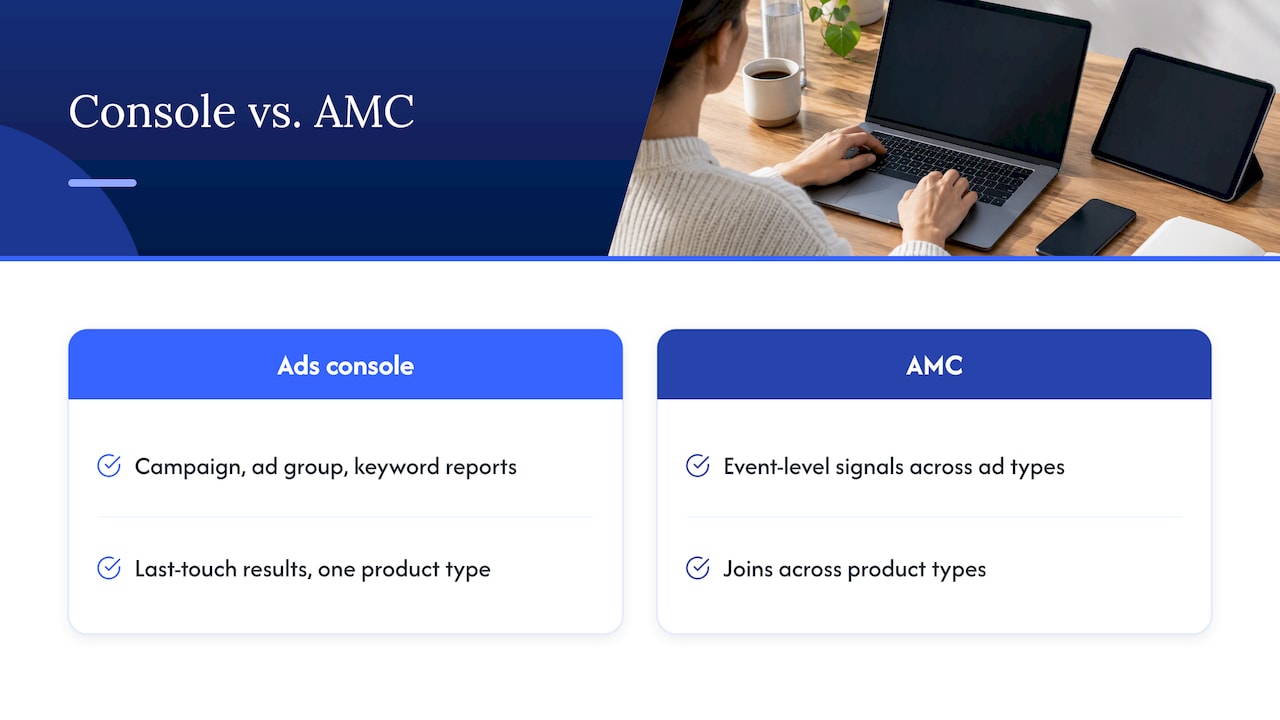
The practical difference from the ads console is the unit of analysis. Console reports are organized by campaign, ad group, and keyword. Each shows last-touch results for one product type. AMC lets you query event-level signals across Sponsored Products, Sponsored Brands, Sponsored Display, and DSP, then join them in ways the console never offers. You define the question, and the query returns the answer.
That flexibility is the whole point, and it is why most use cases below start with a business question rather than a metric.
Use case 1: Map the path to purchase
The question: what do shoppers see and do before they buy?
A brand running Sponsored Products, Sponsored Brands, and DSP usually sees each one claim credit for the same sale. A path analysis in AMC lists the actual sequences of exposure that came before conversions. You can see whether a DSP impression typically precedes a branded search click, or whether shoppers who buy have usually seen two or more ad types.
What teams do with it:
- Move budget away from touchpoints that rarely appear in converting paths.
- Identify the upper-funnel placements that feed branded search, then protect them during budget cuts.
- Set realistic expectations for how long consideration takes in your category.
This is the most common first project because it reframes how the whole media mix is judged. If your team reports channel ROAS in isolation, path analysis will probably change the conversation. For the broader context, see our piece on cross-channel attribution in ecommerce.
Use case 2: Check overlap, reach, and frequency
The question: are we paying several times to reach the same shoppers, and missing others entirely?
Console frequency data is limited to each ad product. In AMC, you can measure how many unique shoppers each product reached, how many were reached by more than one, and how many impressions each person received before converting or going quiet.
Typical findings are uncomfortable but useful. A small slice of shoppers absorbs a large share of impressions. Another group is reached only by the cheapest tactic. Fixing this means capping frequency, shifting budget to underserved segments, and sequencing messages so the second impression says something different from the first.
Use case 3: Understand new-to-brand and repeat behavior
The question: which campaigns bring in shoppers who are actually new, and what do they do afterward?
Growth-stage brands often optimize toward the lowest cost per order and quietly fill their ad spend with existing customers. AMC lets you split conversions by new and returning buyers and follow each group over time. You can see which campaigns, keywords, and creative bring in new shoppers, how many come back, and how long reorder takes.
This matters most for consumables and replenishable products, where lifetime value outweighs first-order profit. If a campaign looks mediocre on first-purchase ROAS but brings in shoppers who reorder twice, AMC is how you prove it and defend the budget.
Use case 4: Analyze audience segments and shopping behavior
The question: who buys from us, who buys from the neighbors on the shelf, and where is the gap?
AMC can group shoppers by the products they browse and buy and show how your customers overlap with adjacent categories. A brand selling cookware might learn that its best customers also buy meal-prep containers and spice sets, which suggests bundles, cross-listing, and new product ideas.
Teams use these findings to:
- Validate a product expansion before committing inventory.
- Decide which complementary ASINs deserve placement in each other’s detail pages and Brand Stores.
- Write creative around the real motivations of the segments that convert.
Understanding what an audience actually needs is also the foundation of content planning, a practice often called audience needs analysis. In AMC, you get that evidence from purchase behavior rather than surveys.
Use case 5: Measure incrementality
The question: how many of these sales would have happened without the ad?
Attribution tells you who clicked before buying. Incrementality tells you what the ad caused. Brand-term campaigns are the classic example: they often show excellent ROAS because the shopper was already searching for you. AMC lets you compare exposed and unexposed groups, or analyze holdout-style tests, to estimate the lift an ad actually produced.
Good incrementality work usually answers three things:
- Which campaigns produce real lift, and which mostly harvest demand that was already there.
- How lift changes with frequency, so you can find the point where more impressions stop helping.
- Whether a new tactic, such as a new DSP audience, deserves a bigger budget.
This is a core part of our service. If you want to see how we structure it, read about our AMC and incrementality testing and our broader advertising and incrementality analytics.
Use case 6: Evaluate keyword and search-term contribution
The question: which search terms start journeys, and which only finish them?
The console ranks search terms by direct sales. AMC can show which terms appear early in converting paths, which ones lead to a first branded search later, and which are consistently the last click before purchase. Generic and competitor-adjacent terms that look weak on direct ROAS often show up as the opening step in valuable paths.
The action is to stop cutting those terms on last-touch numbers alone and to judge them as part of a sequence. Pair this with disciplined Sponsored Ads management so that bid changes follow the evidence rather than the weekly report.
Use case 7: Build custom audiences and activate them
The question: can we reach the specific shoppers the analysis found?
AMC is not only a reporting tool. Once a query defines a segment, such as shoppers who viewed a product detail page twice but never bought, or buyers of a replenishable item who are due to reorder, you can use that segment as an audience for DSP and Sponsored Display campaigns. The segment is built inside the clean room and passed to Amazon’s ad products without exposing individual identities.
Useful audiences include:
- Lapsed buyers who have not purchased in a window that matches your reorder cycle.
- Shoppers who engaged with a high-consideration product and stalled.
- Buyers of one product line who have never tried another.
Lookback windows matter more than most teams expect. A window that is too short misses the buyers you most want, and one that is too long dilutes the message. We cover this in detail in our post on Sponsored Display audiences and lookbacks.
Use case 8: Plan and review high-volume shopping events
The question: what should we do before, during, and after Prime Day or Black Friday to Cyber Monday?
Before the event, AMC can show how far in advance your category’s shoppers start researching and which audiences warm up fastest. After it, you can review which pre-event exposures contributed to event-day purchases and how many event buyers were new to your brand. That shapes the next event’s budget curve, rather than repeating last year’s plan on instinct.
The habit worth building is a standing post-event review that feeds the next planning cycle. Our notes on Amazon shopping event tips give a practical starting point.
Applying AMC insights beyond Amazon
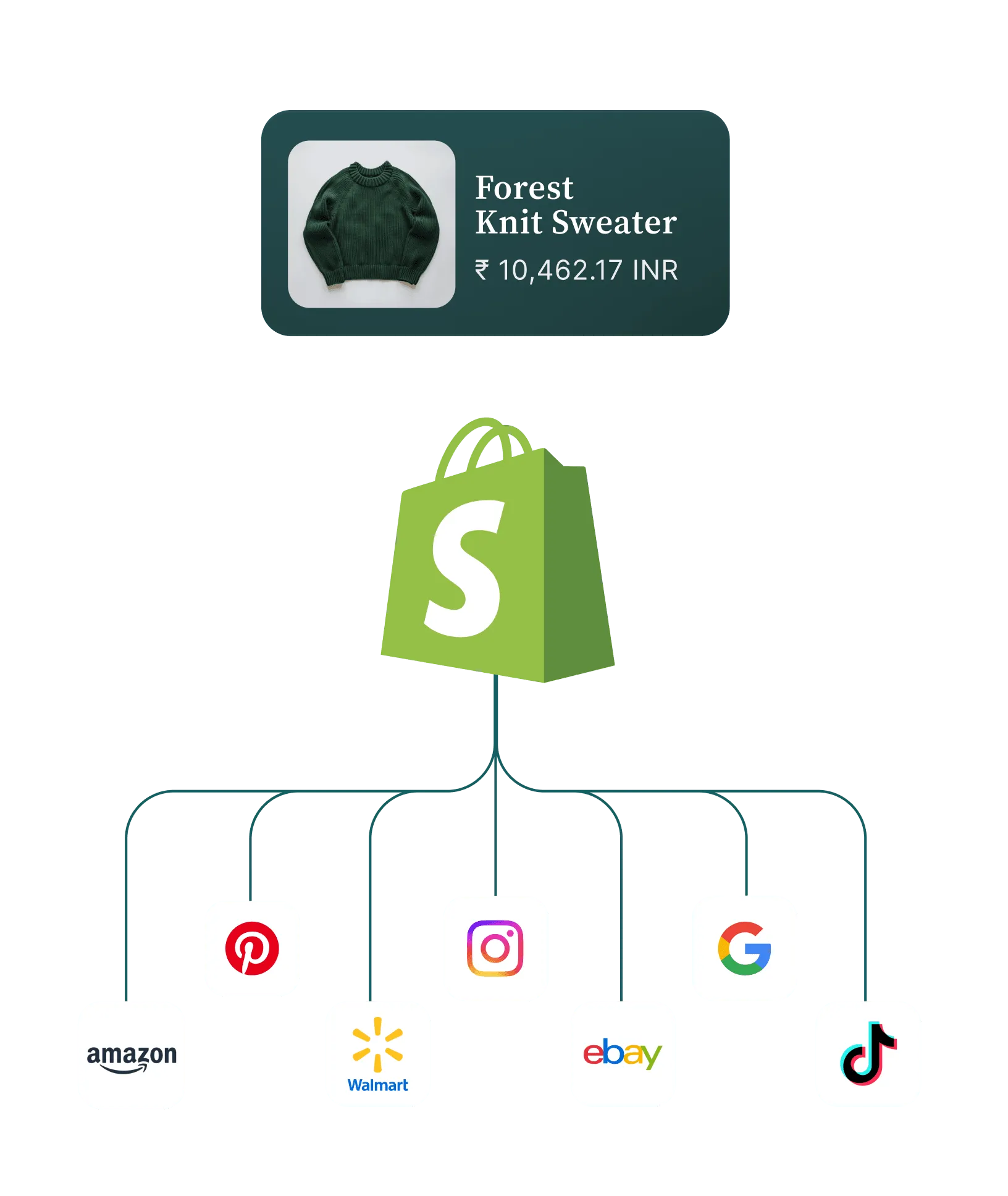
Most mid-market and enterprise brands sell on Walmart and on their own site as well. AMC only sees Amazon Ads signals, but the learnings travel:
- Journey logic. If a top-of-funnel video lifts branded search on Amazon, test whether the same creative lifts branded demand on Walmart and your own store.
- Audience definitions. Segments that respond on Amazon, such as replenishment-due buyers, are good hypotheses for email and paid social on your owned channels.
- Creative angles. Messages that win with new-to-brand shoppers on Amazon are a sensible first test for product pages elsewhere.
- Measurement discipline. If you learn that last-touch metrics overstate brand-term performance on Amazon, apply the same skepticism to your other retail media reports.
The usual caution is to treat these as tested hypotheses, not proven facts, because shoppers and ad systems differ by channel. Teams that run Amazon, Walmart, and a D2C store from one measurement framework make these transfers faster. That is the idea behind our iDerive analytics platform, and why we manage marketplace expansion and Amazon together.
What to have in place before you start
AMC is easy to open and hard to use well. Before the first query:
- Confirm access. AMC is offered to eligible advertisers, so check with your Amazon Ads representative or your agency that your account qualifies and that an instance is set up.
- Have meaningful ad data. Queries need volume. Brands with thin or inconsistent campaign history will get sparse, noisy results, and aggregation rules can hide small segments.
- Write the question first. “What does a converting path look like for our top ten ASINs?” is a project. “Show me everything” is not.
- Decide who runs the SQL. AMC queries are written in SQL. Amazon provides instructional query templates, and many teams start there before building custom ones. You need an analyst who knows both SQL and how Amazon advertising works.
- Plan activation. Decide in advance which budget, audience, or creative decision each analysis will inform, and who owns it.
- Respect the privacy model. You get aggregated, anonymous outputs. Do not plan projects that assume customer-level exports. Data you upload stays in your own AMC instance, per Amazon’s AMC documentation.
How to prioritize your first three projects
If you have limited analyst time, sequence the work by how quickly it changes spending decisions:
- First, a path-to-purchase and overlap analysis. It needs the least setup and almost always surfaces wasted frequency or misattributed credit.
- Second, a new-to-brand and repeat analysis. It tells you whether your growth is real or recycled customers.
- Third, an incrementality test on your biggest brand-term or retargeting spend, where the potential savings are largest.
Audience creation follows once you trust the segments. For help interpreting results with AI-assisted analysis, see how top brands approach AI for Amazon analytics.
Our perspective
Most brands we meet are not short on data. They are short on questions worth asking and the discipline to act on the answers. AMC is a good example: the clean room is available, yet many teams open it once, run a template query, and go back to the console.
We built our approach around the opposite habit. Every AMC project starts with a decision, such as where to move the next $100,000 of budget, and works backward to the query. Then we connect the finding to the buy, the creative, and the listing, because an insight that never reaches the media plan has no value.
That is also why we put AMC next to our iDerive platform. Amazon, Walmart, and owned-site data belong in one view, in business language, so the people approving budgets can see what the analysts see. Profit-first advertising means asking what an ad caused, not only what it touched.
Dan Katona
Put AMC to work with Nectar
If your team wants AMC insights that turn into budget decisions, our Amazon specialists combine clean-room analysis, retail media buying, and creative production under one roof. We run the queries, interpret the results, and activate the audiences, so your brand managers get recommendations rather than raw output.

Explore our Amazon Growth & Optimization service, or see how we run retail media advertising across Amazon DSP and Sponsored Ads.
FAQ
What is the best first use case for Amazon Marketing Cloud?
Start with path-to-purchase and overlap analysis. It needs little setup, works with data you already generate, and often reveals duplicated spend or misattributed credit. The results usually give you a clear budget action within a few weeks.
Do I need SQL to use Amazon Marketing Cloud?
AMC queries are written in SQL, so someone on your team or at your agency needs that skill. Amazon offers instructional query templates that cover common questions, which lowers the barrier. Custom analysis still benefits from an analyst who understands both SQL and Amazon advertising.
Can AMC show me individual customers?
No. AMC returns aggregated, anonymous results, and it is not a customer list or a data export. You can build audiences from the segments it finds and use them in Amazon ad products without seeing who is in them.
Can AMC help with Walmart or my own website?
AMC analyzes Amazon Ads signals, so it does not measure Walmart or D2C performance directly. Its findings on journeys, audiences, and incrementality are still strong hypotheses to test on other channels. A unified measurement setup makes those comparisons easier.
Sources
Recommended