Brand defense on Amazon means protecting the demand you have already built, on two fronts. The first is advertising: you run campaigns on your own brand terms and product pages so a competitor can’t intercept shoppers who were looking for you. The second is enforcement: you use Brand Registry, Project Zero, Transparency and daily monitoring to keep hijackers, counterfeiters and unauthorized sellers off your listings. Most brands do one well and neglect the other. This guide covers both, in the order you should act.
TL;DR
- Brand defense has two surfaces: branded search results, where rivals can bid on your name, and product detail pages, where rivals can target your ASINs.
- Build a dedicated branded Sponsored Products campaign, keep it separate from non-branded campaigns, and protect top-of-search placement on your core brand term.
- Brand Registry gives you standing to enforce your intellectual property, but it does not detect hijackers for you and does not enforce pricing or distribution rules.
- Project Zero and Transparency add automated and serialized protection for counterfeits, and a federally registered trademark is the key to most of it.
- Track branded click share and top-of-search impression share in Brand Analytics and your ad reports, and review them on a fixed cadence.
What brand defense means on Amazon
A shopper who types your brand name into Amazon has already decided something in your favor. Brand defense is the work of making sure that decision ends in a sale for you. Branded defense campaigns target your own brand name and product pages so that people who want your brand see your products rather than a competitor’s. They protect demand. They do not create it.
That applies even if Amazon is not your biggest channel. Search Engine Land notes that brands with a weak branded search presence can see awareness built on other platforms send traffic to competing products on Amazon, eroding market share. The same source makes the point that even established brands need defensive advertising to stop other brands from drafting on the affinity they built.
There are two layers to cover:
- Search and detail page advertising. Branded keywords, Sponsored Brands placements, and product targeting on your own ASINs.
- Listing integrity. Counterfeit products, listing hijacking, unauthorized sellers and misuse of your intellectual property in other sellers’ content.
The first layer is a media-buying discipline. The second is part legal, part operational. Strong brands run them together, because a hijacked listing wastes the ad spend that drives traffic to it.
Defend branded search first
Branded search is the fastest place to lose sales you should have won, and the easiest to fix. If a rival’s ad sits above your organic result on your own name, you are paying for traffic in other ways and handing some of it over.
Keep branded and non-branded campaigns apart
Search Engine Land recommends separating branded and non-branded search campaigns. The reasons are practical. You can see how each performs, you can make better budget decisions, and you can tell how many new customers buy without knowing your brand. If you group them, weak non-branded ads hide behind the high returns of branded terms, and your blended numbers look healthier than your acquisition really is.
Build the core branded campaign
The foundation is a Sponsored Products campaign that holds only branded keywords. A sensible starting list includes:
- Your brand name.
- Brand name plus product type.
- Brand name plus a key variation, such as size, flavor or model.
- Common misspellings pulled from your search term report.
Start with exact match on these terms, and put phrase and broad versions into a separate test campaign with its own budget, so experiments never starve the core defense. If you are unsure how the match types behave, our guide to Sponsored Products match types walks through broad, phrase and exact. Your search term report is also the best source for new branded variants, and our piece on Amazon search terms covers how to mine it.
Amazon’s own Sponsored Brands guidance suggests including at least 25 keywords with a mix of match types, and notes that more than a quarter of customers shop across multiple brands. That is a reminder that defense is not the whole plan. Branded campaigns hold ground, while category-level terms win new shoppers.
Set bids and placements with a target, not a guess
On your own brand name, the top-of-search slot is the one that matters. Page-two or product-page placements on your brand term rarely do the job of defense. A workable routine:
- Choose a target for top-of-search impression share on your core brand term.
- Let the campaign run for a full week before judging it.
- If you are below target, raise the base bid in small steps and check again.
- Stop raising bids once you hold the target. Overbidding on a term only you should win is wasted spend.
Because you are bidding against a few opportunistic rivals rather than the whole category, branded terms are usually cheap relative to their conversion. If costs on a branded term climb, that is itself a signal that someone is bidding on your name, and worth investigating.
Consider reserved placement for your name
For brands under steady attack, Amazon offers a way to stop bidding altogether on the most important term. Sponsored Brands reserve share of voice is a goal-based campaign type that secures consistent top-of-search visibility on your branded keywords at a fixed, upfront price. It suits launches, peak seasons and brands with heavy conquesting pressure, where bid volatility would otherwise cost you the placement.
Defend the detail page too
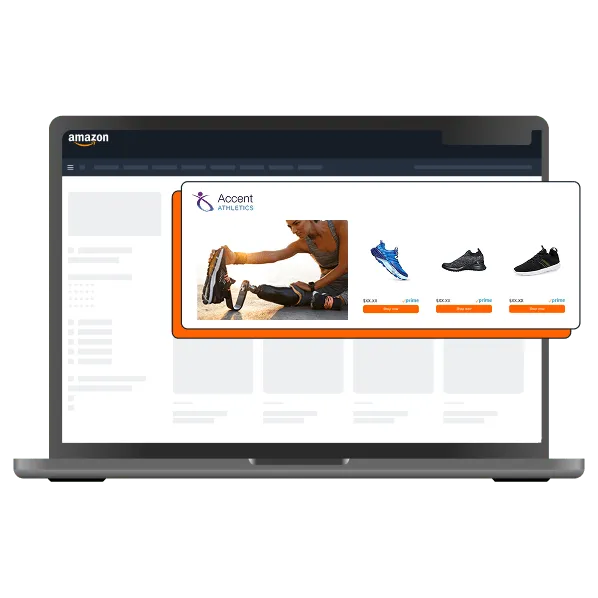
Search is only half of the picture. On a product detail page, competitors can target your ASIN with their own ads, and their products can appear in the buy area next to yours. A complete defense includes product targeting campaigns on your own ASINs, so your own related products occupy those slots first. A simple version: Sponsored Display and product-targeted Sponsored Products aimed at your best-selling ASINs, pointing to your complementary products or your highest-margin variants. Our Amazon sponsored ads management page explains how we structure Sponsored Products, Brands and Display together.
Protect your listings from hijackers and counterfeits
Every brand at scale eventually meets someone selling something they shouldn’t be selling under their listing. Four threats do the most damage: counterfeit products, listing hijacking, unauthorized sellers, and misuse of your intellectual property in listing content. Each hits revenue differently and each needs its own response through Amazon’s reporting systems.

Start with Brand Registry
Brand Registry is the baseline. Amazon describes it as a free program that helps you protect your intellectual property, manage the accuracy of listings and grow your business. It includes automated protections built on machine learning, a Report a Violation tool, support from Brand Registry specialists, neutral patent evaluation, an Impact dashboard and educational resources.
If you do not have a federally registered trademark yet, that is the first thing to fix. Trademark status determines which enforcement routes are open to you. Talk to a trademark attorney about timing and scope before you file.
Know what Brand Registry does not do
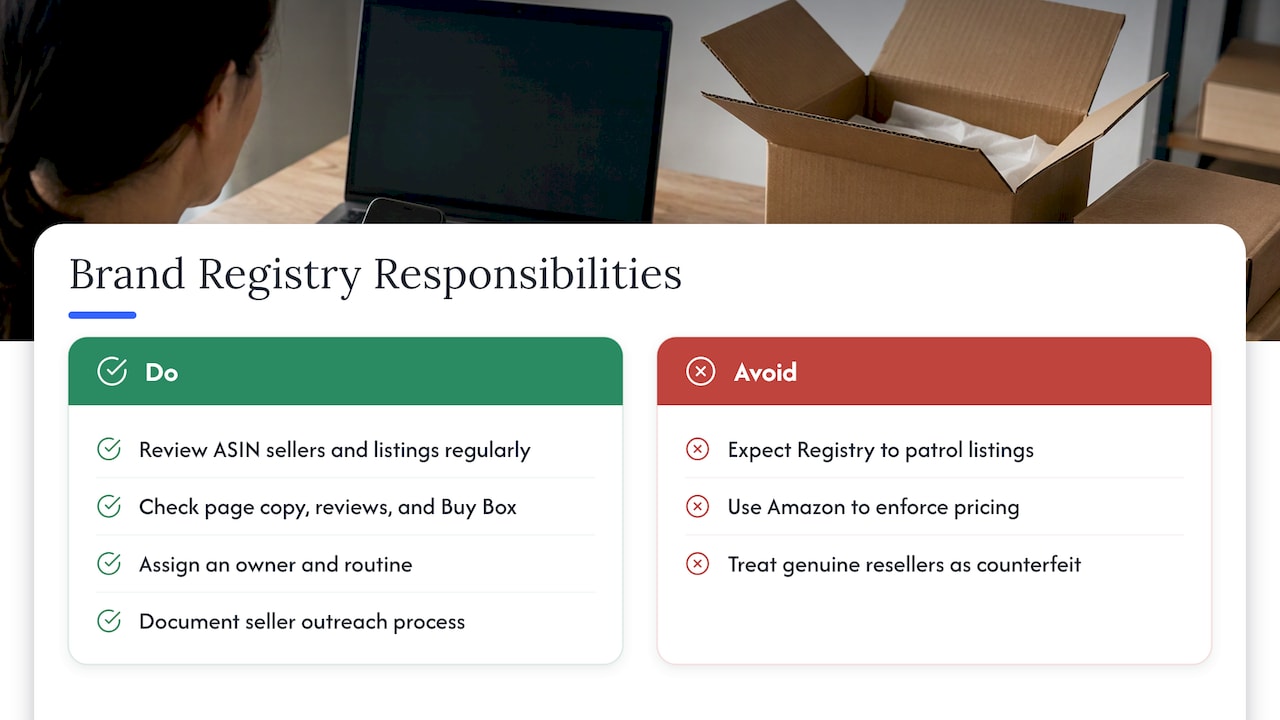
Brand Registry gives you standing to file actions. It does not patrol your listings for you. Detection is your responsibility, which means a regular review of who is selling on your ASINs, what your pages say, and what your reviews and Buy Box look like. Set a daily or weekly routine and assign an owner for it.
It also is not a pricing or distribution tool. If a reseller buys genuine product legally and lists it, Amazon generally treats that differently from a counterfeit. Minimum advertised price policies are a matter for your own contracts and distribution controls, not for Amazon. Here the fix is commercial rather than technical: tighter authorized-reseller agreements, clear channel rules, and a documented process for approaching sellers who break them. For a useful parallel from another category, see how grey market sellers are explained when authorized and unauthorized channels blur.
Add Project Zero for counterfeits
Amazon describes Project Zero as a combination of automated protections, a self-service tool to remove counterfeit listings immediately, and optional product serialization powered by Transparency. Amazon reported in 2019 that its automated protections had stopped more than 65 million suspicious listings for enrolled brands since launch. Check Amazon’s current Project Zero page for eligibility requirements, since they are set by Amazon and can change.
Use Transparency where counterfeits are a real risk
Amazon Transparency puts a unique, scannable code on every unit. Once you enroll a product, units without valid matching codes can’t be listed or shipped in the stores where Transparency is supported. Amazon lists the code cost at $0.05 per unit for the first million units a year, dropping to $0.01 at volume. It fits best on high-value, high-volume or frequently copied products, where the per-unit cost is small next to the revenue at stake.
Lock down your detail page content
Brand Registry also gives you tools to control how your pages are built, and tightening these closes off the easiest hijacking route: someone editing your title or images. Keep your content accurate, keep images and A+ content consistent with what you ship, and monitor for unexplained changes. A stronger creative foundation also makes copycats easier to spot, because your pages become visibly distinct. Our Creative & Content Production team builds that foundation.
A defense routine you can run every week
Defense is a cadence, not a project. Here is a routine we would hand to a brand team.
Daily
- Check the Buy Box owner on your top ASINs.
- Scan for new sellers on those ASINs.
- Glance at branded campaign spend and impression share for anomalies.
Weekly
- Pull the search term report and add new branded variants and misspellings to your exact-match campaign.
- Review rival ads appearing on your brand name and note who they are.
- Review new reviews and Q&A for signs of attack or off-brand content.
- File Report a Violation cases for confirmed infringements, with documentation.
Monthly
- Compare branded and non-branded performance side by side, to see how much of your sales depends on shoppers who already know you.
- Review trademark coverage, new product names and packaging for registration gaps.
- Check whether a reserved placement or higher branded budget is warranted ahead of peak season.
Measure whether defense is working
Two measures tell most of the story. The first is share on branded queries. If you are brand registered, the Search Query Performance report in Brand Analytics shows impressions, clicks and purchases your brand captured for each query. On your own name, your click share should be high, and a drop is a warning that someone is taking attention you earned. The second is top-of-search impression share on your branded campaign, from your ad reporting.
Also watch these:
- Branded ACOS and spend trend. Rising cost on your own name signals competitive bidding.
- Branded versus non-branded sales mix. A brand that is growing healthily adds non-branded customers, not just branded ones.
- Buy Box percentage and number of sellers per ASIN. These show listing integrity.
- Enforcement case outcomes. Track how many reports you file and how many succeed, because accuracy affects your standing with Amazon’s systems.
If your data lives in different dashboards, it is hard to see these together. That is the reason we built iDerive, our analytics platform, to unify marketplace data. For deeper analysis of ad behavior, see our overview of Amazon Marketing Cloud use cases, and for a real example of smarter spend improving search visibility, read the LonoLife case study.
Our perspective
Brand defense is the most underrated line in an Amazon budget. Teams treat it as a tax, something they pay to stop leaking sales. We see it differently: it is the cheapest, highest-converting traffic you will ever buy, and it is also your early-warning system.
When branded costs rise, a competitor is moving. When your Buy Box shifts, a seller is on your listing. When click share on your own name slips, your pages or your ads are not doing their job. The brands that handle this well do not treat advertising, content and operations as separate teams. They read one set of numbers.
That is why we run defense as part of a full-funnel program: profit-first advertising on branded and non-branded terms, creative that makes your pages hard to imitate, and marketplace operations that catch problems early. iDerive gives brand teams one view of all of it, in business language, so the next decision is obvious rather than debated.
Brand Registry is necessary infrastructure, and Project Zero and Transparency are valuable layers on top. But tools only protect you if someone owns the routine. Give defense an owner, a cadence and a scorecard, and it stops being a worry.
Dan Katona
Let us run brand defense for you
If your team is stretched across Amazon, Walmart and your own site, defense is the work that slips first. We manage it end to end as part of our Amazon Growth & Optimization service: branded and non-branded campaign structure, detail page protection, creative, marketplace operations and reporting in iDerive.

We work with mid-market and enterprise brands that want an outside team to manage and grow their marketplace presence. If that sounds like you, talk to us at Nectar about where your brand is exposed today.
FAQ
Do I need brand defense campaigns if I already rank first organically?
Yes. Organic rank does not stop a competitor’s sponsored ad from appearing above your result on your own brand name. A branded campaign keeps your ad, and usually your Sponsored Brands creative, in the top position for shoppers who already want you. It tends to be a small spend relative to the sales it protects.
Does Brand Registry remove hijackers automatically?
No. Brand Registry gives you tools and standing to report infringement, but you have to find violations and file them. It is built around intellectual property enforcement, not pricing or distribution control. Resellers selling genuine goods are generally a contract matter, so pair Brand Registry with clear authorized-reseller agreements.
What is the difference between Project Zero and Transparency?
Project Zero combines automated protection with a self-service tool that lets you remove counterfeit listings yourself. Transparency is a serialization program that puts unique codes on units so only verified product can ship. Amazon describes Transparency as optional within Project Zero, so brands can use them together.
Should I keep branded and non-branded keywords in the same campaign?
Keep them separate. Branded terms convert at high rates and can mask weak non-branded performance. Separate campaigns show you what each is really doing, let you set budgets deliberately, and make it clear how many customers you win without name recognition.
Sources
- Optimizing for Amazon branded search: best practices, Search Engine Land
- Amazon Brand Defense Campaigns: Protect Your Brand Search
- Amazon Sponsored Brands best practices guide
- How to set up Amazon Sponsored Brands reserve share of voice
- What is Amazon Brand Registry?
- Project Zero, Sell on Amazon
- Project Zero Expands to Europe
- Amazon Transparency, Sell on Amazon
Recommended