Connected TV (CTV) lets an ecommerce brand put video ads in front of shoppers on smart TVs, streaming sticks and set-top boxes, then measure what those shoppers do next: visit a product page, search for the brand, buy on Amazon or Walmart, or check out on your own site. It works best when it is planned as one part of a full-funnel program, with creative built for the big screen, audiences built from purchase data, and measurement that looks past last-click reporting.
This guide is for brand managers and ecommerce leads at mid-market and enterprise companies. It covers how CTV works, which formats and targeting options matter, what drives cost, how to measure sales impact, and how to launch.
TL;DR
- CTV is digital video delivered to internet-connected TVs, so it combines TV-style impact with audience targeting and measurable outcomes.
- For ecommerce, the strongest setups connect ad exposure to purchase signals: retailer first-party data, shoppable formats, new-to-brand customers and product-page visits.
- Cost depends mainly on targeting precision, inventory quality and how the buy is made, so set budgets around a test-and-scale plan rather than a single flat rate.
- Measure incrementality, halo effects on search and social, and blended acquisition cost, not only clicks.
- Plan for several weeks of runway, build creative to CTV specs, and match offers to shopping moments.
What connected TV advertising means for an ecommerce brand
CTV advertising is digital advertising delivered to viewers watching content on internet-connected TVs, including smart TVs, streaming sticks and set-top boxes. It pairs the reach and visual impact of television with digital targeting and measurement of site visits, purchases and brand lift.
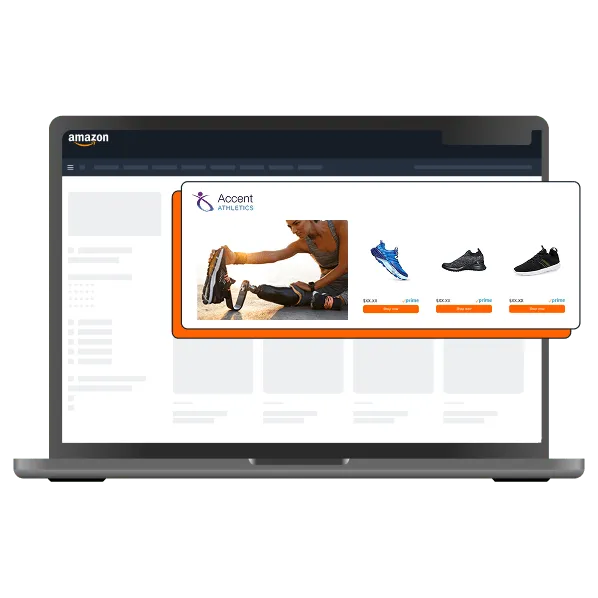
Ads appear inside streaming content. Amazon Ads describes placements within shows, livestreams, news-video apps and Twitch, and notes that CTV is commonly purchased programmatically, meaning through an automated system rather than a negotiated insertion order.
Why does that matter for a brand selling physical products? Three reasons:
- Attention. A full-screen, sound-on video in a lean-back setting is a different job from a sponsored search ad. It builds the awareness that later shows up as branded searches and marketplace conversions.
- Reach beyond linear TV. Amazon says CTV can expand reach beyond linear TV and measure new-to-brand customers and product-page visits, which is exactly what a marketplace brand wants to know.
- Connected data. When the buy is tied to retailer or first-party data, you can aim at shoppers who behave like buyers, not just viewers who match a demographic.
For brands that sell across Amazon, Walmart and their own site, CTV is also one of the few channels that can lift demand on all three at once. That is the reason to treat it as a demand-generation layer feeding your marketplace and DTC conversion work, not as a standalone branding experiment.
How CTV ads connect viewers to products
The classic problem with TV was the gap between seeing and buying. CTV narrows it in a few ways. Which one you choose depends on where you want the sale to happen.
Direct response paths
The simplest approach is giving viewers a way to act on a second screen. Common response paths are QR codes, promotional codes and a short, memorable URL. A QR code on the end card works well because the viewer already has a phone within reach. A unique discount code or landing URL per campaign also gives you a clean signal for attribution.
A product-led spot tends to perform better than a purely atmospheric one: show the product, show it in use, state what makes it different, and finish with one clear call to action.
Shoppable formats
Shoppable TV ads use embedded product links, so viewers can use the remote to open product details and shop or check out on the TV without reaching for another device. The most developed examples come from retailer partnerships. Roku and Walmart, for instance, describe a flow in which a viewer presses OK, stored payment details populate, and a second OK completes checkout on Walmart.
We cover the broader category in our guide to shoppable media and ecommerce sales growth. The takeaway for CTV planning: shoppable units shorten the path, but they only work when the product detail page behind them is ready. A weak listing wastes the click.
Marketplace-linked CTV
If most of your revenue runs through Amazon, buying CTV through the same ecosystem that holds your sales data gives you a tighter loop. Amazon notes that for brands selling on Amazon, new-to-brand customers and product-detail-page visits can connect exposure with shopping behavior. We go deeper on this in our post on Amazon streaming TV ads for brand growth.
Targeting shoppers, not just viewers
Targeting is where CTV earns its place in an ecommerce plan. The main audience types you will see:
- Retailer purchase data. Roku’s commerce media offering can target in-market shoppers using retailer first-party purchase data and purchase-based audiences, and measure purchases, site visits and in-store conversions.
- Retail media first-party audiences. Target’s Roundel describes a CTV offering built on first-party audiences from Target purchasers and loyalty-program behaviors, with reporting on category, brand and product sales plus new-purchaser insights.
- Your own data. Website retargeting and CRM lists, such as past purchasers or email subscribers, for upsell, replenishment and win-back.
- Lookalikes and interest or intent segments. Useful for prospecting when your first-party list is large enough to model from.
- Contextual and location signals. Helpful for seasonal or regional products.
A practical rule: favor signals based on what people buy and search for over broad demographics. Be careful not to stack so many filters that the audience becomes too small to deliver. A good first flight pairs one purchase-based prospecting audience with one retargeting or CRM audience, then widens or narrows based on delivery.
What CTV costs and what moves the price
Published CTV rates vary widely, and any single figure you read depends on the vendor’s inventory and service model. Rather than anchor on a number, understand the levers:
- Targeting precision. The tighter and more premium the audience, the higher the cost per thousand impressions.
- Inventory tier. Premium streaming content and live events cost more than remnant inventory.
- Buying method. In programmatic buying, as Amazon explains, an automated system optimizes prices and placements, and one CTV pricing process is based on video completion rate (VCR) and cost per completed view (CPCV).
- Creative and production. Spots that must be produced or adapted to 15- or 30-second formats add cost before a single impression runs.
- Seasonality. Q4 demand pushes prices up, so a brand that waits until November pays for the rush.
Because our work spans creative, retail media and analytics, we plan CTV budgets backward from the outcome: what incremental revenue and new customers the channel needs to deliver, and what the all-in cost of reaching them looks like once production and management are included. We do not publish CTV pricing, and we scope each program to the brand’s goals. Talk to us about programmatic and CTV if you want a plan built around your catalog.
Creative that works on the big screen
CTV creative is not a repurposed social clip. A few principles hold up:
- Lead with the product. In the first few seconds, the viewer should see what it is and why it matters.
- Show use, not just features. Demonstrations carry more weight on a large screen.
- Respect the specs. Common CTV requirements are MP4 files at 1920×1080, in 15- or 30-second lengths, with audio. Confirm the exact specs with your platform before production.
- One call to action. A QR code, a URL or a shoppable prompt, not all three at once.
- Version by moment. Roku’s holiday guidance recommends aligning creative and offers with shopping moments, shipping cutoffs, local availability and changing seasonal demand instead of leaving one message live for the whole flight.
Because the same footage can feed your CTV spots, Amazon listing videos, A+ content and brand store, shooting once with the full funnel in mind saves money. Our posts on the role of video in product listings and how videography drives ecommerce sales and customer trust show how that video asset can work across channels, and optimizing ad creatives for higher ROI covers testing.
Measuring CTV: beyond clicks
TV viewers rarely click. If you judge CTV by click-through conversions alone, it will look weak and you will cut the channel that was feeding everything else. Use layered measurement instead.
Delivery and attention metrics
Amazon identifies video completion rate, cost per completed view, reach and brand lift as core CTV measures. These tell you whether the ad was seen and whether the audience was the right one.
Shopping-behavior metrics
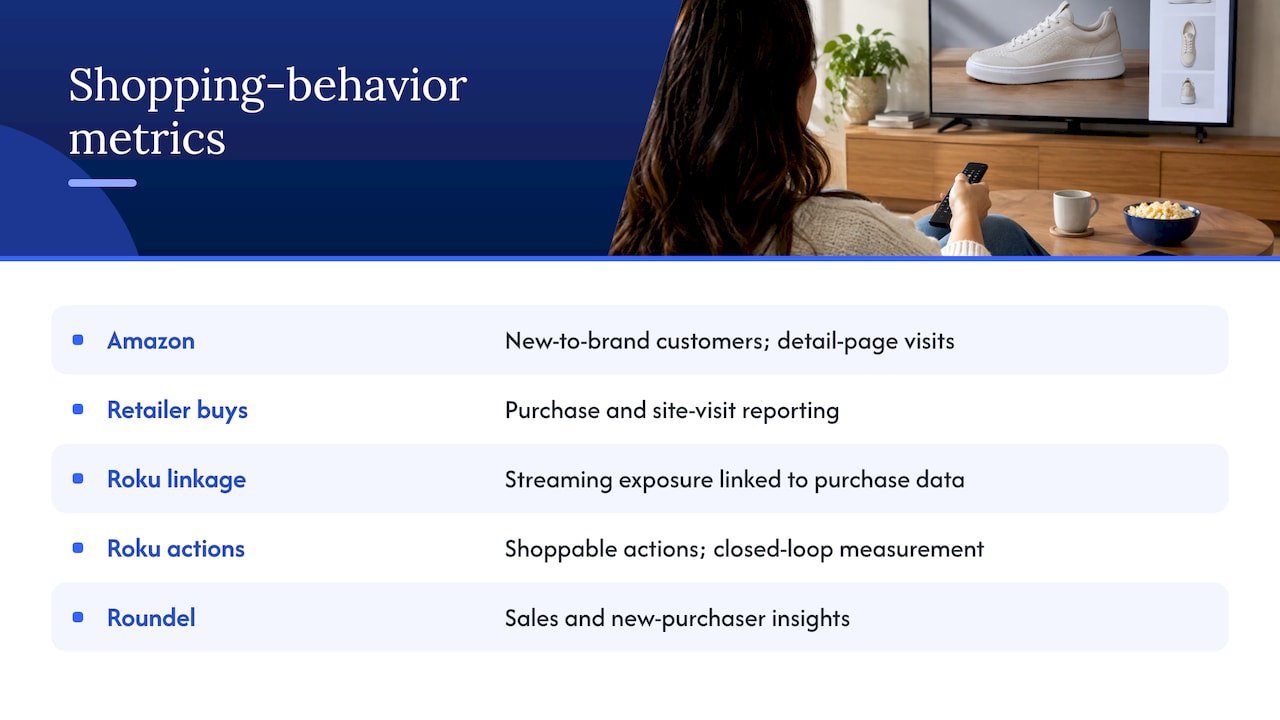
For brands selling on Amazon, track new-to-brand customers and product-detail-page visits. For retailer-connected buys, look at purchase and site-visit reporting. Roku’s commerce guidance describes connecting streaming exposure with retailer purchase data, shoppable actions and closed-loop measurement. Roundel’s offering similarly reports sales and new-purchaser insights.
Business-level signals
Look at the total picture around each flight:
- Immediate traffic spikes to your site or product pages.
- Halo effects on branded search, paid social and marketplace sponsored ads.
- Blended customer acquisition cost across channels.
- Incrementality: what sales would not have happened without the ads.
Incrementality is the hard one, and the one that earns budget. Holdout groups and geo tests separate real lift from customers who would have bought anyway. Our guide to retail media incrementality explains how to approach it, and unified reporting across marketplaces is what our iDerive analytics platform is built for.
A launch plan for your first CTV campaign
Give yourself runway. Target’s Roundel guide says most clients should allow at least six to ten weeks for a CTV campaign. Here is a sequence that fits inside that window.
- Define the outcome. New customers, marketplace sales lift, DTC revenue or replenishment. Choose one primary goal.
- Pick audiences and geography. Start with a purchase-based audience and one retargeting or CRM audience.
- Fix your landing destination. Whether it is a product page, brand store or DTC landing page, make sure content, reviews, inventory and pricing are strong before traffic arrives.
- Produce or adapt creative. Build to the platform’s specs and prepare at least two message variations.
- Set measurement before launch. Decide your KPIs, holdout design and reporting view in advance.
- Set budget, dates and frequency caps. Cap exposure per household so spend does not concentrate on a small group.
- Watch the first days closely. Check pacing, completion rate by placement and delivery early, and fix problems before they eat the budget.
- Test, then scale. Roku recommends testing messages and then scaling the strongest ideas.
If you are planning around the holidays, work backward from your peak shopping weeks, shipping cutoffs and inventory position. A CTV flight that drives demand to an out-of-stock listing is money lost.
Our perspective
We see the same pattern across brands: CTV gets judged on the wrong scoreboard. Teams expect a TV-sized awareness lift to show up as last-click sales, then conclude it did not work. In reality the lift lands in places a single dashboard misses: branded search, product-page visits, new-to-brand orders on Amazon, and conversion on Walmart and the brand’s own site.
That is why we treat CTV as one layer in a full-funnel plan. The creative has to be built with the listing in mind, the audiences have to come from purchase behavior, and the reporting has to be unified, so that a streaming impression and a marketplace order can be read in the same view. Our in-house studio and our iDerive platform exist for exactly this reason: creative and data should not live in separate silos.
We also take a profit-first view. A channel that adds reach but erodes margin is not growth. We would rather run a smaller, well-measured test, prove incrementality, and then scale, than spend a large budget on impressions nobody can tie to revenue.
Dan Katona
Where Nectar fits
CTV rarely succeeds as an isolated buy. It needs strong creative, clean listings, retail media running in parallel and reporting that connects them. We are a fully managed ecommerce agency for mid-market and enterprise brands selling on Amazon, Walmart and their own sites, and we handle those pieces together.
Our programmatic and CTV capability sits alongside our retail media advertising work, so streaming exposure and sponsored ads can be planned against the same goals.

If you want a CTV plan tied to your marketplace and DTC revenue, see our digital marketing and DTC growth services or start from our homepage to talk with the team.
FAQ
Is connected TV worth it for a brand that mainly sells on Amazon?
It can be, particularly when the brand wants to reach new customers beyond sponsored search. Amazon points to new-to-brand customers and product-page visits as measures that link CTV exposure to shopping behavior. Run it alongside strong listings and sponsored ads so the demand has somewhere to convert.
What is the difference between CTV and OTT?
OTT refers to video delivered over the internet rather than traditional cable or broadcast. CTV refers to the screen: internet-connected TVs and the devices that stream to them. In advertising, the two terms are often used together, and most OTT ads viewed on a television are CTV ads.
How long should a first CTV flight run?
Plan for several weeks of setup and a flight long enough to read results. Roundel’s guidance suggests allowing at least six to ten weeks for a campaign. Check pacing in the first days, then use a test-and-scale approach rather than judging results after a few days.
How do I know CTV is driving sales and not just reaching people who would have bought anyway?
Use incrementality testing, such as holdout audiences or geo splits, and compare against baseline sales. Also watch branded search, new-to-brand customers and blended acquisition cost. Click-based conversions alone will understate CTV’s contribution.
Can viewers buy directly from the TV?
Yes, in some formats. Shoppable CTV ads let viewers open product details and check out with the remote. Availability depends on the platform and retailer, so confirm what your target placements support.
Sources
- CTV advertising 101: How streaming TV ads work (Roku Advertising)
- What is connected TV? How CTV advertising works (Amazon Ads)
- How Roku and Walmart are building commerce for TV streaming
- Shoppable TV Explained (Shopify)
- Commerce media (Roku Advertising)
- CTV (Roundel, Target)
- Plan your holiday campaign now: A guide to streaming TV (Roku Advertising)
Recommended