Amazon battery compliance in the US now runs through an authorized third-party testing, inspection and certification (TIC) provider, not through documents you upload to Amazon yourself. If your catalog includes anything powered by a rechargeable lithium battery, or anything that contains or is designed to use a button or coin cell, you need the right test reports, a matching detail page and a clean evidence trail for each ASIN before a flag turns into a deactivation. Because the work cuts across product, sourcing, legal and catalog teams, brands with large catalogs are best served by managing it as an operations program. Our Marketplace Operations Management work covers catalog, inventory, forecasting and compliance for exactly this reason.
TL;DR
- Amazon’s new US lithium-battery requirements start on September 30, 2026 and cover listed products powered by rechargeable Li-Ion, LiPo or LiFePO4 batteries. Verification now goes through an Amazon-authorized TIC provider.
- Button and coin cells, and consumer products containing them, fall under a separate policy tied to federal rules (16 CFR Part 1263, ANSI/UL 4200A) and a General Certificate of Conformity (GCC).
- Non-compliant listings can be deactivated and stay down until compliant documentation clears the TIC process. Notifications arrive in your Account Health Dashboard.
- Detail pages need a model, part or item number and a manufacturer or brand name, and you need a current Certificate of Insurance on file.
- Treat it as a catalog-wide audit: map every ASIN to a battery type, a standard, a report and an owner.
What changed in 2026 and why it matters now
For years, battery compliance on Amazon meant uploading a test report or a certificate when Amazon asked for it. That model has ended. Amazon’s seller forum notice on the new US lithium-battery requirements says you no longer submit compliance documents directly to Amazon. You can send existing testing documents to an Amazon-authorized TIC provider for review, or the provider can run the testing for you.
The change came in stages. According to a 2026 industry report on the rollout, Amazon’s TIC direct verification began in September 2025 with children’s toys. By December 2025 it had expanded to portable power sources, electric transportation equipment and dietary supplements. On May 6, 2026 it was extended to all lithium battery products on the US and Canada sites. Sellers noticed it as “product safety issues” flags on individual ASINs.
For a brand with hundreds or thousands of SKUs, the practical effect is that compliance is no longer a one-off file. It is an ongoing status on every listing that touches a battery.
Which products are in scope
Start with the scoping question, because most compliance mistakes begin with a product nobody realized was covered.
Rechargeable lithium-battery products
Amazon’s new US requirements take effect starting September 30, 2026 and apply to the listed products powered by rechargeable Li-Ion, LiPo or LiFePO4 batteries. The notice also excludes certain battery types and devices, so read the list in the notice against your catalog rather than assuming a whole category is in or out.
Amazon’s separate lithium batteries policy update describes the broader policy scope: lithium batteries, replacement batteries that match a device’s original, single- and multi-cell packs in all formats for consumer or industrial use, rechargeable lithium batteries, and rechargeable lithium-ion coin or button cells. Lithium-ion batteries for e-mobility devices are excluded from that policy.
Button and coin cells, and products that contain them
Amazon’s button and coin battery policy covers standalone flat, round, single-cell batteries, typically 5 to 25 mm in diameter and 1 to 6 mm high, plus consumer products that incorporate them. Button batteries are often alkaline, silver oxide or zinc air at 1 to 5 volts. Coin batteries are lithium at 3 volts.
The part that catches brands off guard is the second half. Under the same policy, testing is required even if you do not supply the battery. Amazon’s example: an LED light with a button-cell remote must be tested even if the remote ships without the cell.
This follows the federal rules behind Reese’s Law, which aims to protect children from swallowing button cells. The CPSC explains in its button cell and coin battery business guidance that a covered battery is a single-cell battery with a diameter greater than its height, and that the packaging of the overall product must bear a warning. The requirements are codified at 16 CFR Part 1263.
A quick scoping exercise
Before anything else, pull a catalog export and tag each ASIN:
- Does the product contain a rechargeable lithium battery, or ship as a battery or power bank?
- Does it contain, or is it designed to use, a button or coin cell, including in a remote or accessory?
- Is it sold as a bundle where one component falls into either group?
- Is the battery shipped separately from the device?
Any yes goes on the compliance register. Bundles and multipacks are where gaps hide, because the parent ASIN may look harmless while a child variation carries the cell.
What documents and tests Amazon expects
The exact list depends on the product type. Here is what Amazon’s policy pages and the federal rules state.
Standalone button and coin batteries
Per Amazon’s policy for products with batteries, standalone button cell and coin batteries must be tested to and comply with:
- 16 CFR Part 1700.15, the poison prevention packaging standard
- 16 CFR Part 1700.20, the testing procedure for special packaging
- ANSI C18.3M, the safety standard for portable lithium primary cells and batteries
Consumer products containing button or coin cells
The same Amazon page requires compliance with 16 CFR Part 1263 and ANSI/UL 4200A. The CPSC’s Federal Register direct final rule determined that ANSI/UL 4200A-2023 meets Reese’s Law performance and labeling requirements for these products, and it granted a 180-day transitional enforcement-discretion period.
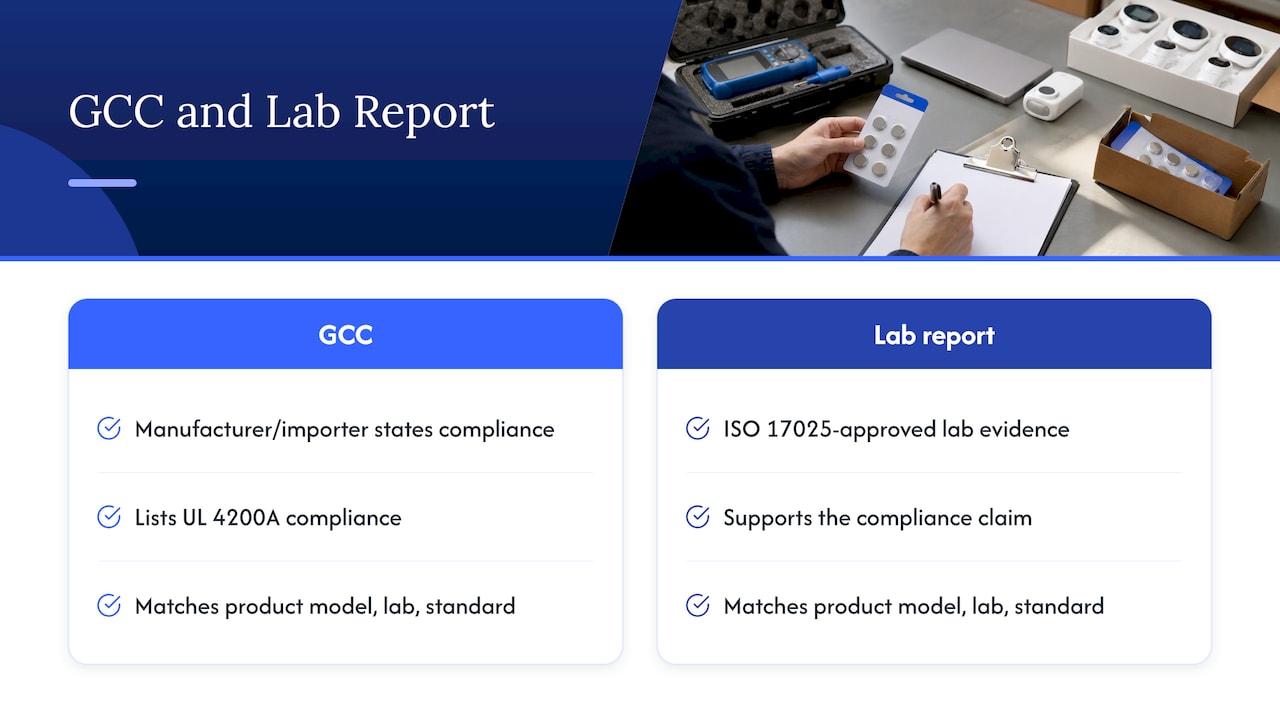
Amazon’s April 2024 notice extended these requirements from the batteries themselves to all consumer products containing button or coin cells. It asks for proof of UL 4200A compliance from an ISO 17025-approved lab and a General Certificate of Conformity that lists UL 4200A compliance. Listings are suppressed if valid documents are not provided.
In plain terms: a GCC is the certificate the manufacturer or importer issues stating the product meets the applicable federal rules. The lab report is the evidence behind it. The two must agree on product model, lab and standard.
Rechargeable lithium products
Standards vary by product. Typical US examples published by test labs include UL 2054 or UL/CSA 62133 for laptop and phone batteries, UL 2056 for power banks and UL 2743 for portable power packs and jump starters. Lithium batteries are also subject to UN 38.3 transport testing, and Amazon’s lithium battery shipping requirements state that lithium batteries are always subject to specific transport requirements and set approval limits by watt-hour rating for US shipments.
Your TIC provider will confirm which standard set applies to each product. What you need to bring is an accurate product description, battery specifications and the model numbers as they appear on the detail page.
Detail page and insurance requirements
Amazon’s September 30, 2026 notice also requires two housekeeping items that are easy to miss:
- Product detail pages must include a model, part or item number and a manufacturer or brand name.
- You must keep a current Certificate of Insurance (COI) through Business Insurance verification in Seller Central.
A missing model number is the cheapest compliance failure to fix, and one of the most common reasons a documented product still cannot be matched to its paperwork.
How TIC review works in practice
The flow is simple on paper:
- Amazon flags ASINs through the Account Health Dashboard. Notifications roll out in phases beginning September 30, 2026.
- You choose an Amazon-authorized TIC provider.
- If you already hold valid test reports, the provider reviews them. If not, the provider runs the testing.
- Once the product is verified, the listing can stay active or be reactivated.
Amazon states that non-compliant listings may be deactivated and will not be reactivated until compliant documentation is submitted through the TIC process. It also conducts periodic surveillance testing, so a passing report today is not a permanent pass.
Timelines vary. Seller discussion on the older button-battery compliance queue has put reviews at several weeks, so plan buffers into your launch calendar rather than starting at the moment of a flag. For the current process and any new deadlines, check the Account Health Dashboard and the Seller Central notice itself.
Where compliance files fail
Most rejections come from mismatches, not from a failed product. The patterns worth auditing for:
- Model mismatch. The report names one model, the detail page another, the GCC a third.
- Standard version drift. A report cites an older edition than the one currently required.
- Out-of-date reports. Amazon’s TIC process looks for recent lab reports from accredited labs; check the age of every report in your files against the TIC provider’s requirements.
- Missing transport testing. A product-safety report with no UN 38.3 for the battery.
- Half-covered products. Battery cell tested, finished appliance not. Amazon’s rules look at the whole product.
- Empty compartments. Products that ship without batteries but with a battery compartment are not automatically exempt.
- Incomplete GCC. Missing manufacturer or importer details, lab name, report number, signature or date.
The customs side matters too. The CPSC’s eFiling requirement for certificates of compliance means importers of products under CPSC rules, including button cell products, submit certificate data electronically before goods arrive. The CPSC has published its eFiling rule and guidance; check the CPSC’s site for the effective dates that apply to your product. Data in the filing has to match your lab report and GCC, which is another reason to keep one master record for each model.
Building a compliance register that scales
If you manage a large catalog, a spreadsheet of folders will not survive the next policy change. A workable register has one row per ASIN and these fields:
- Battery type (rechargeable lithium, button or coin cell, none)
- Battery or device model and manufacturer name as on the detail page
- Applicable standards and the lab report numbers
- Report issue date and the lab that issued it
- GCC status and date
- UN 38.3 status where relevant
- TIC verification status and date
- Responsible owner and next review date
Then sort by risk. Start with ASINs that already show a flag, then best sellers with batteries, then new launches in the pipeline, then long-tail items. A deactivated top-ten SKU costs far more than a deactivated tail item, and the sequence should reflect that.
Two rules keep the register honest. First, no listing change on a battery product ships without checking it against the register, because a title or model edit can break the match to the report. Second, any new supplier or factory change triggers a fresh review, since reports are tied to specific products and factories.
Working with your sourcing and legal teams
Compliance sits between teams that rarely speak the same language. Sourcing knows the factory, legal knows the certificate, the marketplace team knows the listing. The result is often that nobody owns the gap between them.
Assign a single owner for the register. Give sourcing a checklist for new products: battery specification sheet, factory name and address, model numbers, test plan. Give the marketplace team a rule that every battery ASIN carries a manufacturer name and model number. Give legal the GCC template and the standard list. For more on how this fits into marketplace operations more broadly, see our overview of marketplace compliance in US e-commerce, and our guide to fixing Amazon hazmat reviews, which often overlaps with battery products because lithium batteries are also dangerous goods in shipping.
How we approach this at Nectar
Battery compliance is a catalog and account operations problem as much as a testing problem. Our marketplace operations work covers catalog, inventory, forecasting and compliance, and our Seller Central management handles the day-to-day account work where flags, notifications and listing changes happen. For brands that need compliance managed alongside growth, Amazon Growth & Optimization keeps the listing, advertising and operations sides moving together instead of in separate queues.
If your team is staring at a stack of flagged ASINs and a launch calendar, talk to us through thinknectar.com.

Our perspective
Brands usually come to us after a flag lands on a best seller. By then the question is always the same: who owns this? The honest answer is that battery compliance has no natural owner inside most companies, which is why it turns into a scramble.
Our view is that compliance belongs inside marketplace operations, next to catalog and inventory, not in a legal inbox. The listing, the model number, the report and the certificate describe one product, and they need one team keeping them aligned. When the TIC process asks for a match between the detail page and the paperwork, the team that controls the detail page has to be in the room.
That is also why we pair operations with data. Our iDerive analytics platform gives brands one view across their marketplaces, so a suppressed or deactivated listing shows up as lost revenue in business language, not as a surprise at month end. Compliance then gets prioritized by what it costs to leave a product down.
A managed approach turns a policy change into a routine: audit, register, verify, monitor. That is what lets a brand keep launching products while the rules keep moving.
Dan Katona
FAQ
Do I still upload battery test reports to Amazon myself?
For the new US lithium-battery requirements, no. Amazon says you no longer submit compliance documents directly to it. You send existing test documents to an Amazon-authorized TIC provider for review, or the provider conducts the testing you need.
Does a product need testing if it ships without the battery?
For button and coin cells, yes in many cases. Amazon’s policy says testing is required even if you do not supply the battery, for example an LED light with a button-cell remote shipped without the cell. An empty battery compartment does not automatically exempt the product.
What happens if my listing is flagged?
You will see a notification in the Account Health Dashboard. Amazon states that non-compliant listings may be deactivated and stay down until compliant documentation is submitted through the TIC process. Start by checking that the detail page shows a model number and brand name, and that your reports match them.
Is UL 4200A a certificate I can buy?
No. UL 4200A is a safety standard that products are tested against. The compliance credential is the General Certificate of Conformity issued by the manufacturer or importer, supported by a lab report that shows the product meets the standard.
Do these rules apply outside the US?
The rules in this article are for Amazon’s US marketplace and US federal regulations. Other Amazon marketplaces have their own requirements, so check each marketplace’s policy pages before extending listings.
Sources
- Amazon Seller Central: New US lithium battery requirements
- Amazon Seller Central: Lithium batteries policy update
- Amazon Seller Central: Products with batteries
- Amazon Seller Central: Consumer products with button cell or coin batteries
- Amazon: Requirements for lithium batteries and products shipped with them
- CPSC: Button cell and coin battery business guidance
- Federal Register: CPSC direct final rule on ANSI/UL 4200A-2023
- HeyCross: Amazon TIC direct verification rollout
Recommended