Cosmetics sold on Amazon have to meet two sets of rules at once: the FDA’s labeling rules for the physical package, and Amazon’s own policies for the listing. The package needs the product identity, net quantity, responsible-party name and address, an ingredient list and any required warnings, all in English. The listing then has to tell the same story, with no drug claims and no implied FDA endorsement. Brands that treat these as one workflow avoid most suppressed listings.
This guide is written for brand and ecommerce managers at mid-market and enterprise companies. It covers what belongs on the label, where Amazon adds requirements, how claims can turn a cosmetic into a drug, and a checklist for keeping package and detail page in sync.
TL;DR
- FDA treats online sales as retail sales, so the same label rules apply to a product sold through Amazon as to one on a store shelf.
- Every package needs the product identity, net quantity, name and place of business of the responsible company, an ingredient declaration and any required warnings, in English.
- Amazon also checks the listing: it prohibits unsupported FDA-approval claims, FDA logos, certain disease claims and items marked tester or not for resale.
- Claims on your listing, ads and website can establish a product’s intended use, so copy and label must be reviewed together.
- Build one source-of-truth label file and compare it against the detail page before every launch and every reformulation.
The rules behind a compliant cosmetic label
FDA’s summary of cosmetics labeling says U.S. cosmetic labeling is governed mainly by the FD&C Act, the Fair Packaging and Labeling Act, and 21 CFR Parts 701 and 740. A label that is false or noncompliant can make the product misbranded, which exposes it to regulatory action.
That matters on Amazon because a cosmetic is only as compliant as its package. Amazon can ask for pictures of the item from all sides, so the label is what a reviewer sees first. If it is wrong, no amount of clean listing copy fixes it.
FDA’s guide adds a principle that runs through every requirement: required information must be prominent and conspicuous. Small type on a dark background, or a warning tucked behind a fold, can fail even when the words are correct.
What must appear on the package
At a minimum, FDA’s summary lists these items for a cosmetic sold to consumers:
- Product identity. A statement of what the product is, for example “body lotion” or “lip balm”.
- Net quantity of contents. An accurate amount, shown as its own item on the principal display panel.
- Name and place of business. The manufacturer, packer or distributor.
- Ingredient declaration. The retail ingredient list.
- Warnings and directions for safe use. Required where the product could be hazardous if misused.
FDA states that required statements must be prominent, conspicuous and in English. Amazon’s Seller Central guidance also calls for English-language labels and detail pages, so a bilingual package is fine as long as every required element appears in English.
Contact information for adverse events
A newer layer comes from the Modernization of Cosmetics Regulation Act. The U.S. Code provision on labeling, effective December 29, 2024, requires each cosmetic label to carry a domestic address, domestic phone number or electronic contact through which the responsible person can receive adverse-event reports. If your label still shows only a corporate address abroad, this is the first thing to fix.
Ingredients, net quantity and warnings in detail
These three elements cause the most rework, so they get their own treatment.
Ingredient lists
Under 21 CFR 701.3, ingredients must generally be identified by established or adopted names and listed in descending order of predominance. FDA’s summary notes exceptions for color additives, for ingredients present at 1% or less, and for approved confidential ingredients. The list must be conspicuous and readable.
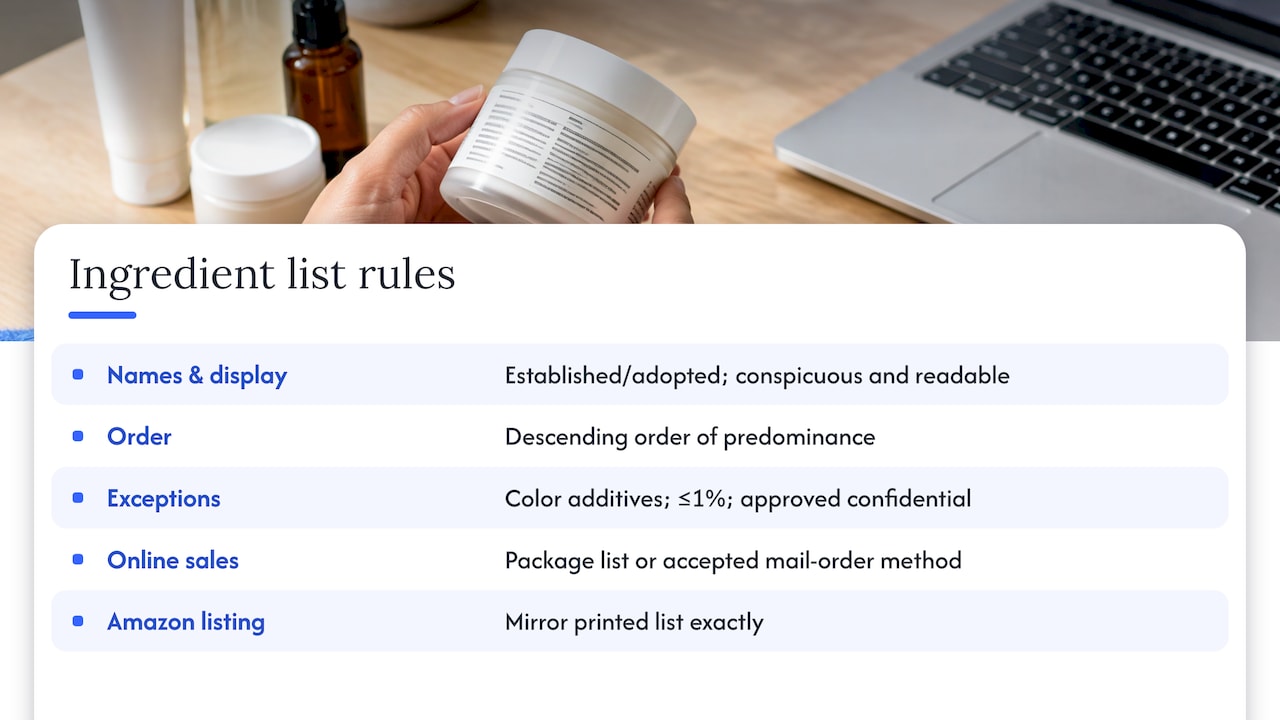
Online sales count too. FDA’s ingredient names page states that retail sales include online sales, so a cosmetic sold through Amazon generally needs an ingredient list on the package or an accepted mail-order method for finding or requesting it. For most brands the simplest path is to print the list on the package and mirror it exactly in the listing.
Why mirror it? Amazon lists the ingredient list among the key details for the label and detail page. A mismatch between the printed list and the one on the page is a common reason for a compliance case, and a reformulation that changes the package but not the page creates exactly that mismatch.
Net quantity
Under 21 CFR 701.13, net quantity is expressed by weight, fluid measure, numerical count, or an appropriate combination. Liquids generally use fluid measure. Solids, semisolids and viscous products generally use weight. FDA’s summary adds that it must appear as a distinct item on the principal display panel.
On Amazon, check that the size shown in the title, the variation attribute and the package all agree. A 4 fl oz tube listed as “4 oz” in the title looks minor, but it is an inconsistency a reviewer or a customer can flag.
Warnings
FDA’s guide says cosmetics that may be hazardous when misused need appropriate warnings and adequate directions for safe use. Three situations come up often:
- Unsubstantiated safety. 21 CFR Part 740 requires a conspicuous statement, “Warning—The safety of this product has not been determined,” when a cosmetic or ingredient lacks adequate safety substantiation before marketing, subject to the regulation’s exceptions.
- Self-pressurized containers. 21 CFR 740.11 specifies warnings for aerosols, including avoiding spraying in the eyes, pressure-related precautions, a 120°F storage limit and keeping the product out of children’s reach.
- Children’s products. FDA’s summary notes prescribed warnings for categories such as children’s bubble bath products.
Aerosol cosmetics also tend to draw Amazon’s dangerous goods questions, a separate review from labeling. Our walkthrough of the Amazon hazmat review fix covers how to clear that flag.
Where Amazon adds its own requirements
Amazon’s Seller Central guidance, as discussed in its seller forum on FDA labeling requirements, names the product name, purpose or use, contents, ingredient list and necessary warnings as key information for the English-language label and the detail page. The physical label also needs the name and address of the manufacturer, packer or distributor.
The same guidance lists several things Amazon prohibits:
- Claims that a product is FDA approved without support, and use of the FDA logo.
- Certain disease claims.
- Sale of items marked tester or not for resale.
When a listing is flagged and you open a case, Amazon recommends submitting evidence and pictures of the item from all sides, plus labels, instructions and packaging. Keep high-resolution label shots from every angle in your asset library so you are not photographing product under deadline.
Those same images serve the listing. Amazon’s image rules and your label work overlap, which is why our Amazon image requirements checklist is a useful companion when you shoot back-of-pack and ingredient panels.
When claims turn a cosmetic into a drug
This is the area where listing copy, not the package, usually causes trouble. Amazon warns against disease claims unless the statement is approved by FDA and the product is properly labeled as both a cosmetic and a drug.
Intended use is the test. FDA materials presented to the Cosmetic Ingredient Review say intended use can be established through claims on labels, advertising, websites and other promotional material, as well as ingredients with recognized therapeutic uses and consumer perception. In practice, that means a bullet point, an A+ module, a sponsored ad headline or a social post can all count.
A practical way to review copy:
- Appearance and cleansing language (smooths the look of skin, cleanses, moisturizes) describes cosmetic effects.
- Language about treating or preventing a condition, or changing how the body functions, moves toward drug territory and needs regulatory review before it goes live.
Skin-lightening, acne, hair-loss and sun-related products deserve a regulatory read every time. If a claim might be a drug claim, take it to your regulatory counsel before it reaches the page. The same logic applies to related claim categories: our guide to Amazon pesticide claims shows how a single word in a listing can trigger a compliance flag that has to be cleared with documentation.
Who is responsible: registration, listing and adverse events
Brands often ask whether they need FDA approval to sell cosmetics on Amazon. Cosmetic products and ingredients, other than color additives, do not go through FDA premarket approval, but the labeling and safety rules above still apply, and MoCRA added registration and listing duties.
A Morgan Lewis summary of FDA’s MoCRA framework explains that cosmetic facilities manufacturing or processing products for U.S. distribution generally face biennial registration requirements, while facilities limited to labeling, packaging, holding or distribution are excluded from the facility definition described there. The same summary reports that the responsible person, generally the manufacturer, packer or distributor named on the label, must submit product listings to FDA and report serious adverse events within 15 business days of receiving the information. It also states that FDA delayed enforcement of registration and listing until July 1, 2024. That grace period has since ended.
Two takeaways for Amazon brands:
- The name on your label determines who the responsible person is. Make sure the entity printed there is the one that owns these obligations.
- The contact on the label is not decoration. It is the channel for adverse-event reports, so route it to a monitored inbox or phone line.
Because these obligations can change, confirm current requirements on FDA’s cosmetics pages and with regulatory counsel.
A checklist to keep label and listing aligned
Most compliance problems we see in beauty categories are not exotic. They are drift: the package changes and the page does not, or the page gets a punchy claim the label never supported. Run this sequence for every SKU.
- Build a label master. One approved file per SKU with identity statement, net quantity, ingredient list, warnings, responsible-party name and address, and contact for adverse events.
- Check the physical label against FDA’s elements. Identity, net quantity as a distinct item on the principal display panel, ingredient order, English text, conspicuous placement.
- Copy the ingredient list verbatim into the listing. Same order, same names. Re-check after every reformulation.
- Match size and count everywhere. Title, variation attributes, images and package should agree.
- Audit every claim. Review bullets, description, A+ content, brand store, ads and off-Amazon pages for disease or treatment language and FDA-endorsement wording.
- Remove prohibited marks. No FDA logo, no “FDA approved” wording without support, no tester or not-for-resale markings on units you sell.
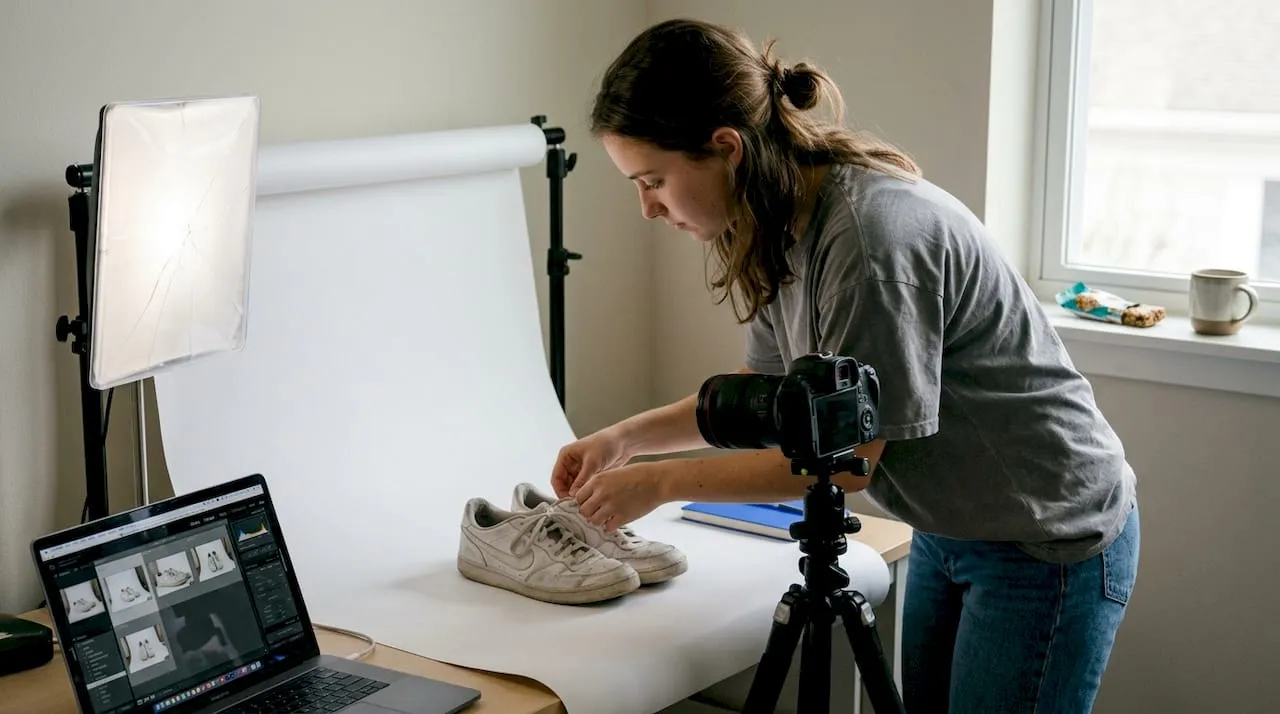
- Photograph the label. Capture every panel in high resolution for both the image stack and any future case with Amazon.
- Check hazard categories. Aerosols, flammables and similar products may trigger separate dangerous goods review.
- Document and date. Keep the label version, listing version and claim approvals together so you can answer a case quickly.
Keep the page discoverable while you tighten it
Compliance edits should not cost you search visibility. When you rewrite titles and bullets to remove risky claims, keep the shopper’s search terms in place. Knowing Amazon SEO fundamentals helps teams see which terms to protect, and our step-by-step content optimization guide shows how to rebuild a listing around compliant language. If catalog rejections are part of the picture, the GTIN exemption guide covers the brand-matching and photo requirements that often come up alongside label reviews.
Our perspective
Cosmetic compliance on Amazon fails at the seams between teams. Regulatory signs off on a label, creative produces images, a content team writes bullets, an ads team writes headlines, and nobody owns the comparison of all four. The result is a page that says something the package does not support.
We run it as one workflow. Our marketplace operations team treats the catalog as a controlled record: ingredient lists, sizes and claims live in one place, and every listing, A+ module and ad is checked against it. Our in-house creative studio shoots label panels and builds PDP and A+ content from that same approved file, so the images a shopper sees and the text a reviewer reads are consistent.
We also think compliance and conversion work together. A listing that is clear about what the product is, what is in it and how to use it removes friction for the shopper and removes reasons for a flag. Our iDerive analytics platform lets us watch what happens after a listing change, so a claim rewrite is measured against conversion and not guessed at.
Claim decisions are legal decisions, and your regulatory counsel should make them. Our job is to make sure the decision they make shows up everywhere your product is sold, every time.
Dan Katona
Get the listing and the label working together
If your beauty catalog has more SKUs than any one person can audit, we can help. Nectar is a fully managed ecommerce agency for mid-market and enterprise brands on Amazon, Walmart and Shopify, combining marketplace operations, creative production and advertising under one team.
To see how we handle catalog quality, content and growth on Amazon, start with our Amazon Growth & Optimization service.

If the gap is on the creative side, such as ingredient panels, A+ modules and brand stores, our Creative & Content Production team builds them from your approved label file.
FAQ
Does my cosmetic need FDA approval before I sell it on Amazon?
FDA does not approve most cosmetic products before sale, so you do not apply for approval. You are still responsible for labeling that follows the FD&C Act, the Fair Packaging and Labeling Act and FDA’s regulations. Under MoCRA, the responsible person also has listing and adverse-event duties, so confirm current requirements with regulatory counsel.
Can I say my product is FDA approved or use the FDA logo on my listing?
No. Amazon’s guidance prohibits unsupported FDA-approval claims and use of the FDA logo. If you want to describe your regulatory standing, keep to factual statements your counsel has reviewed rather than implying endorsement.
Do I need an ingredient list if customers only buy online?
Yes, generally. FDA’s guidance treats online sales as retail sales, so the ingredient declaration requirement applies, either on the package or through an accepted mail-order method. Printing it on the package and matching it in the listing is the simplest approach.
What happens if my claims sound like a drug claim?
Amazon warns against disease claims unless FDA has approved the statement and the product is labeled as both a cosmetic and a drug. FDA also looks at labels, advertising and websites to judge intended use. Have regulatory counsel review treatment or prevention language before it goes live.
What should I send Amazon if my cosmetics listing is flagged?
Amazon recommends evidence and pictures of the item from all sides, plus labels, instructions and packaging. Keep high-resolution photos of every panel and a dated record of the label version so you can respond quickly.
Sources
- Summary of Cosmetics Labeling Requirements | FDA
- Cosmetics Labeling Guide | FDA
- Cosmetic Ingredient Names | FDA
- 21 U.S.C. § 364e: Labeling
- eCFR: 21 CFR Part 701, Cosmetic Labeling
- eCFR: 21 CFR Part 740 Subpart B, Warning Statements
- Amazon Seller Central forum: FDA’s labeling requirements
- Is It a Cosmetic, a Drug, or Both? (Or Is It Soap?) | FDA
- FDA’s views on cosmetics vs. drugs, Cosmetic Ingredient Review
- Register, List, Report, Repeat: FDA Clarifies MoCRA Requirements | Morgan Lewis
Recommended