Walmart DSP earns a spot in your full-funnel retail media mix because it extends Walmart’s first-party purchase signals offsite and measures results against real sales, not modeled proxies. That is the whole argument in one sentence, and it works for any brand with meaningful Walmart sales volume already flowing through Sponsored Search. Three moves this week: check your audience eligibility and trailing sales volume in the Walmart Connect portal, request your first custom audience build in the Asset Library, and launch a 6 to 8 week prospecting-plus-retargeting test tied to one KPI, not five.
Pro Tip: Resist the urge to launch five audiences and three creative formats simultaneously in week one. A single clean test beats a messy portfolio every time you’re trying to read results in week six.
Key Takeaways
A working Walmart DSP strategy requires full-funnel campaign architecture, purchase-tied audience targeting, and closed-loop measurement normalized against your other retail media channels.
PointDetailsVerify eligibility firstConfirm your Walmart sales volume and audience eligibility before requesting builds.Structure by funnel stageSplit budget roughly 40 to 50% awareness, 30% mid-funnel, 20 to 30% conversion.Build audiences earlyCustom audience builds take about two business days in the Asset Library.Normalize attributionAlign lookback windows and attribution models before comparing Walmart to other platforms.Consider managed supportNectar manages full-funnel Walmart DSP campaigns paired with iDerive analytics for unified reporting.
Why a Walmart DSP Strategy Beats Generic Programmatic
Walmart DSP runs on closed-loop measurement tied to actual purchase data, not third-party cookie modeling or lookalike guesswork. That single difference changes which optimization levers actually move revenue, because you’re bidding against verified buying behavior instead of inferred intent.
[Walmart Connect reaches roughly 90% of U.S. households](https://corporate.walmart.com/news/2022/03/30/walmart-connect-building-meaningful-shopping-experiences-between-suppliers-our-customers) and ties online exposure to more than 10,000 physical store locations. That scale means your offsite CTV and display spend can be measured against in-club purchases, not just web conversions.
Compare that to a generic DSP:
Building Your Full-Funnel Campaign Architecture
Structure Walmart DSP the way you’d structure any performance channel: by funnel stage, not by tactic. Awareness campaigns run CTV and display prospecting against broad personas. Mid-funnel work carries video and retargeting toward shoppers who engaged but didn’t convert. Bottom-funnel campaigns retarget cart abandoners and recent site visitors, judged strictly on ROAS or CPA.
Keep naming consistent across DSP and Sponsored Search so reporting doesn’t fragment:
A campaign named AWR_Lookalike-Top10_CTV-Q1 tells anyone on your team exactly what it is without opening the platform.
For an initial test, a workable budget split looks like:
Run it for a minimum of 6 to 8 weeks with enough spend to clear at least one full purchase cycle for your category before judging results.
Which Walmart Audiences Should You Target First?
Walmart Connect gives you five real audience levers: pre-built personas, historical buyer segments, rule-based custom audiences, propensity-based predictive segments, and customer-file matching for your own CRM data. Each fits a different funnel stage, and mixing them up wastes budget fast.
Pre-built behavioral segments like recent buyers and lapsed buyers refresh on cycles ranging from weekly to monthly, which makes them useful for quick-turn re-engagement pushes. Custom audiences, by contrast, are rule-based on purchase frequency, browse behavior, and ad exposure, and typically take about two business days to build in the Asset Library.
Two recipes worth testing first:
Operationally, once an audience finishes building, you attach it directly to an ad group inside the campaign structure you set up earlier. Always suppress recent purchasers from prospecting audiences. Retargeting someone who bought yesterday burns impressions for zero incremental lift.
What Creative Formats Actually Perform on Walmart DSP
Walmart DSP supports CTV and streaming video, 15 to 30 second video cutdowns, mobile video, rich display, and product-set creative built around bundles or multi-SKU promotions. Match format to funnel stage: CTV and long-form video for awareness, shorter cutdowns for mid-funnel retargeting, and rich display with clear pricing and availability signals for conversion.
Test creative against audience in pairs, not in isolation, and don’t call a winner until each cell has cleared a meaningful impression threshold. Judging creative on a few hundred impressions is how teams end up optimizing toward noise.
Pro Tip: Pull your best-performing Sponsored Search product images into DSP display creative. Shoppers already respond to that visual; recycling it saves a production cycle.
How Do You Measure Walmart DSP Performance Accurately?
Use Walmart’s multi-touch attribution model, backed by Luminate and Scintilla clean-room data, to tie DSP exposure directly to onsite, offsite, and in-club sales. Track ROAS, sales lift, new-to-brand rate, and in-club conversion share as your core KPI set, not just click-through rate.
Because retail media vendors implement closed-loop attribution differently, comparing Walmart performance against Amazon or Instacart numbers requires normalization first. Pick one attribution model, generally linear MTA, align lookback windows across platforms, and standardize whether you’re counting view-through or click-through conversions before you put numbers side by side.
Before trusting any lift number, run through this checklist:
Scaling With PMPs, Offsite Data, and In-Club Ads
Once your core prospecting and retargeting engine proves out, three tactics unlock more scale without diluting performance.
Private marketplace deals make sense once you need guaranteed placement on premium CTV inventory or you’re running high-frequency campaigns where open-auction competition drives up cost. Negotiate PMP terms around minimum spend commitments and inventory quality guarantees before locking in.
Walmart Connect’s data enablement partnerships now let advertisers activate Walmart first-party audiences inside other DSPs, including early integrations with Yahoo DSP and Magnite supply. That simplifies workflows for teams already running significant spend on external platforms.
In-club and in-store activations round things out:
Optimization Rules That Protect ROAS While You Scale
Every test needs a hypothesis, a defined cell structure, one primary KPI, and a minimum impression or conversion threshold before you touch it. Review results on a fixed cadence, weekly for pacing, monthly for strategic shifts, not whenever a number looks interesting.
Scale spend only when lift is confirmed against control, and watch frequency caps closely as budgets grow; oversaturating a shrinking audience tanks efficiency fast. A simple decision tree helps: if ROAS holds steady as you increase budget, keep scaling; if it dips, pull back and diagnose audience fatigue before assuming the format failed.
Should You Run Walmart DSP In-House or Hire an Agency?
Keeping Walmart DSP in-house makes sense once you have real transaction volume, a team that can build and interpret clean-room data, and staff dedicated to programmatic and creative operations, not split across five other channels. Below that threshold, the learning curve costs more than it saves.
A managed partner brings audience engineering experience, PMP negotiation leverage, in-house creative production, and a process for feeding Luminate measurement into a unified reporting stack. Nectar manages Walmart Connect and DSP campaigns for mid-market and enterprise brands specifically around this full-funnel structure.
Pro Tip: If your team is stretched thin managing Sponsored Search alone, adding DSP without dedicated bandwidth usually means the higher-effort channel gets the least attention, which defeats the purpose of running it at all.
What we see working for U.S. brands
The strongest results we’ve seen pair CTV prospecting with purchase-tied retargeting, run as one connected funnel instead of two separate budgets. Try syncing your next CTV flight with a retargeting audience built from that same campaign’s site visitors.

How Nectar Runs Walmart DSP for Growing Brands
Nectar manages Walmart Connect and DSP campaigns end to end for mid-market and enterprise brands, pairing audience strategy and creative production with iDerive, our proprietary analytics platform that unifies Luminate outputs with your other retail media data.

If you’re already running meaningful Walmart sales volume but your DSP spend feels disconnected from Sponsored Search, that’s usually a structural problem, not a budget one. Nectar’s team can audit your current setup and scope a pilot test built around a single funnel stage and KPI, so you see incremental results before committing to a broader engagement. Visit Nectar’s Walmart solutions page to request an audit and pilot proposal.
Frequently Asked Questions
Yes, when treated as a complement rather than a replacement. DSP creates and influences demand offsite, while Sponsored Search captures the closer-to-purchase intent that follows.
Custom rule-based audiences generally take about two business days to build in the Asset Library, though pre-built behavioral segments are available immediately.
Plan for 6 to 8 weeks minimum, long enough to clear a full purchase cycle for most categories and gather a sample size that supports a real lift comparison.
Walmart Connect’s data enablement partnerships now support activating Walmart first-party audiences through select external platforms, reducing the need to duplicate audience-building work.
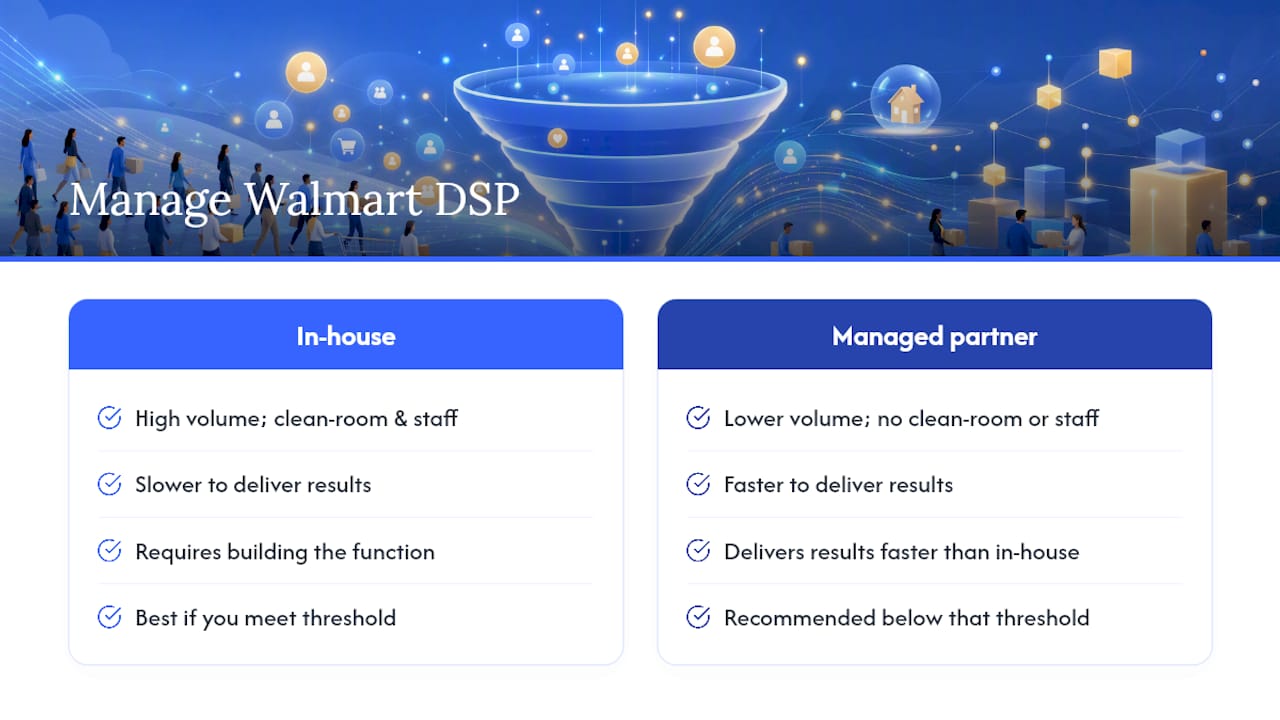
It depends on transaction volume, clean-room data capability, and whether you have dedicated programmatic staff. Below that threshold, a managed partner like Nectar typically delivers results faster than building the function from scratch.
Sources
Save these for onboarding new team members or briefing an agency partner.
Recommended





























































.webp)