Constructor and Algolia both power search and product discovery on ecommerce sites, but they ask different things of your team. Algolia is a hosted search platform you build on through APIs, with controls you tune yourself. Constructor is a product-discovery platform whose ranking learns from shopper behavior across the site. For a mid-market or enterprise brand with a physical-product catalog, the better pick depends less on a feature checklist than on three things: how clean your catalog data is, who will run merchandising week to week, and how you will prove that search moved revenue.
That last point is where most evaluations stall. A search engine ranks what you feed it and learns from the traffic you send it. The brands that get the most from either tool treat search as one part of a wider D2C growth system: product content, paid traffic, conversion work and measurement all feeding the same results.
TL;DR
- Algolia is an API-first platform: you index records, build the search interface and tune relevance, with a public pricing page that starts at $0 per month and scales with usage.
- Constructor emphasizes behavior-driven ranking: its documentation says clicks, cart additions, purchases and returns can inform results, plus merchandising rules to boost, bury or pin products.
- Algolia’s own comparison page calls Constructor’s AI a black box. That is a competitor’s claim, so weigh it as a talking point, not a verdict.
- Whichever you choose, results depend on catalog data quality, event tracking and a measurement plan that isolates search’s contribution to revenue.
- Settle ownership first: who maintains the catalog, who merchandises, and who reports on incremental lift.
What each platform is
Algolia
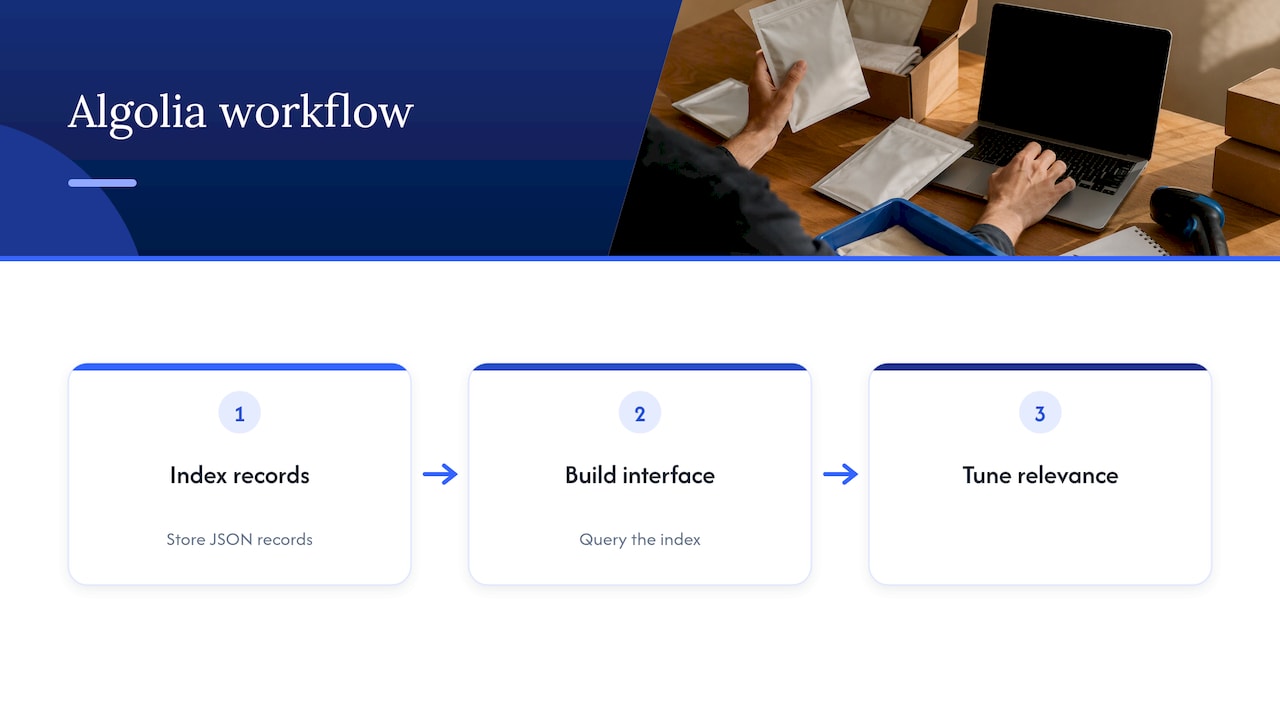
Algolia describes itself as a hosted AI search and retrieval platform. According to its getting-started documentation, you store data as JSON records, query them through APIs and client or UI libraries, and combine keyword, vector and hybrid retrieval. The same documentation covers relevance settings, filters, merchandising, analytics and A/B testing. The workflow it lays out is simple: index your records, build a search interface that queries the index, then tune relevance.
Algolia says its platform serves search, generative AI, agentic commerce and merchandising use cases, and reports more than 18,000 customers across 150+ countries.
Constructor
Constructor positions itself around ecommerce product discovery. Its documentation on how results are ranked says ranking uses shopper behavioral and contextual signals and applies what it learns across discovery touchpoints such as search and browse. It lists clicks, visits, cart additions and removals, purchases and returns as signals that can inform rankings.
The practical difference in philosophy: Algolia hands you a powerful toolkit and expects your developers and merchandisers to shape the experience. Constructor leans on learning from shopper behavior and layers merchandiser controls on top.

How they compare on relevance and merchandising
For a physical-product catalog, relevance is not abstract. It decides whether a shopper typing “waterproof trail shoe” sees the right ten products or a random mix of socks and gift cards.
Behavior-driven ranking
Both platforms use behavioral data. Algolia’s documentation says click and conversion events provide the behavioral data behind Personalization, Dynamic Re-Ranking and most Recommend models. That means you need to send events correctly from the storefront. Constructor’s documentation similarly points to shopper actions as ranking inputs. In both cases, poor event tracking quietly degrades results. If your store’s analytics are not clean, fix that before you compare vendors; our guide to Shopify GA4 tracking for enterprise stores covers the events and QA that this kind of work depends on.
Merchandising controls
Constructor’s documentation says merchandising rules can boost or bury products by attributes such as brand, category and price, or pin products to specific positions on search and browse pages. Algolia also offers merchandising, and its pricing page separates tiers by capability: Grow is described as keyword search plus browse, while Grow Plus adds AI synonyms, AI ranking, advanced personalization, query categorization and collections.
For a brand team, the question is not whether rules exist. It is who writes them. A merchandising rule that pins your new launch to position one is only as good as the launch strategy behind it, and the product data that lets the rule target the right items.
The transparency argument
Algolia’s comparison page argues that Algolia offers more control and transparency than Constructor and describes Constructor’s AI as a black box that can be hard to understand and optimize. Treat that as what it is: one vendor’s positioning against another. The useful takeaway is the question behind it. How much do you want to see and adjust in the ranking logic, versus how much do you want the system to learn on its own? Teams with strong in-house engineering and merchandising often want the first. Lean teams often prefer the second.
Integration and implementation work
Neither platform is a plugin you switch on. Expect a real implementation project.
Algolia’s documentation on sending events lists Adobe Commerce and Magento Open Source, BigCommerce, Salesforce B2C Commerce and Shopify for ecommerce event transmission, and notes that headless setups can send events from the frontend or the server side.
If you run Salesforce B2C Commerce, the detail gets specific:
- Products can be indexed as variant records, base-product records or attribute-sliced records, with separate locale-specific product and category indices.
- Scheduled indexing handles normal synchronization, while an optional real-time inventory feature adds post-checkout updates for high-velocity stores. It complements bulk jobs rather than replacing them.
- For buy online, pick up in-store, Algolia’s BOPIS documentation requires Search & Discovery cartridge 25.3.0 or later plus Salesforce’s plugin_instorepickup cartridge.
The lesson for brand and ecommerce leads: how you model variants (size, color, pack count) in the index changes what shoppers see. A shopper searching “navy” should not see six identical tiles for the same jacket, and your team needs a deliberate decision about that before developers build anything.
What each costs
Algolia publishes its structure. Per its pricing pages:
- Free plan: 10,000 search requests per month, 50,000 records, 5,000 recommendation requests and 5,000 crawls per month.
- Grow: 10,000 monthly search requests and 100,000 records included, then $0.50 per additional 1,000 requests and $0.40 per additional 1,000 records. It is billed monthly with no contract required.
- Grow Plus: the same included allowances, but additional requests run $1.75 per 1,000, with records still at $0.40 per 1,000.
- Elevate: annual contract, volume discounts, NeuralSearch included, quote-based.
A cost detail that matters for catalogs: Algolia’s pricing FAQ explains that records are counted across indices and pre-sorted copies increase record totals. If you offer several sort orders such as price low to high, newest and best selling, your record count can grow faster than your product count. Algolia also notes that the estimates on its page are directional, not binding quotes.
For an enterprise catalog with heavy seasonal traffic, usage-based pricing means search cost moves with demand. Model your peak month, not your average one, and ask each vendor for a written quote against the same catalog size and traffic assumptions so the comparison is apples to apples.
A decision framework for your team
Use these questions in order. They matter more than any feature grid.
- Who owns the build? If you have developers who want API-level control and are comfortable shaping the index and interface, Algolia’s model fits. If you want the ranking to learn from behavior with less hand-tuning, Constructor’s approach is built around that.
- Who merchandises day to day? Rules, pins and boosts need an owner. Someone must decide what the site promotes and keep that aligned with inventory, promotions and ad campaigns.
- How clean is your catalog? Titles, attributes, variants and images drive both filtering and relevance. Thin or inconsistent attributes produce weak results in any engine.
- Can you send reliable events? Behavioral ranking needs accurate clicks, add-to-carts and purchases. Test this in staging before launch.
- How will you measure impact? Search sessions convert at different rates than other sessions, so a naive before-and-after comparison misleads. Decide up front how you will isolate incremental lift, ideally with a holdout or A/B test.
- What is your peak-season cost? Price the platform at your highest traffic month, including pre-sorted copies and extra locales.
What decides results beyond the engine
Brands often expect the search vendor to fix conversion. In practice, three things sit outside the search box and shape what it can do.
Product content and data
Search can only match what your listings say. Strong titles, complete attributes and clear imagery help shoppers find and trust a product. The same content discipline that helps a listing perform on a marketplace helps your owned site; our step-by-step content optimization guide walks through it. Shoppers’ language matters too: keyword research shows you the terms people actually use, which feed synonyms and query rules in either platform.
Traffic and intent
Search quality is judged on the traffic you send. Paid social, search and email bring shoppers with different intent, and onsite search behavior differs by source. Aligning campaigns with what the site can serve, including what is in stock and what is promoted, avoids sending paid clicks to empty result pages.
Measurement you trust
The hardest part of any search project is proving it paid off. You need unified data across your site, your marketplaces and your advertising, and a method for separating lift caused by search from lift caused by a promotion or a seasonal peak. Without that, a vendor’s reported conversion gains are impossible to verify against your own numbers.
Our perspective
We talk to brand and ecommerce leads who are choosing between search platforms, and the pattern is consistent: the evaluation focuses on the engine, while the outcome is decided by everything around it.
Our view is that a brand’s D2C site, its Amazon and Walmart listings and its advertising should be run as one system. The same product title, image set and attribute data shape how a shopper finds you on a marketplace, in a paid ad and in your own search box. When that data is consistent, whichever search platform you pick has better material to work with.
That is why we built iDerive, our analytics platform, around unified reporting and incrementality measurement. The question we want every client to be able to answer is not “did conversion go up?” but “what did this change add that would not have happened anyway?” Search is one more lever to test that way.
Pair that with creative and content produced in-house, and with digital marketing and conversion work managed alongside it, and a site search project stops being an isolated IT purchase. It becomes one part of a growth plan with one set of numbers.
Dan Katona
Where Nectar fits
If you are weighing search platforms for a D2C site while also running Amazon and Walmart, the work around the search box is where we help. We are a fully managed ecommerce agency for mid-market and enterprise brands, covering digital marketing and DTC growth, conversion rate optimization, in-house creative and product content, and marketplace management. Our iDerive analytics platform brings your data into one place and supports incrementality measurement, so you can judge any change to your site against your real numbers.

To talk through your catalog, channels and goals, start at thinknectar.com.
FAQ
Is Algolia or Constructor better for ecommerce?
Neither wins in every case. Algolia suits teams that want API-level control, a public pricing structure and hands-on tuning. Constructor suits teams that want ranking driven by shopper behavior across search and browse, with merchandising rules on top. Match the choice to your team’s engineering capacity, merchandising workflow and catalog complexity.
Does Algolia publish its pricing?
Yes. Its pricing pages list a Free plan, Grow and Grow Plus with usage-based overages, and a quote-based Elevate tier on an annual contract. Grow is billed monthly with no contract. Estimates on the page are directional rather than binding, so request a written quote for your catalog and traffic.
What data do these platforms need to rank products well?
A clean catalog with consistent titles, attributes and variants, plus behavioral events such as clicks, add-to-carts and purchases. Algolia’s documentation says those events feed Personalization, Dynamic Re-Ranking and most Recommend models, and Constructor’s documentation lists similar shopper signals. Accurate event tracking comes before everything else.
How do I know whether a search platform improved revenue?
Compare against a control. Run an A/B test or holdout so you can separate the effect of search from promotions, seasonality and ad spend. Use one reporting source across channels, so the lift you report matches the revenue your finance team sees.
Sources
- Get started with Algolia
- Algolia: Agentic. Generative. Search.
- Results ranking at Constructor
- Algolia pricing
- Algolia Grow plan pricing
- Algolia Elevate pricing
- Algolia vs Constructor comparison page
- Choose how to send events
- Indexing attributes for Salesforce B2C Commerce
- Real-time inventory updates
- Buy online, pick up in-store (BOPIS)
Recommended