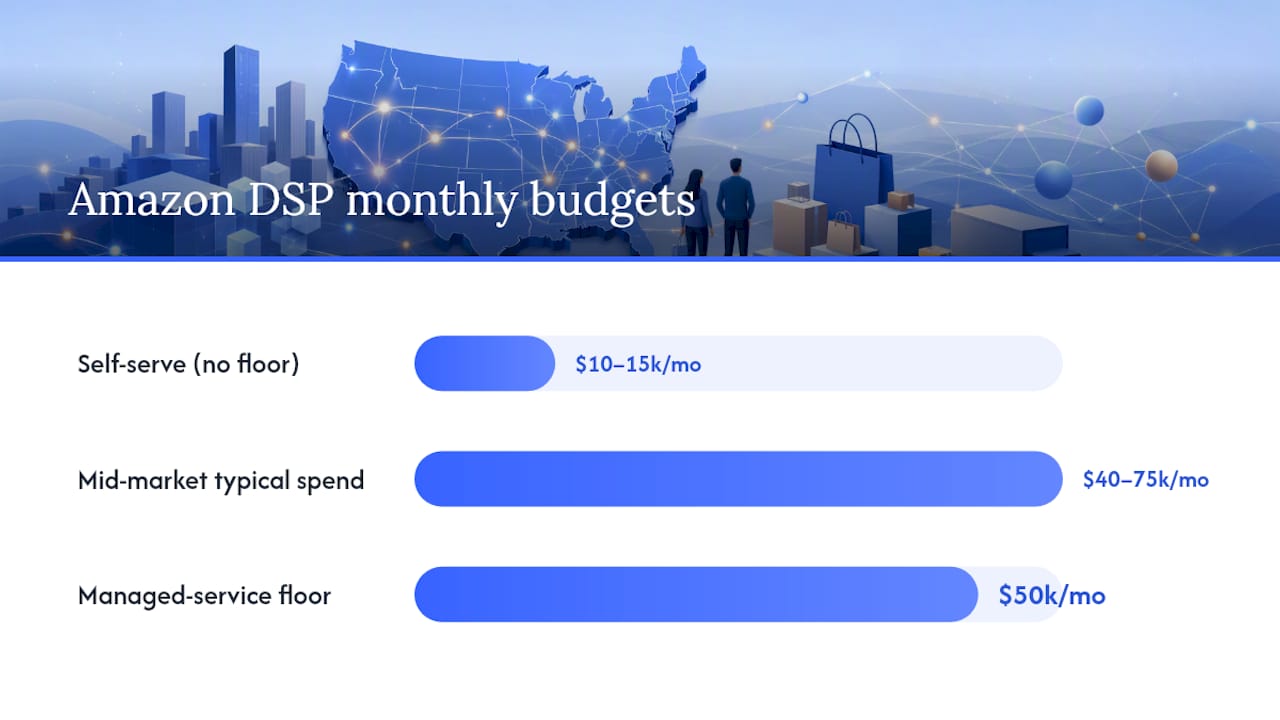
Amazon DSP’s managed-service option typically carries a minimum spend in the tens of thousands of dollars per month in the U.S., while self-service no longer has an Amazon-imposed floor following the platform’s unBoxed 2025 update. That split matters enormously for how you plan your programmatic budget.
Amazon’s managed-service DSP minimum spend in the United States is generally considered significant, per Amazon Ads documentation. Minimums may vary by country and ad format.
When advertisers talk about an Amazon DSP minimum spend, “minimum” can mean a few different things depending on the access model:
Key Takeaways
Amazon DSP’s managed-service minimum is typically $50,000/month in the U.S.; self-service has no Amazon-imposed floor since unBoxed 2025, but practical budgets of $10,000–$15,000/month are needed to generate usable optimization signal.
PointDetailsManaged-service floorAmazon’s stated U.S. minimum is typically $50,000/month; contact an account executive for exact terms.Self-serve no floorAmazon removed the self-serve minimum at unBoxed 2025; practical starts run $10,000–$15,000/month for signal.Practical mid-market rangeFull-funnel DSP for mid-market brands typically runs $40,000–$75,000/month across awareness, consideration, and retargeting.Readiness before committingStable Sponsored Ads performance, creative assets, and AMC setup are prerequisites before scaling DSP spend.Nectar’s managed DSPNectar runs self-serve DSP for mid-market and enterprise brands with iDerive analytics and in-house creative, no managed-service floor required.
What Amazon officially says about DSP minimums
Amazon’s own documentation draws a clear line between the two access paths. On the managed-service side, Amazon runs campaigns on your behalf with consultative support, and a budget minimum applies. On the self-service side, you or your agency control the campaigns directly with no management fees charged by Amazon.
Amazon’s display ads documentation reinforces this: pricing varies by format and placement, and managed-service arrangements typically require that ~$50,000 monthly commitment. The qualifier “typically” does real work here. Amazon directs anyone seeking exact figures to contact an Amazon Ads account executive directly, because the number can shift based on country, format, and the specific package being negotiated.
Actions Amazon recommends for each path:
Pro Tip: Before reaching out to an Amazon account executive, have your trailing 90-day Sponsored Ads spend and ACOS data ready. Account teams use that baseline to size a managed-service proposal.
Managed-service vs. self-service: which model fits your budget?
The choice between managed and self-serve is less about preference and more about where your budget and internal capabilities actually sit.
Managed-service DSP
Amazon manages the campaigns. You get consultative support, access to priority inventory packages, and Amazon’s audience intelligence applied directly to your account. The tradeoff is cost and control: the typical U.S. minimum runs around $50,000 per month, and campaign-level decisions sit with Amazon’s team rather than yours. For brands without in-house programmatic expertise, that loss of control is often a fair exchange.
Self-service DSP
Your team or agency runs everything. Amazon removed the imposed self-serve minimum around unBoxed 2025, which opened the door for mid-market advertisers who couldn’t justify a five-figure monthly floor just to test the channel. No management fees from Amazon. Full campaign control. The catch: you need the expertise to use that control well.
Key differences to weigh:
When to pick each model:
Pro Tip: Self-serve with a strong agency partner often delivers more flexibility than managed-service at similar spend levels. The Amazon DSP management model Nectar uses, for example, gives brands full programmatic control without the managed-service floor.
What practical DSP budgets actually look like for mid-market brands
The Amazon DSP minimum spend figure Amazon publishes is a floor, not a recommendation. Real campaign budgets depend on your goals, formats, and how quickly you need to collect enough data to optimize.
Practical monthly ranges by scenario:
Why practical budgets diverge from Amazon’s stated minimum: DSP media is priced on a CPM basis (cost per thousand impressions). Your actual monthly spend is a function of CPM rates, impression volume, and how many formats you run simultaneously. A brand running only retargeting display ads will spend very differently from one running streaming TV plus display plus mobile. Format mix, not just the floor, drives real budget requirements.
A sample monthly allocation for a mid-market brand spending $50,000:
Pro Tip: Run a 60-day test at $10,000–$15,000/month before committing to a larger managed-service contract. The data you collect on audience performance and CPM rates will make every subsequent negotiation sharper.
Are you actually ready for Amazon DSP? Three questions to answer first
Committing DSP budget before your account is ready is one of the most common ways brands waste programmatic spend. Answer these three questions honestly before signing anything.
If the answer to any of these is “not yet,” here’s the short path forward:
Pro Tip: Amazon Marketing Cloud (AMC) access is available on self-serve accounts and gives you path-to-purchase analysis that managed-service reporting often doesn’t surface at the same granularity. Set it up from day one.
How Amazon actually applies minimum spend in billing and contracts
“Minimum spend” isn’t a single mechanism. How it shows up in your contract or account depends on the access model and the specific arrangement.
For managed-service engagements, the minimum typically functions as a monthly account-level commitment, not a per-campaign floor. Amazon invoices against that commitment regardless of whether all campaigns deliver in full. That structure affects flexibility: if a campaign underperforms mid-month, you don’t get a credit against the minimum. You’ve committed the budget.
For self-serve accounts, there’s no Amazon-imposed monthly floor since the unBoxed 2025 change. Billing is based on actual media spend, priced on a CPM model. You spend what your campaigns deliver.
Common billing mechanics to understand:
Questions your finance team should ask before signing a managed-service contract:
Pro Tip: Ask for a 90-day pilot structure with defined KPI gates before committing to a 12-month managed-service contract. Most Amazon account teams will negotiate this for new advertisers.
How to open a DSP account or engage managed service in the U.S.
Getting started is straightforward once you know which path you’re taking.
Documents and KPIs Amazon account teams typically request at onboarding:
Questions to ask on your initial Amazon or agency call:
Pro Tip: If you’re going self-serve, an advanced DSP guide covering streaming TV and display setup will save you weeks of trial-and-error on account structure.
When a managed agency partner makes more sense than going direct
For brands that don’t have a dedicated programmatic team, the gap between “we have DSP access” and “we’re running DSP well” is wider than most expect. That’s where a managed agency partner earns its cost.

The operational case for agency support comes down to three things: creative production at scale, audience hygiene, and measurement. DSP campaigns require fresh creative rotations to avoid ad fatigue, precise audience exclusions to avoid wasting impressions on existing customers, and AMC-level attribution to understand what’s actually driving incremental sales. Most mid-market brands can’t staff all three internally.
Two concrete ways agencies reduce DSP waste:
Indicators that agency support will return value:
Nectar’s iDerive analytics platform connects DSP impression data with sales attribution and Sponsored Ads performance in a single reporting view, which is the kind of unified measurement most brands can’t build internally without significant engineering investment.
Pro Tip: When negotiating an agency DSP engagement, ask for a defined test period (60–90 days), specific KPI thresholds that trigger a scale decision, and a clear opt-out clause if performance benchmarks aren’t met. A good agency will agree to all three.
A practical note on budget planning and risk
The brands that get the most from Amazon DSP are the ones that treat the first 60–90 days as a learning investment, not a revenue event. Start with self-serve at $10,000–$15,000/month, collect AMC data, and let the audience performance tell you where to scale. The managed-service $50,000 floor makes sense once you have that signal and a clear use case for Amazon’s consultative layer. If you’re not there yet, self-serve with a capable agency partner is the lower-risk path. Either way, contact an Amazon Ads account executive or a specialist agency for a current quote before committing, because format-specific minimums and package structures shift more often than the published documentation reflects.
Nectar’s Amazon DSP management for mid-market and enterprise brands
Brands that need hands-on DSP execution without the managed-service floor can work with Nectar’s Amazon DSP team directly. Nectar runs full-funnel programmatic campaigns across display, video, and streaming TV, with creative production handled in-house and measurement powered by iDerive analytics.

The engagement model is straightforward: Nectar starts with an audit of your Sponsored Ads performance and creative readiness, runs a defined test phase at a practical budget, then scales based on what the data shows. No guesswork on audience targeting, no wasted impressions from poor exclusion lists.
On an initial call, Nectar will assess your monthly ad budget, current KPIs, and creative asset inventory to size a program that fits your goals. See what a DSP-driven campaign looks like in practice, then contact Nectar to start the conversation.
Sources
Recommended

























































.webp)