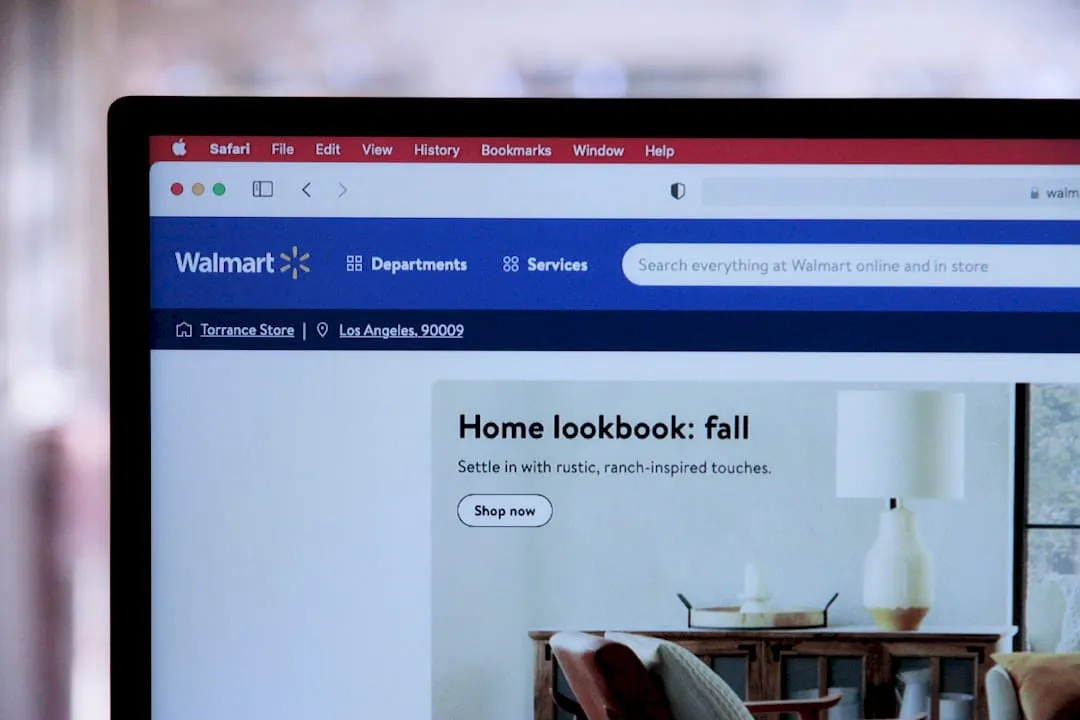
User-generated content is the evidence layer that builds trust, increases conversion, and feeds AI-driven discovery for ecommerce and digital brands. It is not a nice supplement to brand creative. It is the primary signal that shoppers and AI assistants alike use to evaluate whether a product is worth buying.
Three outcomes follow from that:
-
Trust and social proof. Shoppers trust peer voices at decision moments more than any copy your brand writes. Academic research using social cognitive theory confirms that authentic peer experiences measurably improve purchase intention and brand loyalty, a finding backed by consumer trust research on UGC.
-
Measurable conversion lift. Q1 2026 benchmarks from Emplifi show UGC delivered roughly 6.73× higher conversions than non-UGC content in aggregated platform data. Run your own holdout test to find your brand’s actual multiple.
-
AI discoverability. Verified review snippets and creator clips are referenced far more often than brand marketing copy in tested AI-agent queries., according to Idukki’s 2026 UGC report. Structured, verifiable customer proof is what AI assistants cite.
Three immediate priorities follow from those outcomes: secure rights and documented consent on every new asset, structure reviews so machines can parse them, and surface your best proof on high-intent pages like product detail pages (PDPs).
Key Takeaways
The most important thing to know about UGC in 2026: structured, verified customer content is the primary evidence layer that drives conversion, AI discoverability, and trust, and brands that build consent-first, machine-readable UGC programs will compound those advantages over time.
1. Secure rights and documented consent on every new asset. A consent-first intake workflow is the legal and operational foundation. Without it, every paid reuse is exposed.
2. Structure reviews for machine readability. Implement Schema.org Review and AggregateRating markup so AI agents and search engines can parse and cite your customer proof. Verified review snippets are referenced roughly 14× more often than brand copy in tested AI queries.
3. Run a PDP holdout test in month two. Select 20–30 SKUs, split traffic, and measure conversion lift with UGC elements versus without. This is the only metric that justifies ongoing investment to leadership.
4. Deploy UGC across the full funnel, not just social. PDPs, paid creative, post-purchase email, and A+ content are all higher-leverage placements than organic social alone.
5. Use Nectar’s managed program to operationalize the playbook. Nectar covers the full stack from consent workflows and structured proof exposure to shoppable video and holdout measurement, connecting UGC directly to revenue attribution.
What is the role of user-generated content for ecommerce brands?
User-generated content (UGC) is any content created by customers, community members, or independent creators rather than the brand itself. That includes star ratings, long-form written reviews, customer photos, short-form video, unboxing clips, social posts, and community Q&A threads. The defining characteristic is third-party origin: the brand did not produce it, even if it later repurposes it.
The contrast with brand content matters. A brand-produced lifestyle photo is curated, lit, and art-directed to project an ideal. A customer photo taken in a real kitchen or on a real hiking trail carries something no studio shoot can replicate: verifiable, unscripted experience. That authenticity is the mechanism behind UGC’s conversion advantage.
The American Marketing Association’s practitioner guide to UGC distinguishes between organic UGC (unsolicited posts and reviews) and incentivized UGC (content created in response to a campaign, seeding program, or creator brief). Both count. The legal and disclosure obligations differ, which is why the distinction matters operationally.
Stat to anchor your planning: Yotpo’s 2026 strategy analysis reports that shoppers who engage with reviews and UGC convert at 161% higher rates than those who do not. That figure comes from an engaged-shopper cohort, not a general population, so treat it as a ceiling rather than a baseline. Still, the directional signal is consistent across every major dataset.
What types of UGC work best, and where do they perform?
The format determines the channel, and the channel determines the placement. Here is how the core types map to platforms and use cases:
-
Star ratings and written reviews. The workhorse of ecommerce UGC. On Amazon and Walmart PDPs, review count and average rating are among the top factors shoppers scan before clicking “Add to Cart.” On Google Reviews and Yelp, they drive local discovery and brand credibility for DTC brands with physical presence. Long-form reviews that describe specific use cases are the most quotable by AI agents.
-
Customer photos. Flat-lay or in-context shots submitted via post-purchase email or Instagram tags. These perform best in PDP galleries, shoppable Instagram grids, and email campaigns. They show real scale, real color, and real fit in ways studio shots cannot.
-
Short-form video (TikTok and Instagram Reels). The fastest-growing UGC format. TikTok’s algorithm rewards authentic, low-production content, which means a genuine unboxing clip from a micro-creator often outperforms a polished brand video. Reels work similarly on Instagram. Both formats translate directly into paid creative: a winning organic clip can be whitelisted and run as a feed ad with minimal editing.
-
YouTube creator clips and long-form reviews. YouTube sits at a different point in the funnel. Shoppers use it for research, not impulse. A 6-minute honest review of a skincare product or a kitchen appliance can carry a shopper from awareness to purchase intent in a single session. These clips also rank in Google Search, extending organic reach.
-
Google Reviews and Yelp. For brands with any physical or local dimension, these are non-negotiable. Pew Research’s 2025 social media usage data confirms that review platforms remain among the first stops for American consumers evaluating a new brand. Google Reviews feed directly into local SEO and AI-generated summaries.
-
Community Q&A and forum content. Amazon’s Q&A section, Reddit threads, and brand community forums generate long-tail keyword content that surfaces in organic search and AI answers. A well-answered product question on a PDP can resolve a purchase objection for thousands of future shoppers.
-
Unboxing and before/after content. Unboxing clips build anticipation and validate packaging quality. Before/after content is particularly powerful for health, beauty, fitness, and home improvement categories where visible transformation is the core purchase promise.
Pro Tip: When briefing creators for short-form video, ask for a 15-second “problem-solution” clip and a 30-second “in-use” clip from the same shoot. You get two distinct ad variants from one session, and the shorter cut typically outperforms in feed placements.
How does UGC help brands with trust, conversion, and discoverability?
The benefits of user-generated content are not abstract. Each one connects to a measurable business outcome.
Social proof at the decision moment
Shoppers arrive at a PDP already skeptical. They have seen brand copy before. What they are looking for is confirmation from someone who bought the product and has no financial reason to lie. That is exactly what a verified review or a customer photo provides. Research grounded in social cognitive theory finds that UGC improves purchase intention by providing emotional resonance and peer validation that brand messaging structurally cannot replicate.
Conversion lift with real benchmarks
The Emplifi Q1 2026 benchmark puts the aggregate conversion multiple at roughly 6.73× for UGC versus non-UGC content. Idukki’s parallel 2026 analysis shows consistent directional results across brand-level case examples, while cautioning that the exact multiple varies by category, SKU, and placement. Both datasets point to the same conclusion: run a holdout test on your own PDPs and measure your brand’s actual lift rather than borrowing an industry average.
Cheaper creative at scale
A library of customer photos and creator clips reduces dependence on expensive studio shoots. For paid social, UGC-based ad variants often outperform brand creative on cost-per-click and return on ad spend, particularly in the first few days of a campaign when the algorithm is still learning. That cost advantage compounds as the library grows.
SEO and AI discoverability
Review text generates keyword-rich, naturally written content that search engines index and AI assistants parse. Verified review snippets are referenced roughly 14× more often than brand copy in tested AI-agent queries, per Idukki’s 2026 data. Yotpo frames this directly: UGC is “data for AI,” and brands that structure their reviews for machine readability gain a discoverability advantage that compounds over time.
Retention and community signals
Shoppers who contribute content, whether a review, a photo, or a forum post, have a higher stake in the brand. That contribution creates a psychological commitment that increases repeat purchase rates and reduces churn. Featuring customer content in post-purchase emails and loyalty programs reinforces that loop.
Where should you display UGC across the customer journey?
Placement determines whether UGC converts or just sits in a database. The highest-leverage locations are not always the most obvious ones.
High-intent placements: PDPs and checkout
The PDP is where purchase decisions get made or abandoned. Foursixty’s ecommerce UGC analysis shows that placing customer photos and review excerpts directly on PDPs shortens evaluation time and increases purchase confidence. The specific placements that move the needle: a shoppable photo gallery below the hero image, a review excerpt near the “Add to Cart” button, and a short creator clip showing the product in use. A+ content modules on Amazon and Walmart are a natural home for curated customer photos and testimonial excerpts.

Discovery and inspiration: social and paid creative
Homepage hero sections, category pages, and shoppable Instagram or TikTok grids serve the discovery phase. A shopper who has not yet decided what they want is more influenced by aspirational peer content than by product specs. Paid social feed ads built from creator clips consistently outperform static brand creative in click-through rate for most consumer categories. Shoppable video, where a viewer can tap a product tag and go directly to a PDP, collapses the funnel from inspiration to purchase in a single interaction.
Retention: post-purchase and loyalty
Post-purchase email sequences are an underused UGC placement. A “show us how you use it” email sent 14 days after delivery generates new assets while reinforcing the customer’s satisfaction with their purchase. Loyalty programs that reward photo or review submissions create a repeatable sourcing mechanic. Community hubs, whether a brand forum, a Facebook Group, or a Discord server, generate ongoing UGC that doubles as customer support content.
How do you generate high-quality UGC and build a flywheel?
A sustainable UGC program does not depend on hoping customers post. It is a system with defined inputs, workflows, and feedback loops.
-
Start with product seeding. Send products to micro-creators and loyal customers before launch. A seeding program with 20–30 carefully selected recipients generates an initial library of authentic content and early reviews without paid creator fees.
-
Deploy post-purchase review prompts. An automated email or SMS sent 7–14 days after delivery is the single highest-yield review generation tactic. Keep the ask specific: “Tell us one thing you love about [product name]” outperforms a generic “Leave a review” prompt because it lowers the cognitive barrier.
-
Run incentivized photo and video campaigns. A hashtag campaign with a small reward (a discount code, early access, or a feature on the brand’s feed) generates customer photos at scale. The incentive must be disclosed per FTC rules, covered in the compliance section below.
-
Brief creators for shoppable clips. A one-page creative brief specifying the problem to solve, the product feature to demonstrate, and the call to action produces more usable content than a loose “just be authentic” instruction. Include aspect ratio, length, and any brand safety guardrails.
-
Build submission workflows with consent capture. Every asset that enters your library needs a documented opt-in. A submission form with explicit rights language, or a direct message reply confirming permission, is the minimum. Rights-management platforms like Bazaarvoice or Stackla can automate this at scale.
-
Tag and categorize every asset on intake. Metadata standards (product SKU, content type, creator handle, consent status, expiration date) make assets findable and reusable. A library without metadata is a liability, not an asset.
-
Activate the flywheel: repost, reward, and repurpose. Feature customer content on your brand’s social channels and credit the creator. That recognition is itself an incentive for future contributions. Repurpose the best assets across paid creative, email, and PDPs. The Shopify UGC marketing guide identifies this repost-reward-repurpose loop as the most sustainable mechanic for ongoing library growth.
Pro Tip: Set a weekly calendar reminder to feature one customer photo or review on your brand’s Instagram Stories. It takes five minutes, costs nothing, and signals to your entire community that contributing content gets noticed. That signal is more powerful than any incentive program.
What are the legal and compliance rules for UGC in the United States?
Rights and disclosure are not optional. They are the foundation that makes every other UGC tactic legally defensible.
FTC endorsement disclosure rules
The FTC’s endorsement guidance is the governing standard for U.S. brands using influencers, paid creators, or incentivized UGC. The core rule: any material connection between a brand and a creator must be clearly and conspicuously disclosed. That includes free products, discount codes, affiliate commissions, and paid partnerships. “Material connection” is broader than most marketers assume. If you sent a creator a free product and they posted about it, that is an endorsement requiring disclosure, even if you did not ask for a post.
Disclosure language must be clear: “#ad,” “#sponsored,” or “I received this product for free” placed prominently in the post, not buried in a string of hashtags. The FTC has issued warning letters and fines for inadequate disclosure, and the risk extends to the brand, not just the creator.
“The FTC’s Endorsement Guides apply to endorsements in all media. An ‘endorsement’ is any advertising message that consumers are likely to believe reflects the opinions, beliefs, findings, or experiences of a party other than the sponsoring advertiser.”
Source: FTC Endorsement Guides FAQ
Rights, consent, and the one-yes-many-surfaces model
Documented consent is now both a legal requirement and a competitive advantage. Idukki’s 2026 data shows that roughly 62% of brands now require documented consent before reusing customer content. The brands that build clean, auditable rights pipelines can syndicate content across paid ads, PDPs, email, and retail media without re-clearing each asset. Those that do not face repeated takedown requests and legal exposure.
The practical standard is “one yes, many surfaces”: obtain explicit permission for all intended uses at the point of submission, document it with a timestamp and the creator’s identifier, and store it in a rights-management system. Verbal or implied consent is not sufficient for paid media reuse.
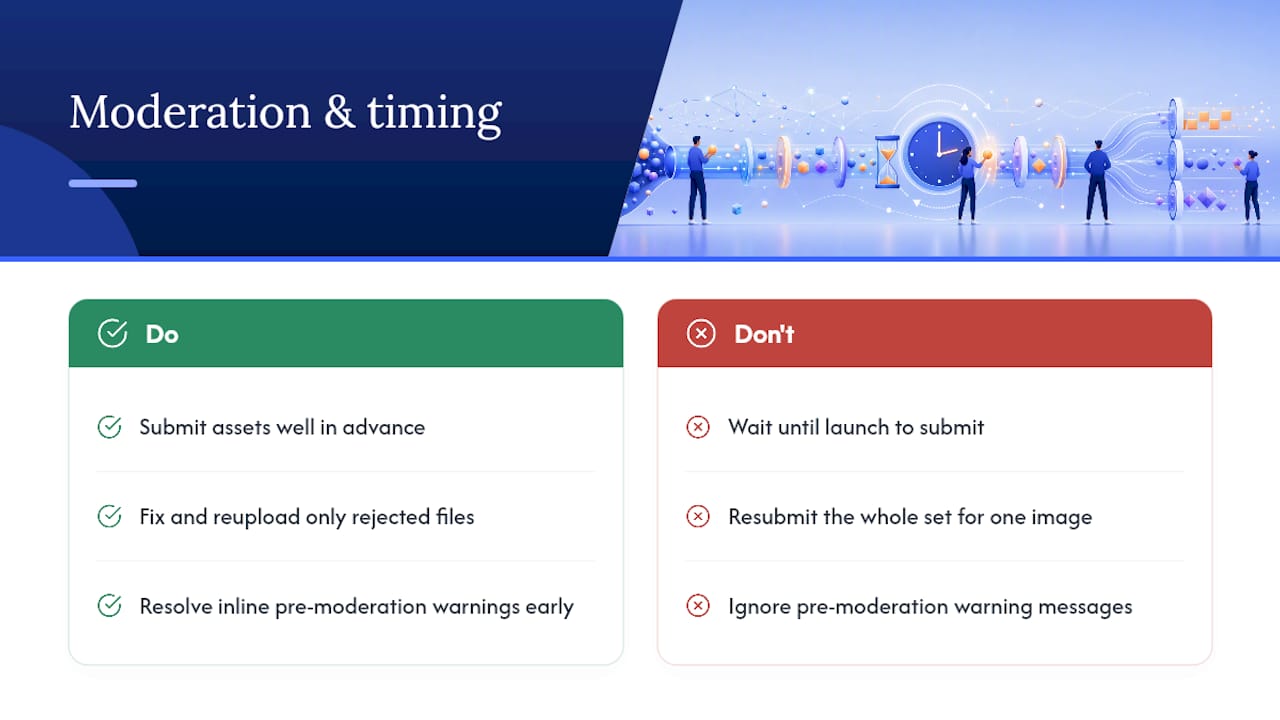
Moderation and authenticity checks
A daily moderation workflow should include three checks: authenticity verification (is this a real customer?), brand safety review (does the content meet community standards?), and negative review handling. Negative reviews should not be removed unless they violate platform terms or contain false factual claims. Responding to negative reviews publicly, with a resolution offer, converts a trust liability into a trust signal.
How do you measure UGC’s impact with the right KPIs?
Measurement is where most UGC programs break down. Teams collect content, deploy it, and then report engagement metrics that do not connect to revenue. Here is a framework that does.
Primary KPIs by channel
On PDPs:
-
Conversion rate lift on instrumented pages versus holdout (the most direct measure)
-
Add-to-cart rate for pages with UGC galleries versus without
-
Return rate reduction (better content sets accurate expectations)
In paid creative:
-
CTR for UGC-based ad variants versus brand creative variants
-
Cost per acquisition for UGC-led campaigns
-
Revenue attributed to UGC creative in multi-touch attribution
For engagement and community:
-
UGC submission rate (reviews per order, photos per campaign)
-
Engagement rate on UGC posts versus brand posts
-
Share of voice in organic search for review-driven long-tail queries
The holdout A/B test blueprint
Select a subset of 20–30 SKUs with sufficient traffic (at least 500 monthly PDP visits each). Split traffic so half of visitors see the PDP with UGC elements (customer photos, review excerpts near the buy button, creator clips) and half see the standard PDP. Run the test for a minimum of four weeks to account for weekly traffic patterns. Measure conversion rate, add-to-cart rate, and average order value as primary metrics.
Attribution for AI discoverability
Structured review markup (Schema.org’s Review and AggregateRating types) makes review data parseable by search engines and AI agents. Brands that implement this markup correctly see their review content surfaced in AI-generated summaries and featured snippets. Track impressions and clicks from rich-result appearances in Google Search Console as a proxy for AI discoverability. Monitor whether your brand appears in AI-assistant answers for category queries by running periodic test queries in ChatGPT, Perplexity, and Google’s AI Overviews.
How should ecommerce teams integrate UGC into listings, ads, and lifecycle programs?
Operational integration is where strategy becomes revenue. Each channel has a specific playbook.
PDP integration
Place a shoppable customer photo gallery immediately below the hero image. Pull the three most relevant review excerpts (those that address the top purchase objections for that SKU) and display them near the “Add to Cart” button. Embed a short creator clip, 15–30 seconds, that shows the product in use. For Amazon listings, use A+ content modules to feature curated customer photos alongside benefit-led copy. Nectar’s A+ content and brand story capabilities are built specifically for this kind of PDP integration.
Paid creative integration
Build a UGC creative testing calendar. Each month, select the top three performing organic UGC assets (by engagement rate) and produce paid variants. Test UGC clips against brand creative in Facebook and Instagram feed placements using identical targeting. For retail media on Amazon, Sponsored Brand Video placements are a natural home for creator clips that show product use. Track creative fatigue by monitoring CTR decay over a 30-day window and rotate assets before performance drops.
Lifecycle and retention integration
Post-purchase email sequence: Day 7 sends a “how are you enjoying it?” check-in with a review request. Day 14 sends a “show us your setup” photo submission prompt with a small incentive. Day 30 sends a replenishment or cross-sell email featuring customer photos of complementary products. Tag every asset generated through lifecycle emails with the source campaign so you can measure submission rates by sequence and optimize accordingly. Rights tracking for lifecycle-sourced assets follows the same consent-first standard as any other UGC.
How Nectar operationalizes UGC for managed ecommerce brands
The workflow Nectar runs for managed brands follows a five-stage pipeline that connects sourcing to revenue attribution.
Stage 1: Sourcing and seeding. Nectar identifies high-potential micro-creators and loyal customers from the brand’s existing customer data, then coordinates product seeding with a structured brief. The brief specifies content type, aspect ratio, key message, and disclosure requirements.
Stage 2: Consent capture and rights documentation. Every asset enters a rights-management workflow with a timestamped opt-in, creator identifier, and permitted-use scope. This documentation is stored in a centralized system that feeds the creative reuse pipeline.
Stage 3: Metadata tagging and structured exposure. Assets are tagged by SKU, content type, creator tier, and consent status. Review content is marked up with Schema.org Review and AggregateRating structured data so it is parseable by search engines and AI agents.
Stage 4: Creative reuse pipeline. The best-performing UGC assets are repurposed across PDPs, paid social, retail media, and lifecycle email. Nectar’s creative content workflow integrates UGC alongside brand photography and video so the asset library grows from both sources simultaneously.
Stage 5: Measurement and iteration. Nectar tracks conversion lift on instrumented PDPs using holdout methodology, revenue attributed to shoppable UGC placements, and return rate changes for SKUs with improved content. Nectar’s internal data shows that branded content programs can reduce returns by 30% for client brands, a figure that reflects the combined effect of better content setting accurate expectations.
Key outcomes the team monitors in a typical UGC program:
-
Conversion rate lift on PDPs with UGC galleries versus holdout pages
-
CTR improvement for UGC-based paid creative versus brand creative variants
-
UGC submission rate per order (a leading indicator of program health)
-
Return rate reduction on SKUs with creator clips and customer photos
-
AI discoverability: brand appearances in AI-assistant answers for category queries
Month 1 priority: Consent pipeline and structured review markup. Without clean rights and machine-readable reviews, every other tactic is either legally exposed or invisible to AI agents.
Month 2 priority: PDP holdout test and paid creative UGC variants. These two experiments generate the revenue attribution data needed to justify ongoing investment and scale the program.
An honest take on what most UGC programs get wrong
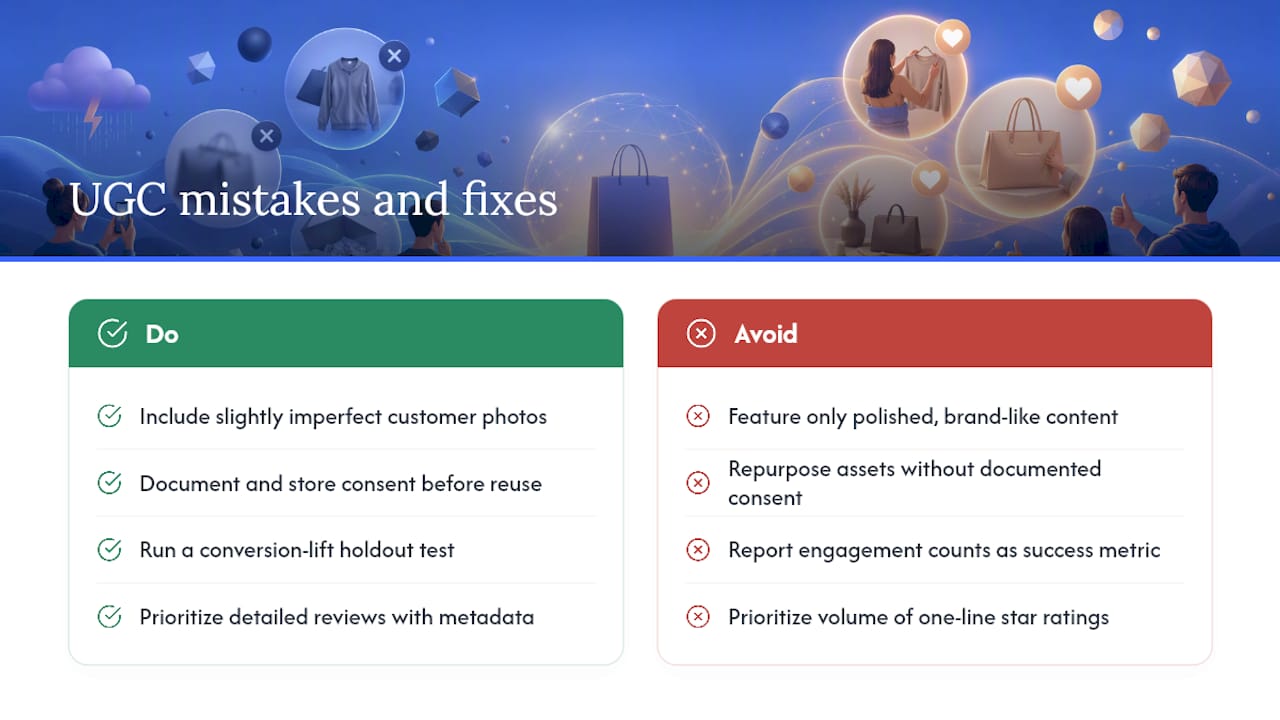
Most brands treat UGC as a content volume problem. They set up a hashtag, run a campaign, collect a few hundred posts, and then wonder why conversion rates barely moved. The volume was never the issue.
The real problem is almost always one of three things: over-curation, rights gaps, or measuring the wrong KPIs.
Over-curation is the most common. A brand’s instinct is to feature only the most polished customer photos, the most enthusiastic reviews, the most flattering creator clips. The result is a UGC library that looks suspiciously like brand content. Shoppers notice. The authenticity signal disappears, and with it the conversion advantage. The fix is counterintuitive: include the slightly imperfect photo, the honest “it took me a week to figure out the setup” review. That texture is what makes UGC credible.
Rights gaps are a legal and operational time bomb. A brand that repurposes a customer photo in a paid Facebook ad without documented consent is exposed to a takedown request, a creator dispute, and potential FTC scrutiny if the content was incentivized. The solution is not complicated, but it requires discipline: consent-first intake on every asset, documented and stored, before the asset enters any paid channel.
Measuring the wrong KPIs is the third failure mode. Teams report UGC engagement rates and submission counts to leadership, which are useful leading indicators but not revenue metrics. The KPI that justifies budget is conversion lift on instrumented PDPs, measured against a holdout. Run that test in month two of any program and you will have the number that unlocks continued investment.
One more thing worth saying plainly: the 2026 shift toward AI-driven discovery changes the calculus on review quality. A single detailed, verified review that describes a specific use case, names the product, and includes the buyer’s context is worth more for AI discoverability than 50 one-line star ratings. Quality with metadata beats volume without structure, every time.
Nectar scales UGC programs for mid-market and enterprise brands
Brands that want to move from ad-hoc UGC collection to a fully instrumented program, with consent workflows, structured proof exposure, and revenue attribution, need more than a platform subscription. They need an operational team that has run the playbook before.

Nectar’s managed ecommerce services cover the full UGC stack: creative production and creator briefing, rights documentation and consent workflows, structured review markup for AI discoverability, shoppable UGC integration on Amazon, Walmart, and Shopify PDPs, and paid creative testing using customer content. The iDerive analytics platform ties UGC performance back to revenue so you always know which assets are earning their place.
Specific service touchpoints relevant to UGC programs:
-
Consent-first rights workflows with centralized documentation
-
Schema.org structured review markup for AI and search discoverability
-
Shoppable video production and PDP integration at scale
-
UGC-based paid creative testing across retail media and paid social
-
Holdout measurement and attribution reporting
If your brand is ready to treat UGC as a revenue asset rather than a content tactic, see what Nectar’s services cover and request a program audit.
Sources
Recommended


































































.webp)