What Is Catalog Management? A Guide for E-Commerce Brands
.webp)

TL;DR:
- Effective catalog management involves continuously enriching, validating, and distributing product data to ensure consistency across all sales channels. It is a key operational process that directly impacts search rankings, customer trust, and sales performance, especially in omnichannel retail. Implementing dedicated systems like PIM and automation tools is essential for scaling and maintaining data accuracy at larger product volumes.
Catalog management is defined as the systematic process of organizing, enriching, maintaining, and distributing product data across all digital sales channels to deliver consistent, accurate shopping experiences. This includes product specifications, pricing, imagery, and inventory levels. Done well, it becomes the operational backbone of your entire e-commerce presence. Done poorly, it causes data decay and marketplace penalties that cost you rankings, conversions, and customer trust. For brand managers selling across Amazon, Walmart, and Shopify, understanding what product catalog management involves is not optional. It is the difference between a listing that converts and one that gets buried.
What is catalog management in e-commerce?
Catalog management is the systematic process of organizing product data including specifications, pricing, imagery, and inventory levels across all digital sales channels to ensure consistency and accuracy. The catalog management definition extends beyond simply uploading product data. It covers how that data is structured, updated, validated, and delivered to every channel where your customers shop.

Key performance indicators for catalog management include catalog completeness scores, error rates in channel feeds, and update frequency for pricing and inventory. These KPIs tell you whether your catalog is actually working or just existing. A catalog with 60% completeness on Amazon is leaving money on the table, regardless of how strong your advertising budget is.
The industry term most closely associated with this practice is Product Information Management, or PIM. Catalog management and PIM overlap but are not the same thing. Understanding the distinction matters when you are deciding where to invest in tools and processes.
What are the main stages of catalog management workflows?
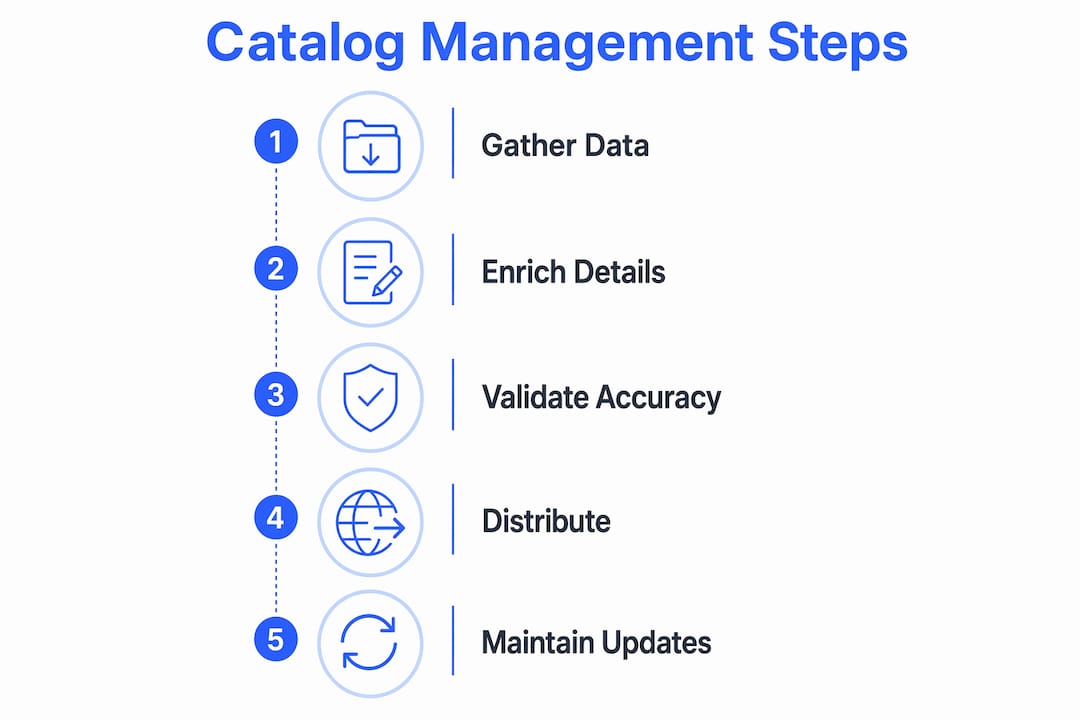
Standard catalog management follows five core workflow stages. Each stage builds on the previous one, and skipping any of them creates compounding problems downstream.
-
Data Collection. Product data arrives from suppliers, internal teams, and manufacturers. At this stage, the goal is gathering raw specifications, dimensions, materials, and identifiers like GTINs and UPCs. Inconsistent sourcing here creates errors that multiply across every channel.
-
Data Enrichment. Raw data becomes sellable content. This means writing marketing copy, adding lifestyle and detail imagery, and building out attribute sets that match what each channel requires. Strong enrichment is what separates a listing that ranks from one that does not. Nectar’s product photography work shows how improved visuals directly lift conversion rates.
-
Data Validation. Before any data goes live, it must be checked against channel-specific requirements. Amazon has different attribute rules than Shopify or TikTok Shop. Errors at this stage trigger feed rejections and performance penalties.
-
Data Distribution. Validated content is pushed to each sales channel. This includes Amazon, Shopify, Walmart, TikTok Shop, and any retail partner feeds. Automation tools handle the content transformations each platform requires.
-
Data Maintenance. Pricing and inventory change constantly. Real-time synchronization keeps your catalog accurate and prevents overselling, which is one of the fastest ways to earn a marketplace suspension.
Pro Tip: Shift from spreadsheets to a PIM system once you manage more than 200–500 SKUs or sell across three or more channels. Manual processes break down at that scale, and the errors become impossible to track without dedicated software.
For a structured approach to managing large catalogs, Nectar has published a six-step framework that covers enrichment and presentation in detail.
How does catalog management differ from PIM?
PIM is the software and database used for storing and normalizing product data. Catalog management is the process of organizing, presenting, and distributing that data to specific sales channels. The two are related but serve different functions.
Think of it this way. PIM is the brain. It holds the master record for every product attribute, every image, every specification. Catalog management is the delivery mechanism. It takes what the PIM stores and packages it correctly for each channel’s requirements.
Here is why the distinction matters in practice:
-
A PIM system like Akeneo or Salsify stores your master product data in one place. Catalog management processes pull from that master record and adapt it for Amazon’s flat file format, Shopify’s metafields, or a retail partner’s EDI feed.
-
Without a PIM, catalog management relies on spreadsheets and manual updates. That works for small catalogs. It fails at scale.
-
Without catalog management processes, a PIM becomes a data warehouse with no distribution strategy. The data sits there but never reaches customers in the right format.
Coordinating both is what allows brands to scale across channels without sacrificing data accuracy or customer experience quality.
Why is catalog management critical for omnichannel sales?
Catalog management acts as an omnichannel bridge that synchronizes product data across social media ads, marketplaces, and brand websites. Modern shoppers use 3–5 touchpoints before making a purchase. Every one of those touchpoints needs to show the same price, the same product description, and the same availability status.
When catalog data is inconsistent, the consequences are direct and measurable:
-
Returns increase. Customers who receive a product that does not match its listing description return it. Accurate catalogs reduce return rates by delivering complete, trustworthy product data.
-
Search rankings drop. Incomplete or inaccurate product data hurts your visibility in marketplace search algorithms. Amazon’s A9 algorithm rewards completeness and relevance.
-
Conversion rates fall. Shoppers who cannot find the information they need to make a decision leave. They do not come back.
-
Marketplace suspensions happen. Persistent data errors in channel feeds lead to listing suppression or account-level penalties.
Cross-selling and up-selling effectiveness also depends directly on catalog structure. Well-organized catalogs with defined product relationships and bundle configurations increase average order value compared to flat product structures with no hierarchy. A brand selling kitchen appliances, for example, can use catalog relationships to surface compatible accessories at the point of purchase, but only if the catalog is structured to support those connections.
Catalog management is the foundation of a brand’s digital identity and a strategic enabler for e-commerce growth and consistency.
For a deeper look at how catalog quality connects to Amazon conversion rates, Nectar’s analysis shows the direct relationship between listing completeness and purchase behavior.
What are the best practices for managing catalogs at scale?
Treating catalog management as a one-time task is the most common and most costly mistake brands make. Pricing changes, inventory fluctuates, channel requirements update, and new products launch. A catalog that was accurate six months ago may be riddled with errors today.
The following practices define high-performing catalog management at scale:
-
Separate master data from channel content. Mapping workflows that keep master product data distinct from channel-tailored content structures reduce errors and make updates faster. When Amazon changes its attribute requirements, you update the channel template, not the master record.
-
Validate product identifiers continuously. GTINs, UPCs, and ASINs must be accurate and consistent. Mismatched identifiers cause listing conflicts and suppress products in search results.
-
Standardize image management. Each channel has specific image requirements for size, background, and content. Building an image library organized by channel prevents the last-minute scramble that leads to non-compliant uploads.
-
Monitor catalog completeness scores. Set a minimum completeness threshold for each channel and track it weekly. Listings that fall below threshold should trigger an automatic review workflow.
-
Synchronize inventory in real time. Real-time synchronization is critical for linking advertising spend to actual purchasability. Running ads to an out-of-stock listing wastes budget and damages your account health metrics.
Pro Tip: Automate feed generation and syndication using tools like Feedonomics or Salsify. Automation reduces manual errors, handles content transformations for each channel, and scales without adding headcount.
Addressing common product listing challenges before they compound is far less expensive than recovering from marketplace penalties after the fact.
How to apply catalog management to amazon and shopify listings
Translating catalog management principles into platform-specific execution requires a structured approach. Generic product data does not perform well on Amazon or Shopify. Each platform rewards content that is built to its specific requirements.
-
Tailor titles and descriptions for each platform. Amazon titles follow a specific formula: brand, product type, key features, size, and color. Shopify titles prioritize readability and SEO. The same master product record needs two different content outputs.
-
Build out complete attribute sets. Amazon’s catalog penalizes incomplete attribute data with lower search placement. Fill every relevant attribute field, including bullet points, search terms, and product type nodes.
-
Use structured categories and taxonomies. Proper categorization aids product discovery on both platforms. Miscategorized products appear in irrelevant search results and convert poorly.
-
Synchronize pricing and inventory across channels. Overselling on one channel while another shows available stock creates fulfillment failures and negative reviews. Centralized inventory management prevents this.
-
Use analytics to monitor catalog health. Track completeness scores, suppressed listings, and feed error rates weekly. Nectar’s iDerive analytics platform provides the granular data needed to identify catalog gaps before they affect sales performance.
For brands managing e-commerce data analysis, connecting catalog quality metrics to conversion data reveals exactly which listings need attention first.
Key takeaways
Effective catalog management requires continuous data enrichment, channel-specific distribution, and real-time maintenance to protect product visibility and drive consistent sales performance across every channel.
Catalog management is a process, not a project
Catalog management must be treated as an ongoing operational function. One-time setup without continuous maintenance leads to data decay and lost sales.
PIM and catalog management serve different roles
PIM stores and normalizes master product data. Catalog management packages and distributes that data to each sales channel in the correct format.
Channel-specific content is non-negotiable
Amazon, Shopify, and Walmart each have distinct attribute requirements. Mapping workflows that separate master data from channel content reduce errors and speed up updates.
Completeness scores drive visibility
Catalog completeness directly affects search ranking on marketplace platforms. Monitoring completeness scores weekly and setting minimum thresholds keeps listings competitive.
Automation scales what manual processes cannot
Automated feed generation and syndication tools handle content transformations at scale. Manual spreadsheet management breaks down past a few hundred SKUs or three or more channels.
Catalog management is strategy, not administration
I have worked with brands that treated their product catalog as a database maintenance task. They assigned it to a junior coordinator, checked it once a quarter, and wondered why their Amazon rankings kept slipping. The catalog is not a back-office function. It is the primary interface between your brand and your customer.
What I have seen consistently is that brands with strong catalog discipline outperform their competitors on metrics that matter: conversion rate, return rate, and repeat purchase rate. Not because they have better products, but because their customers can find the right information at the right moment. A shopper who cannot confirm a product’s dimensions before buying will either not buy or will return it. Both outcomes cost you money.
The shift to omnichannel retail has made this more complex. Managing a catalog for a single website is manageable with spreadsheets. Managing it across Amazon, Walmart, Shopify, TikTok Shop, and retail partner feeds simultaneously requires systems, workflows, and automation. Brands that invest in that infrastructure early scale faster and with fewer operational fires.
My advice is to treat catalog management the way you treat your advertising strategy: with dedicated ownership, regular performance reviews, and a clear set of KPIs. Catalog completeness, feed error rates, and update frequency are not vanity metrics. They are leading indicators of your revenue trajectory.
— Dan Katona
How Nectar helps brands master catalog management
Catalog management at scale requires more than good intentions. It requires the right combination of creative content, technical execution, and performance data.

Nectar specializes in exactly this for brands selling on Amazon, Walmart, and Shopify. From in-house photography and copy production to feed management and marketplace expansion, Nectar handles the full catalog workflow. The proprietary iDerive platform tracks catalog completeness, feed health, and conversion performance in one place, giving brand managers the visibility they need to act fast. If your catalog is underperforming, Nectar’s marketplace management solutions are built to fix it.
FAQ
What is catalog management in simple terms?
Catalog management is the process of organizing, updating, and distributing product data across all sales channels to keep listings accurate and consistent. It covers everything from product descriptions and images to pricing and inventory levels.
What does catalog management involve day to day?
Day-to-day catalog management involves updating pricing and inventory, validating product data against channel requirements, monitoring completeness scores, and pushing corrected content to platforms like Amazon and Shopify.
When should a brand switch from spreadsheets to a PIM system?
Brands should transition to a PIM system once they manage more than 200–500 SKUs or sell across three or more channels. Manual spreadsheet processes break down at that scale and create data errors that affect marketplace performance.
How does poor catalog management affect sales?
Poor catalog management leads to incomplete listings, suppressed products, increased return rates, and lower conversion rates. Inaccurate data creates customer friction and can trigger marketplace penalties including listing suspension.
What is the difference between PIM and catalog management?
PIM is the software that stores and normalizes master product data. Catalog management is the process of packaging and distributing that data to specific sales channels in the correct format for each platform’s requirements.
Recommended

































































.webp)