Amazon vendor negotiations are won before the call. The brands that come out ahead walk in with one number, net contribution per unit after every term, and with their own proposal ready instead of a reaction to Amazon’s. At Nectar, we manage Vendor Central (1P) operations and build that picture inside our iDerive analytics platform, so the negotiation rests on data your vendor manager cannot wave away.
This guide is for brand managers and ecommerce leads at mid-market and enterprise brands that sell to Amazon wholesale. It covers what is actually on the table, how to prepare, how to answer a cost-reduction request and how to judge the result.
TL;DR
- Amazon negotiates more than cost price: co-op, freight and damage allowances, payment terms, promotions and growth commitments all move your margin, so treat them as one number.
- Cost-reduction requests are common. In the 2024 annual negotiation, Amazon asked 57% of first-party brands for a lower wholesale cost.
- Set your floor first: compare what a unit earns you in 1P against your other channels, and refuse anything below it.
- Never concede for free. Trade each concession for something measurable, such as growth targets, faster payment or a program that costs you little.
- Counter with a mix of cost moves across item groups instead of a flat cut, and bring your own first proposal.
What Amazon actually negotiates with vendors
In Vendor Central, Amazon buys your products wholesale and sells them as the retailer. Once a year, Amazon’s vendor management team runs the annual vendor negotiation, usually shortened to AVN, to reset the commercial terms for the coming year. Amazon’s own vendor managers are typically the people across the table.
The terms fall into a few groups:
- Cost price by ASIN. The wholesale price Amazon pays for each product (an ASIN is Amazon’s product identifier).
- Co-op and allowances. Co-op is money you give Amazon, usually as a percentage of sales, for marketing. Freight and damage allowances sit alongside it. Retail TouchPoints notes that co-op spend, which covers marketing development funds plus damage and freight allowances, is one of the most important numbers in the negotiation, and that Amazon’s vendor managers are incentivized to raise it year over year.
- Payment terms. How many days Amazon takes to pay you, and whether a discount buys a faster payment.
- Program participation. Subscribe & Save funding, vendor services fees, supply-chain programs and promotional commitments.
- Broader asks. The same guide reports that Amazon asks for margin guarantees, global pricing strategies and program participation.
The point most brands miss is that these lines are not separate negotiations. A one-point concession on co-op is a price cut by another name. Add every line together and the real question is what each unit leaves in your pocket.
Build your net contribution number first
Before you plan any ask, calculate net contribution per unit for your top ASINs: cost price minus accruals, freight and damage allowances, chargebacks and promotional funding, minus your landed cost. Reconcile last year’s actual deductions against what the contract said they would be. Gaps between the two are often the cleanest early win, because you are asking Amazon to honor its own paperwork.
Here is an illustration with made-up numbers, to show the mechanics:
- Your product retails at $30 and costs you $6.50 landed.
- At a $15.00 cost price, accruals and allowances take $2.30 per unit in total (treated here as a flat amount for simplicity), so you net $6.20.
- Selling the same unit through your own third-party account or a distributor might net you $5.40 to $5.90, depending on fees.
- Amazon proposes a $13.75 cost price. The unit now nets $4.95 ($13.75 minus $2.30 minus $6.50), below both alternatives.
Your best alternative, $5.90 a unit, is your floor. Any cost price that nets less than that is a worse deal than the channels you already have, so you walk through the same math for every ASIN.
The same math gives you an exchange rate for trading. On a $15.00 cost price, one extra point of accrual costs you $0.15 per unit. When Amazon asks for two points of co-op, you can say what that is worth in cents and ask for something at least equal in return.
This is the work our team does with brands in Vendor Central. We use iDerive to pull marketplace data into one view, so sales, advertising and deductions sit side by side and the per-unit picture is ready before the window opens. Brands that run this analysis in spreadsheets stitched together from several reports usually reach it late.
Prepare a full year ahead
AVN preparation is a twelve-month job, not a two-week sprint. The practical sequence:
- Audit the current contract. List every term, what it costs in dollars last year and what you got for it. Flag terms that bought nothing measurable.
- Measure return on each dollar. If a dollar of advertising drove several dollars in sales while a dollar of co-op produced far less, you have an argument for redirecting money, not simply cutting it. Your advertising data matters here, which is why we connect Amazon Sponsored Ads management to the same reporting as 1P operations.
- Know your category position. Where you rank, who the close competitors are and how much of the category you carry shape how much leverage you have.
- Choose three asks. A short list of data-backed requests beats a long wish list. Decide in advance the order you will trade them in.
- Decide what you can lose. Know which ASINs you would accept losing from the Amazon assortment rather than sell below your floor.
- Script the trade-offs. For each ask, know what you will offer and what it costs you.
Timing matters too. Supply-chain disruptions and cost increases, backed by detailed data, can give you bargaining leverage, as Retail TouchPoints observes. The leverage is the evidence, not the complaint.
Where your leverage comes from
Leverage in an Amazon negotiation is rarely about size alone. It is about alternatives and reliability.
- Alternative demand. If a unit earns you the same or more through another channel, Amazon knows you can walk. Many 1P brands also run a Seller Central account, which makes a third-party scenario credible when you model it honestly.
- Distinctiveness. Products shoppers search for by name, or that Amazon cannot easily replace, carry more weight.
- Operational reliability. Clean purchase order fulfillment, low chargebacks and accurate content make you cheaper to work with.
- Your own performance data. Sell-through, return rates and category growth let you counter generic requests with specifics.
One framing works well in practice: show willingness to invest in growth drivers such as advertising or Subscribe & Save discounts, then show that a particular fee is not producing proportional sales and propose moving the money. That moves the conversation from emotional to analytical.
Negotiating each term
Co-op and marketing funds
Amazon rarely just cuts a co-op rate. What does move is how the money is used. Ask to redirect a share into programs with measurable outcomes, and tie any increase to growth targets or promotional commitments instead of conceding on request. Retail TouchPoints points out that brands can negotiate each component of co-op separately.
Freight allowance
If Amazon asks for a higher freight allowance, look at your own cost of getting product to its fulfillment centers. Retail TouchPoints describes brands handling freight themselves or through a third-party logistics provider instead of accepting an increase. A consolidation program can also justify a lower rate than the one Amazon opens with.
Damage allowance
Request Amazon’s damage and returns reports, then check whether the standard allowance still matches reality. If your packaging or content improvements have lowered damage rates, that is evidence for a lower allowance, ideally stepped down over the year against a specific plan.
Payment terms
Payment terms are tradeable. Longer terms cost you cash flow, and early-payment discounts convert time into a price cut. Work out what a faster payment is worth to your business in financing cost before you agree to give up points for it.
Subscribe & Save and vendor services
Flat Subscribe & Save accruals can be compared with a flexible arrangement once you know your real subscription share. For vendor services fees, ask what service level you receive and tie the spend to clear deliverables in writing.
Always give something back
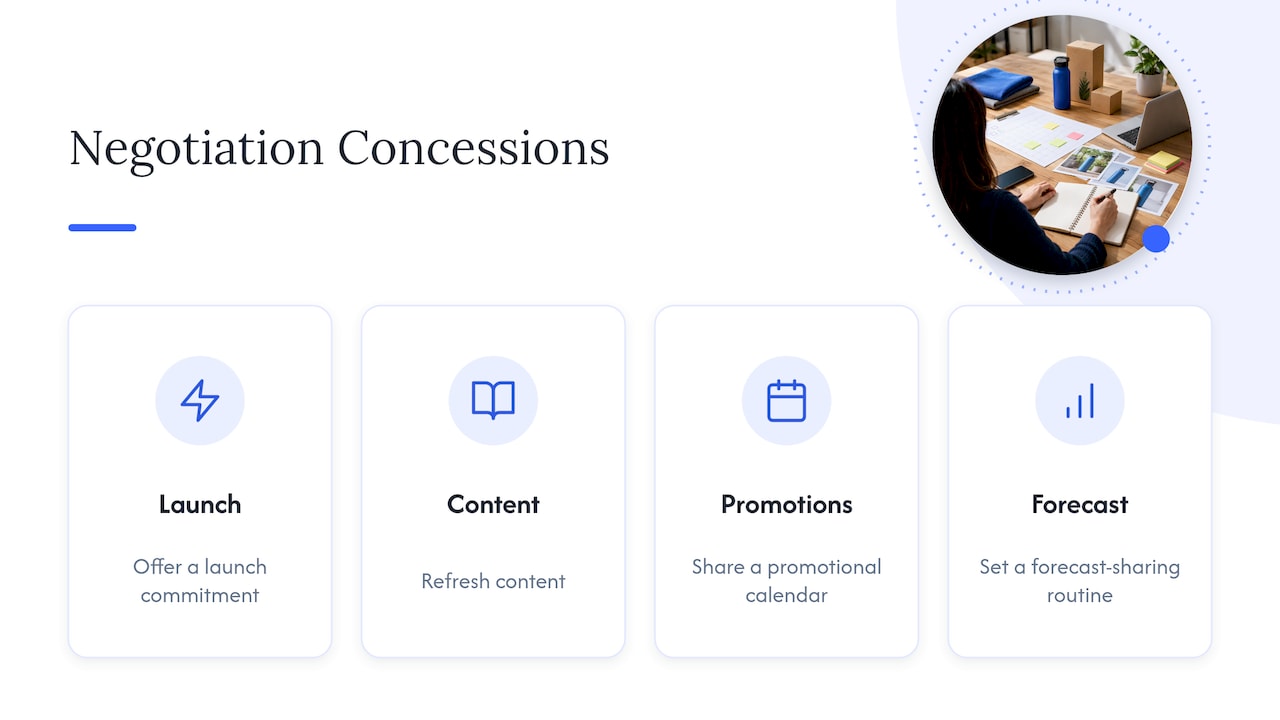
Every ask should come with something that costs you little and matters to Amazon: a launch commitment, a content refresh, a promotional calendar or a forecast-sharing routine. Concessions made under time pressure are the ones brands regret, so take time to assess each proposal before committing.
How to respond to a cost-reduction request
The ask usually arrives early and it is large. In the 2024 AVN, Amazon requested a wholesale cost decrease from 57% of first-party brands, according to Stratably data reported by WARC. Being asked is the standard opening, not a verdict on your brand.
Modern Retail reported on a hardlines vendor that Amazon asked for about a 10% cost decrease on a few hundred items, citing lower container rates and supply-chain costs. The vendor planned to counter with a mix of cost moves across item groups instead of a flat 10% cut. Amazon was aiming to close by March 1.
The response pattern that follows from this:
- Hold the status quo. Do not agree on the call.
- Evaluate item by item. Run the net contribution math on each ASIN named.
- Delay if you need to. A few days of analysis is cheap.
- Counter with a mix. Offer to lower cost on one group of items while Amazon pays more on another, so the blended result meets your floor.
- Present your numbers first. If you wait for Amazon’s proposal, Amazon frames the conversation. Set the agenda and timeline, then anchor the deal around your own figures.
Expect pressure. Amazon’s pricing is dynamic, and it may match competitors automatically, so structure your cost submissions to protect profitability even when the retail price moves. Your reply should state which of your decisions are firm and which are open.
Judging the outcome
After the deal, recalculate net contribution for every ASIN under the new terms and compare it with your floor and your other channels. Then watch three things through the year:
- Deductions against the contract. Do chargebacks and allowances match what you signed?
- Return on the funded programs. Did the co-op, vendor services or Subscribe & Save spend produce the growth you tied it to?
- Assortment and orders. Are purchase orders and detail page content staying healthy on the products you protected?
Be careful with one metric. Amazon tracks net pure product margin, its own profit view of your products. A healthy figure tends to bring better trade terms, while a low one prompts requests for cost reductions. Tracking it is useful, but do not let it replace your own view of free cash flow, damage rates and long-term growth.
Where Nectar fits
We are a fully managed ecommerce agency for mid-market and enterprise brands on Amazon, Walmart and Shopify. For brands that sell through Vendor Central, our work spans marketplace operations (catalog, inventory, forecasting, compliance), retail media buying, and an in-house creative studio for product photography, video and A+ content. The data side runs on iDerive, our proprietary analytics platform for unified reporting and incrementality measurement.
That combination is useful at AVN time because the terms you negotiate touch all of it: co-op and advertising, content quality and returns, forecasting and freight. If you want the negotiation prepared around your own numbers, start with our Amazon growth and optimization service.

We have also written up what we learned across a large set of brand negotiations in our 2026 Amazon AVN recap, which pairs well with this guide.
Our view on AVN
Most brands treat the annual negotiation as an event. We treat it as the output of a year of operating well. The vendor manager who opens with a cost-reduction request is following a script, and the brand with its own script, built from clean data, changes the conversation.
What we see as the strongest position is simple: know your unit economics across every term, know what your advertising and content investments return, and decide your floor before anyone asks you to move it. Our approach is profit-first. That means we judge every dollar of co-op, advertising and operations by what it contributes, not by what it spends.
When creative, operations and advertising data sit in one place, you can answer Amazon’s ask with a specific counter instead of a feeling. That is what iDerive is built for, and it is why we run Vendor Central management, retail media and the creative studio as one team.
Dan Katona
FAQ
How often does Amazon negotiate terms with vendors?
The main negotiation is annual, which is why it is called the annual vendor negotiation. Amazon can open conversations at other times, especially when costs or market conditions shift. Keep your net contribution analysis current so you can respond at any point.
Do I have to accept Amazon’s first cost-reduction request?
No. A request for a lower cost is the standard opening position. Evaluate it item by item against your floor, delay if you need time, and counter with a mix of cost changes across item groups instead of a flat cut.
What is the most important number in an Amazon negotiation?
Net contribution per unit after all terms. Cost price, co-op, freight and damage allowances, payment terms and promotional commitments all reduce it, so a concession anywhere is a concession on price. Retail TouchPoints also highlights co-op as one of the most important figures.
Can I negotiate the allowances separately?
Yes. Co-op, freight and damage allowances can each be negotiated on their own. Bring evidence for each, such as your own freight handling costs or damage data, and trade any concession for a measurable return.
Sources
- Vendor’s Guide to Amazon Negotiations 2022, Retail TouchPoints
- Amazon pushes for lower cost of wholesale purchase from brands, WARC
- Cash-strapped 1P brands are trying to play hardball with Amazon, Modern Retail
Recommended