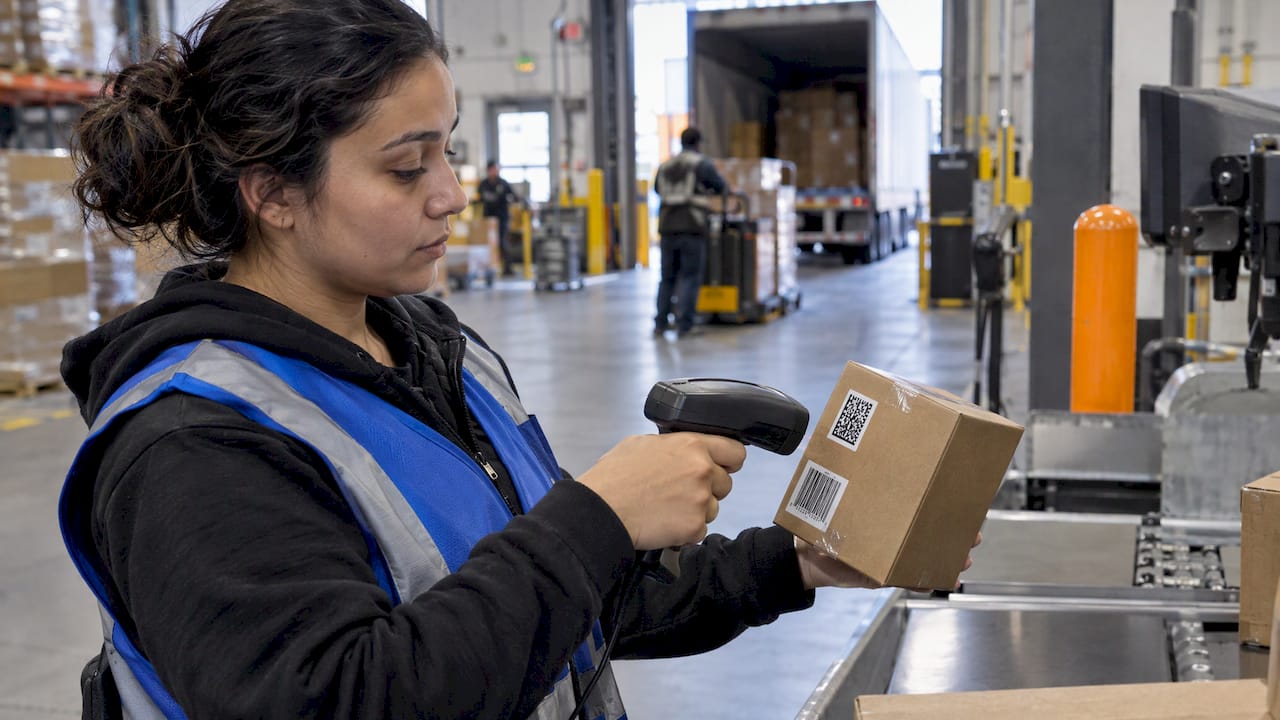
Amazon Transparency is a product serialization and anti-counterfeiting service: every unit of an enrolled product carries its own unique code, and Amazon scans that code so only authentic items are listed or shipped. For a mid-market or enterprise brand, the code fee is the small part. The real work is rolling labels through manufacturing, passing Amazon’s review, and keeping catalog, inventory and brand protection aligned while it happens. That is why most brands treat Transparency as an operations project, not a checkbox in Seller Central.
This guide covers what the program does, who qualifies, what it costs, where codes go on the package, how it relates to GS1 barcodes and what to do about compliance documents.
TL;DR
- Transparency gives each unit a unique code. Amazon verifies it at listing, inbound and order, and shoppers can scan Amazon-issued codes in the Amazon Shopping app.
- Amazon lists no enrollment or subscription fee. Codes cost $0.05 each for the first 1,000,000, then $0.03 and $0.01 at higher volume tiers. Label printing is extra.
- You need Brand Registry, a GS1-certified GTIN, and a commitment to code 100% of units manufactured for each enrolled GTIN, including units sold off Amazon.
- The program protects against counterfeits and materially different versions. It does not replace your UPC and it does not remove bad listings by itself.
- Plan it as a cross-functional rollout: packaging, factory, 3PL, catalog and brand protection all touch it.
What Amazon Transparency actually does
Amazon assigns a unique code to every unit of a product you enroll. Codes are scanned across the supply chain, and only authentic, accurate items are supposed to be listed or shipped in Transparency-supported stores. Once a product is protected, it cannot be listed without valid codes that match the enrolled product.
Three things happen in practice:
- Listing and fulfillment checks. Amazon’s guide says that after enrollment, selling partners must provide codes at listing. Codes are also verified before shipment, and units that fail are set aside for investigation.
- Version control. Amazon’s US page says the checks can also block materially different versions of your product, such as ones that differ in materials, compatibility, color or language, or that do not meet regulatory requirements.
- Customer verification. Shoppers can scan an Amazon-issued code in the Amazon Shopping app or the Transparency app to confirm authenticity and see brand-provided information. Amazon’s 2019 announcement notes brands can attach unit-level details such as manufacturing date, place or ingredients.
Transparency works at the unit level, so it sits beside, not instead of, the rest of brand defense: Brand Registry reporting, test buys, listing monitoring and hijacker enforcement. Our guide to brand defense on Amazon shows how those layers fit together.
Who can enroll and what you need first
Amazon’s onboarding guidelines set the entry conditions:
- Verifiable brand ownership, with Brand Registry credentials.
- A GS1-certified GTIN for every product you enroll.
- Unique codes on 100% of units manufactured for enrolled GTINs, across Amazon and non-Amazon channels.
- A Product Configuration Template listing the GTIN, ASIN and SKU of each product.
The 100% rule is the one that surprises operations teams. If a unit of that GTIN ships to a retail partner or your own Shopify store, it needs a code too. Decide early whether you enroll your whole line or start with the SKUs that attract the most counterfeit or hijacker activity.
Transparency-supported stores are the US, Canada, Germany, France, Italy, Spain, the UK, Australia, India and Japan, per Amazon’s program page. The same page lists eligible enrollment origins, which add China to that list.
If your GTINs are not yet clean, fix that first. Mismatched brand names, missing GS1 prefixes and weak images are the usual reasons for listing trouble. Our walkthrough on GTIN exemption and brand matching covers the catalog side.
How much Amazon Transparency costs
Amazon’s US page states there are no enrollment, subscription or minimum costs. You pay per code:
- $0.05 per code for 1 to 1,000,000 codes
- $0.03 per code for 1,000,001 to 10,000,000 codes
- $0.01 per code for 10,000,001 and above
Tiers follow cumulative annual volume, and the count resets on your account creation date. According to the onboarding guidelines, fees are billed per code requested, payment is by check or wire transfer rather than deducted from Seller or Vendor Central, and generated codes are a separate cost from the physical labels.
Worked example
Say you ship 400,000 units of enrolled GTINs in a year. At $0.05 per code, code fees come to $20,000. Then add printing. One enrolled seller told Modern Retail they spent $0.15 to $0.20 per unit including printing, with every manufactured unit labeled across channels. That reported range is a reference point, not a quote: your own figure depends on label stock, printers, application method and factory labor.
For a brand with healthy margins and a counterfeit problem that costs sales, reviews or returns, the arithmetic usually favors enrolling. Amazon’s own guide lists traceability and return-reason quality control among the benefits for brands, which matter when returns from fakes drag down your ratings.
How the codes work, step by step
1. Request codes
You request codes through the Transparency Self-Service Portal or a Transparency Service Provider. Amazon-issued codes are over 26 digits and delivered as .csv or .pdf files. Order against your production plan, since you are billed per code requested, not per code used.
2. Print and apply the labels
The code is a 2D Data Matrix with the Transparency logo and call to action, placed on the exterior packaging of each unit. Amazon’s guide specifies a minimum code size of 12.7 mm by 12.7 mm with a quiet zone of at least 0.635 mm (doubled for larger codes), on a flat, unobstructed area free of other printing or marks.
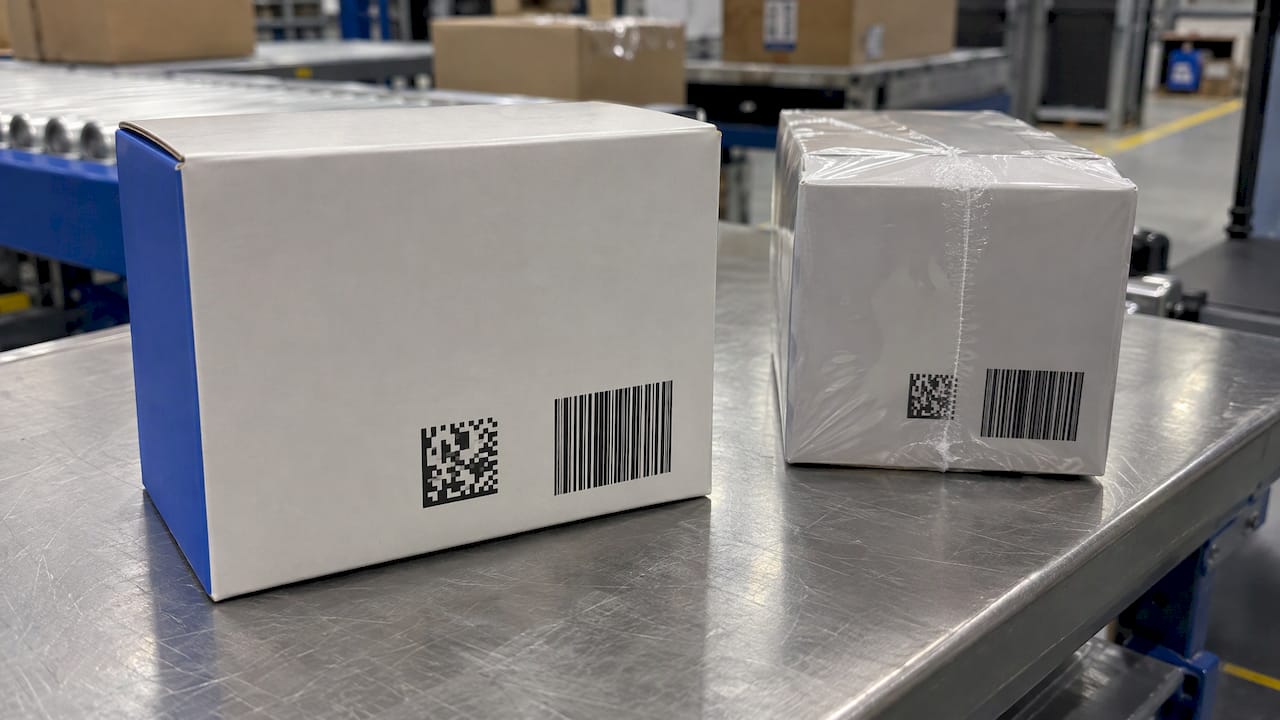
Where it goes wrong: curved surfaces, shrink wrap seams, glossy film that glares under a scanner, and a code placed over a fold. Pick a consistent spot, ideally on the same panel as the UPC, and test scans on real finished packs before the first production run. Two ways to get the code on the pack exist: designing it into the artwork when you print packaging, or applying a label after packing. The first is cleaner for new packaging runs; the second is faster for existing inventory.
3. Pass the Operational Performance Review
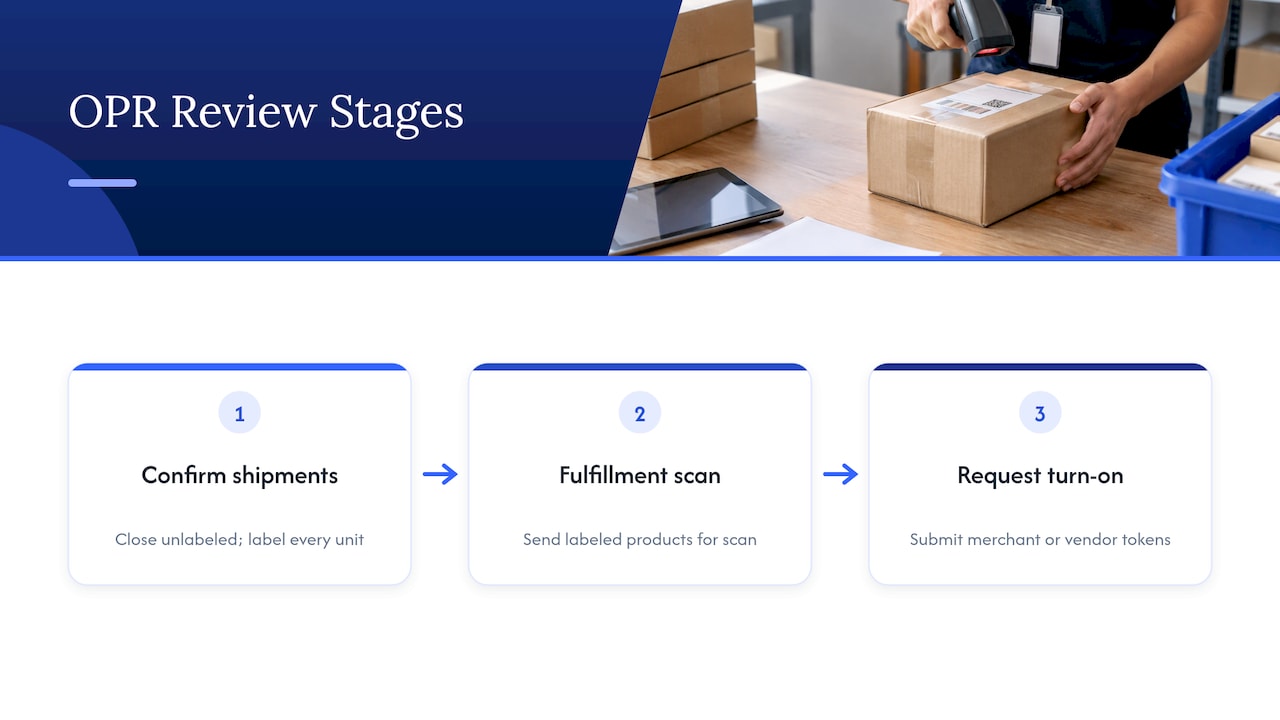
The Operational Performance Review (OPR) is Amazon’s check that your labeling works in the real flow. Per the onboarding guidelines, you confirm that unlabeled shipments are closed, commit to labeling every unit, send labeled product to an Amazon fulfillment center for scan verification, then submit an OPR turn-on request with your merchant or vendor tokens.
4. Protections go live
After the request, Amazon sends third-party sellers a 30-day notice. Once protections apply, merchant-fulfilled sellers get a 14-day notice to upload codes or have listings removed. FBA inventory must scan valid codes at inbound. Existing inventory is not removed, but unlabeled product cannot enter fulfillment centers.
That last rule is where launches stall. A single pallet of unlabeled units from a contract manufacturer can block an inbound shipment during a promotion. Map every location that touches the product, including co-packers, 3PLs and returns handling, before the turn-on date.
Amazon-issued codes versus your existing serial numbers
Since Amazon’s October 2023 interoperability update, brands can connect their own serial numbers to Transparency, and Amazon validates each one when a unit sells, the same way it validates its own codes.
The requirements on Amazon’s US page are specific: serials must be unique per unit for a GTIN or SKU, 7 to 20 characters long, scannable externally in 1D, QR or 2D format, on the same side of the packaging as the GTIN, with all serials shared with Amazon. The trade-off to weigh is that brands using existing serials do not get app-scan verification or the customer engagement features. If shopper-facing verification matters to your brand, Amazon-issued codes are the route that supports it.
Transparency codes and GS1 barcodes
The two systems do different jobs and run side by side. Your UPC, EAN or GTIN barcode stays on the pack for pricing and retail scanning, and Amazon requires a GS1-certified GTIN to enroll. The Transparency code identifies the individual unit.
A GS1-standards explainer describes Amazon-generated codes as 29-character strings beginning with AZ: or ZA: printed as DataMatrix, and notes that brands can alternatively use GS1 SGTINs, which combine the GTIN with a serial number. It also states GS1 Digital Link QR codes are not applicable to the program. So do not plan a single combined code on your packaging; plan for the retail barcode and the Transparency code to coexist, with clear space around each.
Compliance documents and safety data sheets
Transparency enrollment is about identity and serialization. The requirements in Amazon’s onboarding guidelines (Brand Registry, GS1 GTIN, product template, 100% labeling) do not include a safety data sheet. A safety data sheet, or SDS, is a separate document describing how a chemical-containing product is handled, stored and shipped. Amazon asks for one through its own product compliance and dangerous goods reviews, and it depends on what the product is, not on whether it is enrolled in Transparency.
If you sell batteries, aerosols, cosmetics or cleaning products, expect that review to run alongside any Transparency rollout. Gather the SDS and any test reports from the manufacturer before you ask Amazon for anything else. Our guides on Amazon battery compliance and documents for restricted products show what to prepare, and Amazon’s Account Health and compliance requests show which of your ASINs are flagged.
When Transparency makes sense
Transparency fits brands that have all or most of these:
- Products that attract counterfeiters or unauthorized sellers, with returns or reviews tied to fakes.
- Meaningful unit volume, so per-unit cost is a small share of the price.
- Packaging and manufacturing that can take a label on every unit.
- A clean catalog: correct GTINs, Brand Registry in order, consistent variations.
One limit is worth knowing for scoping. A Carnegie Mellon professor quoted in an FxDailyReport piece noted the technology focuses on the packaging, not the product inside. That is why it works best as one layer, combined with listing monitoring and enforcement, and why enterprise brands pair it with a wider brand-protection program. Our overview of online brand protection covers the rest of that stack.
Where Nectar fits
Transparency touches catalog data, inventory flow, creative and advertising at once. We run fully managed Amazon, Walmart and Shopify programs for mid-market and enterprise brands, including marketplace operations (catalog, inventory, forecasting, compliance), creative production and retail media. If you are weighing enrollment, our Amazon Growth and Optimization team can fold it into your catalog and brand protection plan, and our marketplace operations management covers the day-to-day inventory and compliance work around it.

If your listings need an audit before you enroll, start with our guide to auditing listings for Amazon and Walmart, or talk to us through thinknectar.com.
Our perspective
Brands often treat Transparency as a packaging task and then discover it is a catalog and operations task. The code is the easy part. The hard part is making sure every factory, 3PL and listing agrees on which GTINs are protected and when.
We approach it as part of brand defense and profit-first growth. A protected listing keeps your Buy Box, reviews and ad spend working for you instead of for whoever is selling a fake or a different version under your ASIN.
That is why we pair marketplace operations with analytics. Our iDerive platform is built to give brands unified, plain-language reporting, so you can see whether protection is lifting conversion and returns, not just whether labels are being scanned.
Dan Katona
FAQ
What is the Amazon Transparency program?
It is Amazon’s product serialization service. Each unit of an enrolled product gets a unique code, and Amazon verifies it when the product is listed, received and ordered. Customers can scan Amazon-issued codes in the app to check authenticity.
How much does Amazon Transparency cost?
Amazon lists no enrollment or subscription fee. You pay $0.05 per code up to 1,000,000 codes, $0.03 from 1,000,001 to 10,000,000, and $0.01 beyond that, based on cumulative annual volume. Label printing and application are separate costs.
How do I get Amazon Transparency codes?
Once you are enrolled through Brand Registry with a GS1-certified GTIN, you request codes in the Transparency Self-Service Portal or through a Transparency Service Provider. Codes arrive as .csv or .pdf files, and you then print them as 2D Data Matrix labels.
Do Transparency codes replace my UPC?
No. Your UPC, EAN or GTIN barcode remains on the pack for pricing and retail scanning, and Amazon requires a GS1-certified GTIN to enroll. The Transparency code identifies each individual unit and sits alongside it.
Does Transparency require a safety data sheet?
The program’s enrollment requirements do not list one. Safety data sheets come up in Amazon’s separate dangerous goods and compliance reviews for products such as batteries, aerosols and cosmetics, so prepare them as part of that process.
Sources
- Amazon Transparency, Sell on Amazon
- Transparency onboarding guidelines (US)
- Amazon Transparency guide for brands
- Amazon press release on Transparency, 2019
- Amazon interoperability announcement, October 2023
- Modern Retail: Inside Amazon’s counterfeit fighting service
- Clarifying the Amazon Transparency Program, GS1 standards explainer
- FxDailyReport: Amazon Transparency Program
Recommended