Amazon Marketing Cloud (AMC) audiences are custom shopper segments you define with a query inside Amazon’s clean room, then activate in Amazon DSP campaigns. They let a brand target, or exclude, groups such as people who viewed a product page repeatedly and never bought, without seeing any individual shopper’s identity. Done well, they are the bridge between what your data says and what your ads actually do. At Nectar, we manage Amazon DSP and retail media for mid-market and enterprise brands, and audience design is where the planning and the media buying meet.
TL;DR
- AMC audiences are built from a SQL query or a template inside the AMC clean room, then pushed to Amazon DSP, with a refresh frequency you set.
- Eligible signals include sponsored ads, Amazon DSP, the Amazon Shopping Insights (beta) subscription and your own first-party data.
- The best audiences are tied to a goal: awareness, consideration, conversion or loyalty, plus exclusions that stop wasted impressions.
- Privacy rules are built in: results are aggregated and anonymized, and the agreement limits what data can be uploaded and how it can be reused.
- Access is no longer limited to DSP advertisers, so brands running sponsored ads through an agency partner can use it too.
What Amazon Marketing Cloud audiences are
AMC is described by Amazon Ads as a secure, privacy-safe, cloud-based clean room where advertisers can run analytics and build audiences across pseudonymized signals, including Amazon Ads signals and their own inputs. A clean room is a controlled environment where two sets of data can be matched and analyzed without either side handing over raw, identifiable records.
An AMC audience is the output of that analysis. Per Amazon Ads, AMC custom audiences are built with SQL queries or templates and activated in Amazon DSP campaigns. You can configure the query, use the eligible signals in your AMC instance and set how often the audience refreshes.
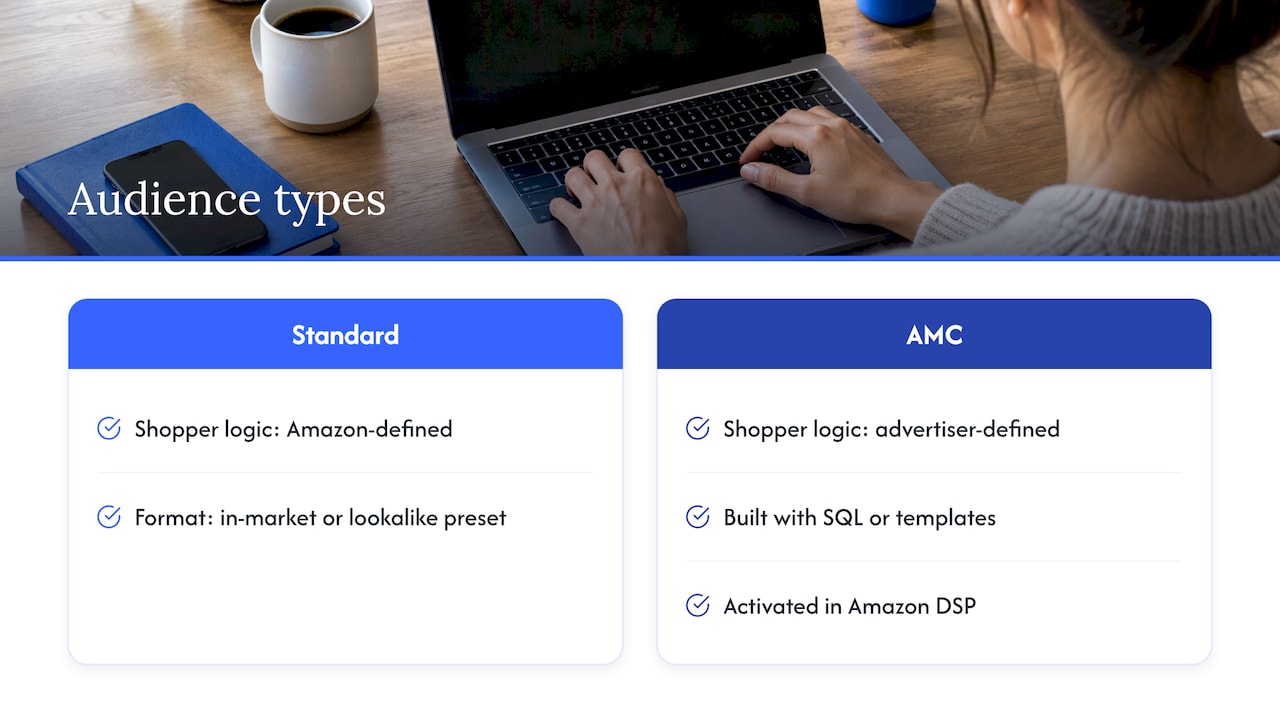
That is the difference from a standard in-market or lookalike segment. Those presets are Amazon’s definition of a shopper. An AMC audience is your definition: the logic is yours, so it can reflect how your category actually behaves.
Why brands care
Most brands already know the shoppers they want back: the ones who looked and left. Standard tools make that hard to express. AMC lets you write the rule once, for example shoppers who viewed your detail pages several times in a window and did not purchase, and turn the result into a targetable group. Amazon’s own unBoxed 2024 announcement frames AMC as the place to join first-party data with Amazon Ads signals to understand the customer journey and then build and activate audiences.
Which signals can feed an AMC audience
Amazon lists four families of eligible signals in its custom audience announcement:
- Sponsored ads signals: exposure and engagement from Sponsored Products, Sponsored Brands and Sponsored Display.
- Amazon DSP signals: impressions and engagement from display, video and streaming TV.
- Amazon Shopping Insights (beta): a subscription that adds shopping behavior signals.
- Your own signals: first-party data you choose to bring into AMC.
The fourth family is where enterprise brands gain the most. If your CRM knows who bought through your owned D2C site, AMC can use that to find overlap, suppress people who already converted elsewhere, or seed a lookalike.
Bringing first-party data in
There are two main routes. The first is through the AWS ecosystem: AMC on AWS Clean Rooms became generally available on July 31, 2024, letting advertisers use first-party data in open formats such as CSV, Parquet and Iceberg stored in an S3 bucket, and match it with Amazon Ads signals without moving the data outside their AWS account.
The second is through a customer data platform. Amazon Ads integrated AMC and Amazon DSP with nine CDPs, including Adobe, Salesforce, Tealium and Treasure Data, so mutual customers can stream pseudonymized first-party signals in. Signals can be joined on hashed keys such as email, phone number, name or address.
If your data lives in one of those systems, the plumbing is solved. The harder question is what to do with it, which is a strategy problem rather than a technical one.
How an audience goes from query to campaign
The mechanics follow a consistent path. The AWS announcement describes three kinds of work in AMC on AWS Clean Rooms: SQL queries that return aggregate results to your own S3 bucket, audience queries whose output goes to Amazon Ads’ S3 bucket, and a Clean Rooms ML lookalike job where Amazon Ads supplies the model and you supply a seed audience.
In practice, building an audience runs in five steps.
- Define the shopper behavior. Write down the group in plain language and the campaign goal it serves. “Cart adders who did not purchase in the last 14 days” is a usable definition. “High-intent shoppers” is not.
- Write or adapt the query. Start from an Amazon template or a tested query. Our guide to Amazon Marketing Cloud queries covers what to ask and how to phrase it. The common failure here is a query that is logically correct but returns too few shoppers to be usable.
- Set the refresh frequency. A cart-abandoner audience goes stale fast. A loyalty audience of past purchasers can refresh less often. The cadence should match how quickly the behavior changes.
- Activate in DSP. Choose the audience as a target or an exclusion in the line item. Because audience results are pushed to the ad product rather than shown to you, check the destination advertiser account and the final query before you submit.
- Measure against a baseline. Hold the audience to a result, such as new-to-brand orders or detail page views, and compare it with your standard targeting so you know it earned its place.
The weak points are the first and last steps. Brands that skip a clear definition end up with audiences nobody can explain, and brands that skip measurement cannot tell whether a clever audience is outperforming a simple one. Both are easier with unified reporting. Our iDerive analytics platform is built for unified marketplace data and incrementality measurement.
Targeting versus excluding
The same audience can do two opposite jobs. In DSP, you can target a custom audience or exclude it. A brand might exclude shoppers who already bought on its D2C site so it stops paying to advertise to people who converted. Sponsored ads placements are more limited, so the choice of where to activate shapes what the audience can do. For the Sponsored Display side, we cover lookback windows in Sponsored Display audiences.
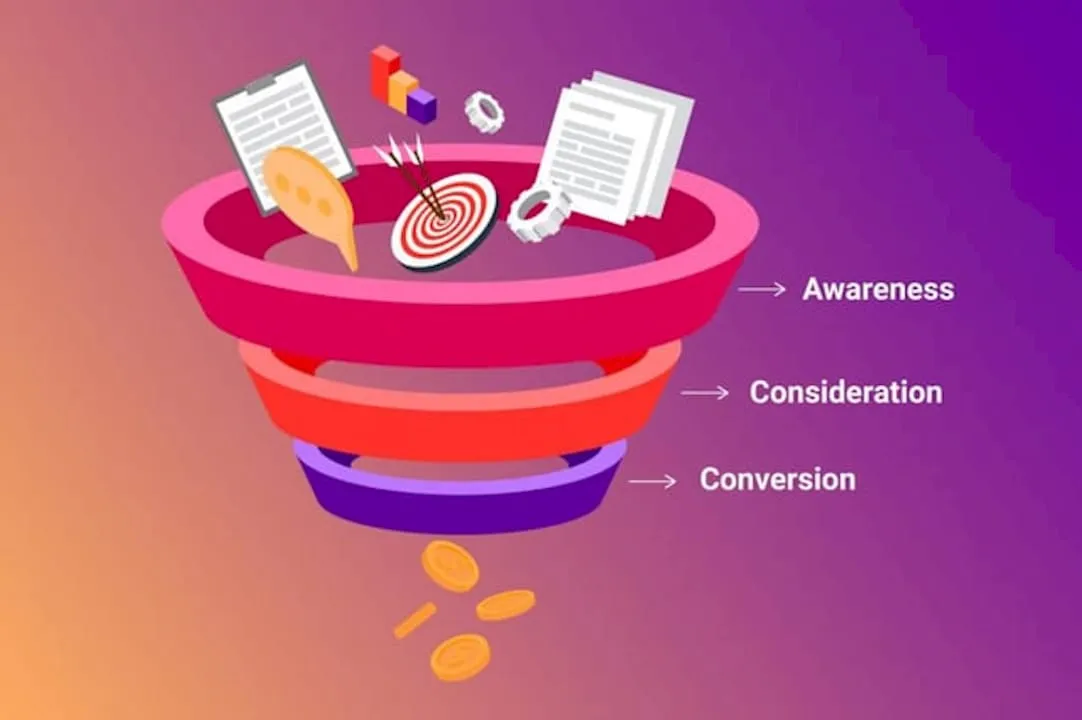
Audience strategies that map to the funnel
Amazon’s launch examples organize audiences by goal, and that structure is still the most practical way to plan. These come from Amazon’s custom audience announcement.
Awareness
Reach people who have not seen your message yet. One example is Streaming TV engagers who have not been exposed to display ads. The mirror image is exclusion: shoppers who have already seen too many impressions, so you stop spending on them.
Consideration
These are shoppers showing interest without commitment: repeat product detail page viewers and people who added an item to a wish list. They know the product exists. They need a reason, such as a review-led creative or a comparison.
Conversion
The closest to purchase: shoppers who explored keywords after seeing an ad, and cart adders who did not buy. Creative and offer matter most here, and so does frequency control.
Loyalty
Past purchasers with no recent engagement, or high customer lifetime value customers. In categories with repeat purchase, this is often the cheapest revenue available, because the shopper already trusts the product.
A worked example
Take a household brand selling a consumable. It builds three audiences. The first targets repeat detail page viewers who have not purchased, with a lookback long enough to cover its buying cycle. The second targets last year’s purchasers who have not engaged recently, refreshed on a longer cadence. The third excludes anyone who purchased in the past 30 days so the brand does not advertise to people who just stocked up. Three audiences, three jobs, each with a measurable outcome. That is a plan. A single large catch-all audience is not.

Layering instead of replacing
A useful habit is to treat AMC audiences as a refinement layer on top of broad Amazon audiences, not a replacement. Overlaying a behavior such as detail page viewers who have not purchased on a standard in-market audience narrows the reach to the shoppers who matter while keeping scale. Our guide to Amazon DSP targeting shows how include groups combine so this layering stays manageable.
Privacy safeguards and rules to plan around
AMC is a clean room because of what it will not let you do. Under the Amazon Marketing Cloud Agreement (version dated October 11, 2024), query results contain aggregated, anonymized data without personally identifiable information. The agreement also:
- bars uploading personal data unless it is pseudonymized, and bars uploading prohibited data;
- bars creating audiences or reports based on prohibited data;
- bars re-identification of shoppers;
- bars repurposing Amazon or provider data for other uses;
- allows Amazon to pause or reduce queries for operational reasons.
Two practical consequences follow. First, audience size matters: audiences need enough shoppers to be activated, so very narrow definitions can fail to build or refresh. Check the current minimums in Amazon’s audience documentation before you design a niche segment. Second, plan for refresh. An audience that is built once and forgotten drifts out of date, so assign someone to own each one.
Your legal and privacy team should review how first-party data is collected, hashed and uploaded, and what consent covers. That is their call, not the agency’s.
Who can use AMC audiences
For years, DSP usage was a prerequisite for AMC. That changed. According to Amazon’s eligibility expansion, all DSP direct advertisers and Amazon Ads Partner Network partners can register, including partners that serve clients who only run sponsored ads. The announcement lists the United States among the supported countries.
For a mid-market or enterprise brand, the practical question is rarely whether you can get in. It is whether your team has the SQL skills, the data pipeline and the time to run AMC well. A brand with a lean ecommerce team often finds that the access is the easy part and the weekly discipline is the hard part. If you are weighing DSP for the first time, our piece on Amazon DSP minimum spend explains what U.S. brands should budget.
How AMC fits with other retail media clean rooms
Brands selling across several retailers ask whether AMC is the only clean room that matters. It is the one attached to the largest marketplace, but not the only one. A Digiday CMO survey from November 2023 found Walmart Connect (24% of respondents) and Target’s Roundel (21%) were the second- and third-most-used retail media networks after Amazon. The same piece notes that Walmart Connect offers first-party data on transactions, loyalty, in-store purchases and online browsing and search behavior.
The point for planning: each retailer’s clean room speaks only for its own shoppers. AMC audiences tell you about Amazon behavior. They do not tell you who walks into a store, or what happens on Walmart.com. Brands that sell on Amazon, Walmart and their own site need a reporting layer that reads across all of them, so budget decisions are made on one view rather than three. That is the job of unified reporting, and it is why we pair retail media buying with marketplace expansion and management.
Common mistakes to avoid
- Building audiences with no goal. If you cannot say which funnel stage an audience serves, it is not ready to launch.
- Over-narrowing. The tighter the rule, the fewer shoppers qualify. Start with a reasonable window and tighten only if results justify it.
- Ignoring exclusions. Suppressing recent buyers and over-exposed shoppers often saves more than a new targeting group earns.
- Treating the audience as finished. Review refresh cadence, performance and creative every cycle.
- Separating audiences from creative. A cart abandoner and a first-time viewer need different messages. Our Amazon DSP and streaming TV guide shows how formats change the job.
Where Nectar fits
AMC audiences sit across three disciplines: data, media buying and creative. Nectar is a fully managed ecommerce agency for mid-market and enterprise brands, so those pieces work from one plan. We run Amazon DSP management and wider retail media advertising, build creative in-house across photography, video and design, and report through iDerive, our proprietary analytics platform.
If you want audiences that connect to a plan rather than a one-off experiment, start with Amazon Growth & Optimization.

For a deeper read on where AMC pays off, see our Amazon Marketing Cloud use cases for 2026.
Our perspective
Most of the audience conversations we have start with the tool and skip the question. A brand hears that AMC can build any audience it can imagine and then builds ten, with no shared definition of success.
Our view is simpler. An audience is a media decision. It should have a goal, a creative treatment, an exclusion logic and a measurement plan before anyone writes a line of SQL. When those four things exist, the query is the easy part.
This is also why we do not treat AMC as a standalone project. The best audience in the world underperforms if the detail page it lands on is weak or the creative does not speak to that shopper’s stage. Running DSP, creative and analytics under one roof means the audience, the ad and the landing page are designed together, and the results come back into one profit-first view in business language.
If your team is spending more time wrestling with queries than acting on what they show, that is the signal to bring in a partner who does this every day.
Dan Katona
FAQ
What is the difference between an AMC audience and a standard Amazon DSP audience?
Standard DSP audiences are predefined by Amazon, such as in-market or lifestyle segments. An AMC audience is one you define with your own query logic, using eligible signals such as sponsored ads, DSP and your first-party data. You then activate it in DSP with a refresh frequency you choose.
Is Amazon Marketing Cloud the same as a clean room?
Yes. Amazon Ads describes AMC as a secure, privacy-safe, cloud-based clean room. It lets advertisers analyze and build audiences across pseudonymized signals without exposing individual shoppers. The audiences are the activation side of that analysis.
Do I need to run Amazon DSP to use AMC audiences?
Not necessarily to register. Amazon expanded eligibility so that DSP direct advertisers and Amazon Ads Partner Network partners can register, including partners serving sponsored-ads-only clients. To activate audiences in DSP campaigns, though, you need DSP access.
Can I bring my own customer data into AMC?
Yes, within Amazon’s rules. You can use AMC on AWS Clean Rooms with data stored in your AWS account, or stream pseudonymized signals from a supported customer data platform. The AMC agreement bars uploading unpseudonymized personal data, so your data team should confirm how records are hashed first.
How do I know whether an AMC audience is working?
Tie each audience to one outcome, such as new-to-brand orders or detail page views, and compare it against your standard targeting over the same period. Reviewing it on a fixed cadence keeps stale audiences from lingering.
Sources
- Amazon Marketing Cloud product page, Amazon Ads
- Amazon Marketing Cloud custom audience creation and activation, Amazon Ads
- New AMC advertising capabilities, Amazon Ads unBoxed 2024
- AMC on AWS Clean Rooms now generally available, AWS News Blog
- AMC and Amazon DSP integrated with customer data platforms, Amazon Ads
- Amazon Marketing Cloud Agreement, Amazon Ads
- AMC eligibility expanded to sponsored ads advertisers, Amazon Ads
- CMO Strategies: Beyond Amazon, Digiday
Recommended